




Overview
Most term insurance buyers focus on one question: “How much cover do I need?” But there is a second question that does not get enough attention: “How should that money reach my family?”
A lump sum gives nominees full control and flexibility, while a monthly income provides structure and predictability. Rather than just picking a side, this review breaks down what the Aditya Birla Income Suraksha Plan actually offers, compares it honestly against a standard lump-sum term plan, and helps you figure out which one makes more sense for your situation.
What Is the ABSLI Income Suraksha Plan?
The ABSLI Income Suraksha Plan is a pure term plan which is built around one defining feature. The death benefit is paid exclusively as monthly income.
The nominee does not receive a one-time payout. Instead, they receive monthly instalments over the Income Payout Period, which is the greater of 120 months (10 years) or the remaining months of the policy term from the date of death. The death sum assured equals 120 times the monthly income amount chosen at inception.
Eligibility Criteria:
- Entry age: 21 to 55 years
- Maturity age: 31 to 70 years
- Policy Term: Minimum 10 years, maximum 49 years
- Premium Payment Term: Limited pay (5, 7, 10, 12, 15, 20 years) or regular pay
- Minimum Monthly Income: ₹20,833 (equivalent to ₹25 lakh sum assured)
- Maximum Monthly Income: ₹20.08 lakh (equivalent to ₹25 crore sum assured)
ABSLI Income Suraksha: Monthly Income Payout Options
How the Increasing option actually works: The monthly income chosen at inception will increase at 5% per annum, compounded annually. Upon death, the nominee receives the income applicable at that time, and it continues to grow until it reaches the 1.5x cap.
For a ₹1 lakh monthly income chosen at inception, this cap is ₹1.5 lakh per month, reached around year 9. After that, income stays flat for the remainder of the payout period.
The increasing option costs roughly 45% more in premium for a benefit that maxes out at 50% more income and stops growing after year 9. Whether that trade-off is worth it or not depends on your family's specific situation.
Key Features of the ABSLI Income Suraksha Plan
Income Payout Period: The nominee receives monthly income for the higher of 120 months or the remaining months from the date of death to the end of the policy term. Death early in the term means more total income paid out. Death near the end means the family is guaranteed at least 10 years (120 months) of income.
Discounts: First-year premium discounts of 7% for male/transgender and 9% for female lives, applicable to policyholders with an annual income of ₹5 lakh or above.
Premium Payment Term Flexibility: The plan offers both regular pay and limited pay options. Under limited pay, you can choose a premium payment term of 5, 7, 10, 12, 15, or 20 years.
Commutation Benefit: Upon death, the nominee may elect to convert the remaining monthly income into a lump sum. The conversion uses a 9.55% p.a discount rate. This is an important caveat: a 9.55% discount rate is punitive. On a long outstanding payout period, the family will receive significantly less in a lump sum than the nominal value of the remaining monthly payments. This option exists but should be evaluated carefully before exercising it.
Riders Available With the ABSLI Income Suraksha Plan
Note
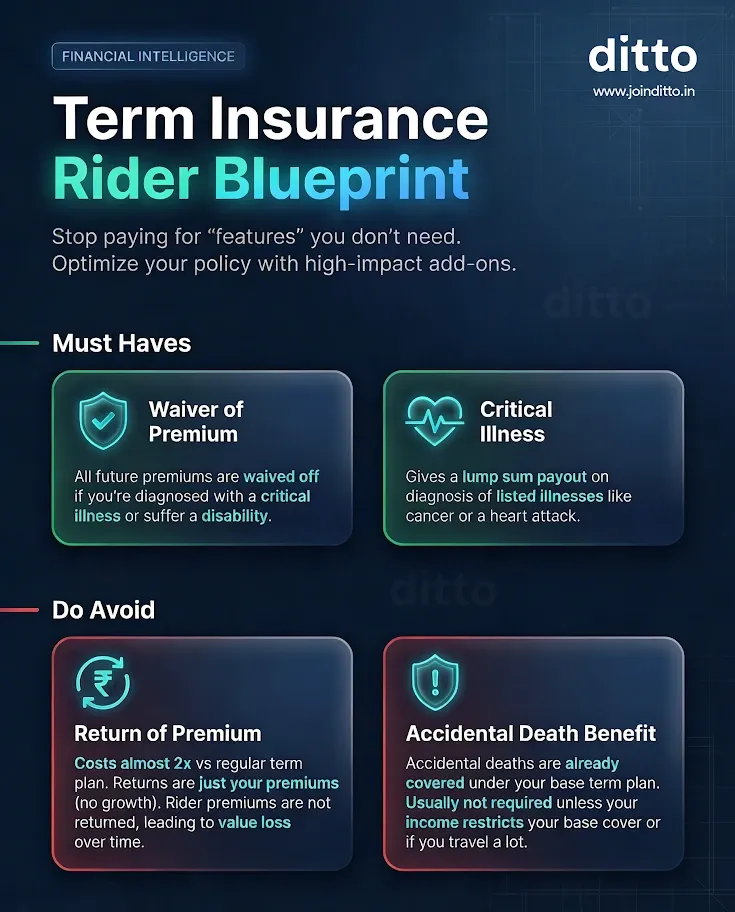
In addition to the riders listed in the table above, ABSLI also offers the Surgical Care Rider and the Hospital Care Rider. To learn more about which riders we recommend, refer to the infographic below.
ABSLI Income Suraksha Plan Premiums
Sample annual premiums for a non-smoking male, ₹1 lakh monthly income, coverage to age 70, regular pay compared with Axis Max Life Smart Term Plan Plus and Aditya Birla Super Term Plan (death sum assured of ₹1.75 crore & coverage till 70)
Premiums are illustrative in nature, the final amount depends on riders chosen, age, gender, tenure, discounts, and insurer underwriting. The premium amount for the ABSLI Income Suraksha Plan is based on the brochure illustration.
₹1.75 crore is the lump sum that, if invested at 5.5%–6%, would roughly generate ₹1 lakh/month for the payout period of an early-death claim, i.e., the amount needed to replicate the income plan's benefit.
ABSLI: Performance Metrics
Aditya Birla Sun Life Insurance has a decent claim record. With a 3-year average CSR of 98.70% for FY 2024-26, a complaint volume of just 1.33 per 10,000 claims, and a solvency ratio of 1.82x, it comfortably clears the threshold for a dependable insurer. Here is the full breakdown:
Please note that the metrics shown above are for the life insurer as a whole, not just its term insurance business.
Sources: Public disclosures from the Axis Max Life Insurance website and annual reports from the IRDAI official website. To explore these metrics in detail, refer to Ditto Data Lab.
Pros of the ABSLI Income Suraksha Plan
- Structured monthly income ensures nominees do not have to manage a large lump sum all at once, which works well for families where financial literacy is a concern.
- The increasing option provides some inflation protection, though limited to the 1.5x cap.
- Commutation benefit gives nominees the option to exit the income structure if needed.
- Salaried individuals with income above ₹5 lakh get a first-year discount of 7% to 9%.
- ABSLI has one of the lowest complaint volumes in the industry at 1.33 per 10,000 claims (FY 2024-2026).
Limitations of the ABSLI Income Suraksha Plan
No Lump Sum payout Option: A nominee who receives a lump sum can always structure it as monthly income through a Fixed Deposit (FD), annuity, or SIP. On the other hand, a nominee locked into monthly income cannot easily access a lump sum when needed, such as for debt repayment, a medical emergency, or a child's education corpus.
Declining Effective Cover Over Time: The Income Payout Period is the greater of 120 months and the remaining policy term. If the policyholder dies near the end of the policy, the family receives only 120 months of income, which is the minimum guaranteed payout period under the plan. The total nominal payout shrinks the longer you survive. This is the opposite of a lump-sum plan where the death benefit stays constant.
Inflation Risk for Nominees on the Fixed Option: ₹1 lakh/month in year 1 is worth far less in real terms by year 15 or 20 at 6% inflation. The nominee bears this erosion, while the insurer holds and invests the corpus. The increasing option only partially fixes this since growth stops at year 9.
Opportunity Cost: A standard lump-sum term plan offers a significantly higher total sum assured. If the lump sum is invested well by the nominee, it can generate equal or higher monthly income while retaining the flexibility to meet significant financial needs.
Talk to an expert
today and
find
the right
insurance for you.


Who Should Buy the ABSLI Income Suraksha Plan (and Who Should Avoid It)
Consider it if: Your nominee is genuinely unlikely to manage a large lump sum well, and structured, predictable monthly income is more useful for your family's situation. It also works for salaried individuals who want a term plan marketed specifically for income replacement and are comfortable with ABSLI as an insurer.
Avoid it if: You want the flexibility that a lump-sum payout provides. Most families benefit more from a standard term plan where you get a larger total cover for a lower premium, the nominee retains full control over how to use the money, and the effective cover does not shrink over time.
At Ditto, we generally recommend lump-sum term plans over income-payout plans for most buyers because optionality has real economic value that is surrendered for free in an income-only structure.
If you are specifically comparing this plan with ABSLI's broader term insurance offerings, refer to our Aditya Birla term insurance review for a fuller picture.
Why Choose Ditto for Life Insurance?
At Ditto, we’ve assisted over 8,00,000 customers with choosing the right insurance policy. Why customers like Aaron below love us:

- No-Spam & No Salesmen
- Rated 4.9/5 on Google Reviews by 30,000+ happy customers
- Backed by Zerodha
- Dedicated Claim Support Team
- 100% Free Consultation
You can book a FREE consultation. Slots are running out, so make sure you book a call or chat on WhatsApp now!
Conclusion
The ABSLI Income Suraksha Plan solves a real problem: some nominees are not equipped to manage a large lump sum, and a structured monthly income is genuinely more useful for them. For that specific situation, this plan does its job. ABSLI, as an insurer, has solid metrics and one of the lowest complaint volumes in the industry.
But for most buyers, a standard lump-sum term plan is the better choice. It gives the nominee more cover, full flexibility, and the ability to construct a monthly income if needed, without the irreversible one-way structure of an income plan.
If you like ABSLI as an insurer, you can consider opting for the insurer’s Super Term Plan. Otherwise, you can also check out the best term insurance plans in India, which include Axis Max Life Smart Term Plan Plus and HDFC Life Click2Protect Supreme Plus.
Frequently Asked Questions
Last updated on: