


Overview
Retirement should feel like a relief, not a financial planning confusion. But for many Tamil Nadu pensioners, the accompanying government-offered health cover can be confusing. Is ₹7.5 lakh available every year, or just once?
The Tamil Nadu New Health Insurance Scheme answers this, but the fine print matters more than the base number. This guide breaks down eligibility, coverage, premiums, and claims. By the end, you will know what NHIS 2026 gives you, what it does not, and whether you need a personal plan alongside it.
What Is the Tamil Nadu New Health Insurance Scheme for Pensioners?
NHIS 2026 expands the government health coverage framework for Tamil Nadu's retired employees, giving eligible pensioners cashless access to hospital treatment through a single group arrangement.
How the Scheme Works
The scheme runs through United India Insurance, under a government order that fixes its terms for the full five-year block:
- Notified under G.O.Ms.No.123 dated June 24, 2026, running from July 1, 2026 to June 30, 2031.
- Pensioners are enrolled as a group, not individually underwritten, so there is no medical exam and no age limit.
- Bills are settled at fixed government package rates, not the hospital's actual invoice.
- Cashless treatment applies only to procedures on the approved list of treatments and surgeries.
Please Note: Because this is a group government scheme rather than a policy you buy, you do not choose your insurer or negotiate its terms. Eligibility, coverage, and premiums are all set by government order and can change at the next renewal.
Who Is Eligible for the Tamil Nadu New Health Insurance Scheme for Pensioners?
Coverage is compulsory for most Tamil Nadu civil and teacher pensioners, including their spouses. It also extends to:
- Family pensioners, including divisible family pension cases.
- All India Service (TN cadre) pensioners, by option.
- A son or daughter with a qualifying mental or physical disability who cannot earn a living may remain eligible after age 25. Eligibility ends if the dependent gets married.
- Unmarried, widowed, or divorced daughter who is wholly dependent on the pensioner remains eligible until marriage or remarriage, or until she starts earning ₹7,850 per month, whichever occurs first.
Key Insight
Coverage, Sum Insured and Premium Under the Scheme
Sum Insured and Scope
- ₹7.5 lakh standard cover per family for the entire five-year block (2026 to 2031), not per year.
- Enhanced cover of up to ₹12 lakh, family floater, reserved for 46 specified critical treatments such as organ transplants, cancer surgery, and advanced cardiac procedures.
- Covers 2,992 approved treatments and surgeries at fixed package rates.
- No waiting period, including for pre-existing diseases, from the day you enroll.
- Room rent is bundled into the package rate, which is capped at a single AC room, so there is no separate cap.
Where You Can Use It
- Cashless treatment at 1,535 empaneled private hospitals plus government hospitals in Tamil Nadu.
- The scheme also requires a minimum number of network institutions in five locations outside Tamil Nadu. Hence, a minimum of three each has been maintained in Puducherry, Bengaluru, Thiruvananthapuram, Wayanad, and New Delhi.
- Treatment must be on the approved procedure or illness list. Anything unlisted gets nothing from NHIS. Depending on the circumstances, reimbursement may still be considered separately under the Tamil Nadu Medical Attendance Rules.
- A non-network hospital cannot offer cashless treatment. Emergency cases are reimbursed at the lowest-grade network rate, while planned treatment receives only 60% of that rate.
Premium and How It Is Paid
Every enrolled pensioner pays ₹7,728 a year, deducted as ₹644 a month from the pension. Retired Contributory Pension Scheme (CPS) employees instead pay the full amount upfront to the insurer by July 31 each year. This remains payable even if the family's cover has already been exhausted.
Talk to an expert
today and
find
the right
insurance for you.


The Genuinely Good Parts and the Coverage Gaps You Should Know
What Works Well
- No waiting period applies to PEDs, which is hard to find in the retail market at this age.
- No age limit or medical underwriting is applicable.
- Room rent is bundled into the package rate
- 8% annual interest if a beneficiary pays eligible expenses because cashless authorization was wrongly denied or restricted.
What Falls Short
- Only 2,992 procedures and 46 illnesses are covered, so anything else will not be covered entirely.
- The scheme pays a fixed package rate, not the actual bill, so any excess is out of pocket.
- No Outpatient Department (OPD) or ambulance cover is available.
- Coverage works mainly within Tamil Nadu.
How to File a Claim: Documents, Deadlines and Where to Submit
How to File a Cashless Claim
Planned Hospitalization:
- Choose a currently empaneled hospital approved for the specialty you need.
- Show your NHIS e-card, Integrated Financial and Human Resources Management System (IFHRMS) ID, Pension Payment Order (PPO) details, or other recognized beneficiary proof.
- Ask the hospital to send a pre-authorization request before you get admitted.
- Keep the pre-authorization or claim reference number safe.
- Confirm the approved package amount and get a written breakup of what is not payable.
- The insurer must process this within 12 hours, and the first approval should usually cover at least 70% of the eligible package.
Emergency Hospitalization: At a network hospital, the hospital gets an Emergency Pre-Authorization Number or immediate authorization. Telephone approval can cover 50% of the eligible package right away, with the rest processed afterward.
At a non-network hospital, cashless treatment is not available. You pay first and claim reimbursement later, at the lowest-grade network hospital's package rate for an emergency, or just 60% of that rate for planned treatment.
How to File a Reimbursement Claim
Submission Deadline: File within 60 days of discharge for ordinary treatment, or within 90 days for the 46 specified high-cost illnesses. If these deadlines are not followed, the claim will not be approved or accepted.
Where to Submit: Send the claim to your Pension Disbursing Officer, which is usually your Treasury Officer, Sub-Treasury Officer, or Pension Pay Officer. Not the insurer directly. The Pension Disbursing Officer must verify the documents and upload them to the NHIS portal within 7 days.
Core Documents Required:
- IFHRMS ID
- Original discharge summary
- Original detailed final bill
- Original numbered receipts
- Investigation reports
Key Insight
Tamil Nadu New Health Insurance Scheme vs. Private Health Insurance: Do You Still Need Cover?
NHIS 2026 delivers real value. A ₹7.5 lakh family cover which can go up to ₹12 lakh for certain illnesses, no waiting period, and day 1 coverage for PEDs are hard to match, especially at this stage of life.
But it has real gaps. It is a state-funded scheme, not a retail policy you own and control. It runs on a five-year government contract that has already been renegotiated several times since 2014, so benefits and premiums can change at the next renewal.
Geography is another limit. Cashless access is mainly available in Tamil Nadu, with only a few hospitals empaneled elsewhere. If you spend months with family in another city, that thin network can leave you stranded.
Fixed package rates are the third gap. If you want a private room upgrade, a newer surgical technique, or a hospital outside the network, you will likely pay the difference yourself. And once the five-year overall block is exhausted, nothing remains, no matter how many years are left in the scheme.
Have a look at the infographic below to compare NHIS 2026 with a private health insurance policy:
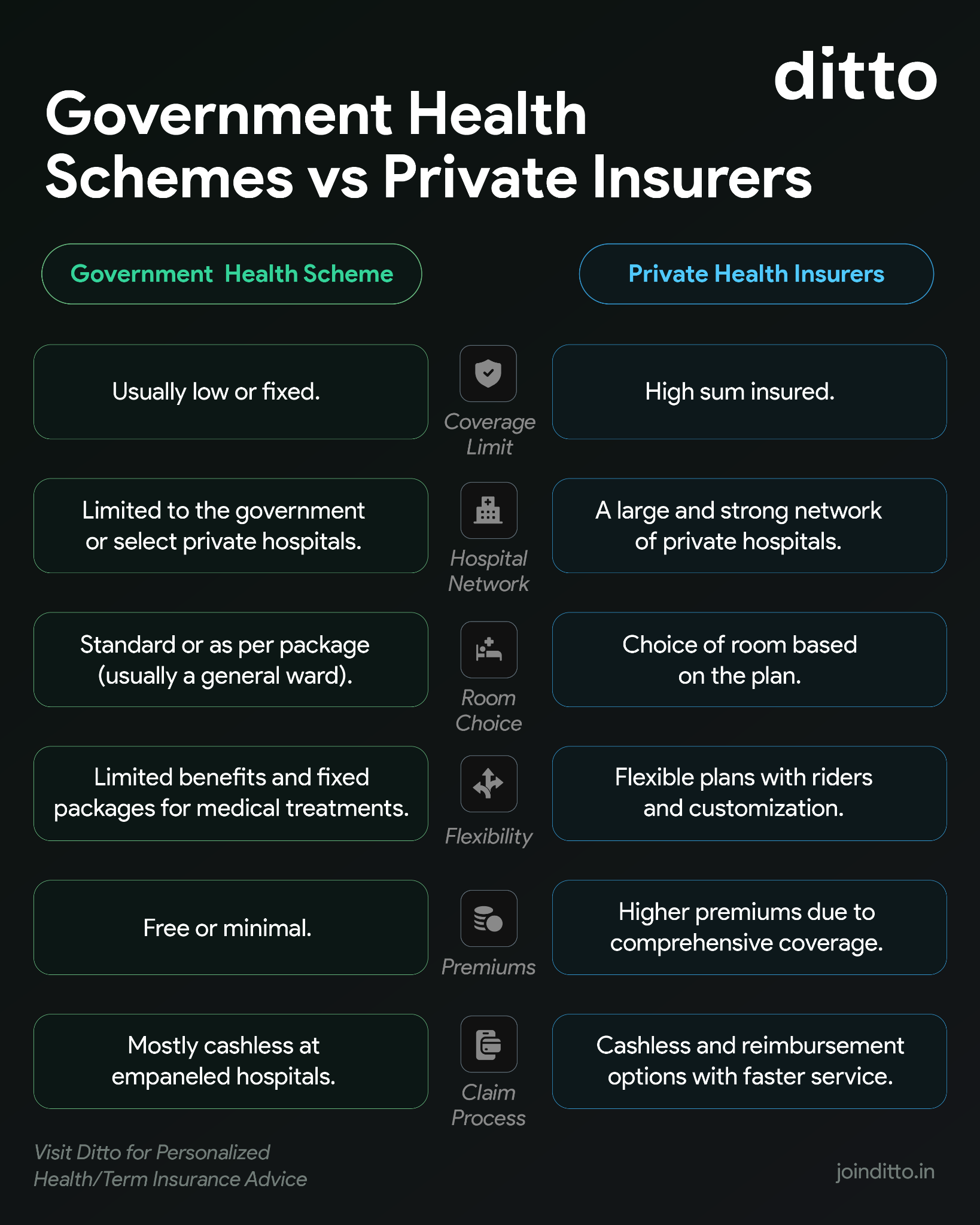
Ditto's Take: Keep NHIS 2026 as your base cover, since it is compulsory and comes at a minimal cost. But add a personal health plan for a wider hospital network and real protection once the five-year block is over. Buy it before you retire, while waiting periods still work in your favor.
Why Choose Ditto for Health Insurance?
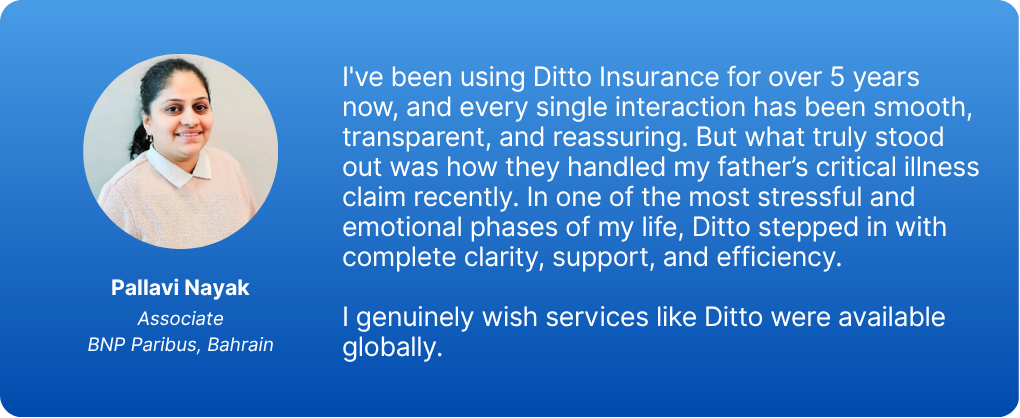
At Ditto, we’ve assisted over 8,00,000 customers with choosing the right insurance policy. Why customers like Pallavi below love us:
- No-Spam & No Salesmen
- Rated 4.9/5 on Google Reviews by 30,000+ happy customers
- Backed by Zerodha
- Dedicated Claim Support Team
- 100% Free Consultation
Confused about the right insurance? Speak to Ditto’s certified advisors for free, unbiased guidance. Book your call or chat with us on WhatsApp now!
Conclusion
NHIS 2026 offers basic financial protection through its ₹7.5 lakh family cover, cashless treatment, and day-one coverage for pre-existing diseases, especially valuable given the no-underwriting, no-age-limit enrollment. However, it doesn't cover every treatment, hospital, or expense, and the cover does not reset each year.
You can still face out-of-pocket costs for non-network hospitals, room upgrades, or treatments outside the approved list, and once the five-year block is used up, nothing is left.
For more complete and consistent protection, add a retail health insurance plan alongside the scheme, ideally before you retire, while waiting periods still work in your favor. If you're comparing options built for this life stage, explore our guide on the best health insurance plans for senior citizens.
Frequently Asked Questions
Last updated on: