



Quick Overview
Many people are surprised to hear someone say they have ₹1 crore health insurance cover while paying a relatively modest premium. In most cases, this is achieved by combining a base health insurance plan with a super top up, a structure designed to handle high-cost medical years without drastically increasing premiums.
If you are researching the best super top up health insurance, it is important to first understand how these plans work and how they fit into your overall coverage.
This article explains the concept of super top up health insurance, how it works, and when it makes sense to include it in your coverage strategy.
How does Super Top Up Health Insurance Work?
Let’s say you have a ₹10 lakh base health insurance plan and add a super top up cover of ₹50 lakh with a ₹10 lakh deductible.
During the same policy year, you face two hospitalizations:
- Hospitalization 1: ₹6 lakh
- Hospitalization 2: ₹8 lakh
Your total eligible medical expenses for the year come to ₹14 lakh.
Here is how the coverage applies:
- The base plan pays expenses up to ₹10 lakh, which matches the deductible.
- Once the cumulative expenses cross ₹10 lakh, the super top-up becomes active.
- The super top up then pays the remaining ₹4 lakh (₹14 lakh minus ₹10 lakh), subject to policy terms.
A super top up applies the deductible to your total yearly medical expenses, not each claim. This makes it useful when multiple hospitalizations occur, and the deductible can be met through your base policy, employer coverage, or out-of-pocket payments.
If you are evaluating affordability, reviewing a super top-up health insurance premium chart can help you understand how premiums vary based on age, deductible chosen, and sum insured.
Difference Between Top Up and Super Top Up Health Insurance
Note: A top up works only when one hospital bill crosses the deductible. A super top-up considers your total annual medical expenses, so several smaller claims can combine to activate the coverage, making it more practical for real-world healthcare needs.
Advantages of Super Top Up Health Insurance
- Flexible Deductible Choice: You can choose the deductible based on your base coverage. Keep it equal to or slightly lower than your base sum insured.
- Works as a Second Layer: It sits above your base or employer policy and activates when that primary cover is exhausted.
- Aggregate Deductible Advantage: The deductible applies to total yearly expenses, so multiple claims can add up and trigger the coverage.
- Higher Coverage at Lower Premium: Super top ups cost less because they pay only after the deductible is crossed, making them an affordable way to increase overall coverage.
- Protects Your Savings: It provides a financial buffer during major medical events that could otherwise drain your savings.
Drawbacks of Super Top Up Health Insurance
- Not a First-Rupee Cover: A super top up does not pay from the start of a claim. You must first cross the deductible amount before the policy contributes. This means it cannot replace a base health insurance plan and should always be viewed as a supplementary layer.
- Managing Multiple Policies Can Be Cumbersome: Having both a base policy and a super top up increases administrative work. You may need to handle:
- Separate renewal dates
- Additional paperwork during claims
- Coordination between two policies, especially if they are from different companies
- Coverage May Be Basic: Super top up plans are sometimes structured as standard or no-frills policies. As a result, they may:
- Exclude coverage for consumables or non-medical items
- Include stricter sub-limits or conditions like room rent
- Offer fewer add-ons or customization options than base plans
It is important to review the policy wording carefully to understand what is included.
- Policy-Year Mismatch Can Lead to Claim Complications: If the base policy and the super top up operate on different policy periods, the deductible calculation may not align properly. For example:
- Base Plan: January–December
- Super Top Up: April–March
If a claim occurs in March, it is counted in the super top up year ending in March. A second claim in April falls into the new super top-up year starting in April. As a result, the deductible resets on April 1, and expenses from March don’t help meet April’s deductible.
If your base plan renews in January but your super top-up renews in April, expenses from March and April may fall into two different super top up policy years. Even if your base plan treats both claims within one policy year, the super top up could assess them separately because its deductible resets at renewal.
Super Top Up Vs Personal Health Insurance: Which Is Better?
How to File a Claim Under a Super Top Up Plan?

Things to Keep in Mind Before Buying a Super Top Up Health Insurance Plan
Have a Base Policy First
A super top up does not pay from the start. It activates only after the deductible is crossed.
Understand the Claim Trigger
You must show that the deductible has been met through your base plan, employer cover, or out-of-pocket payment.
Choose the Right Coverage Combination
A common approach is ₹10–15 lakh base cover with a higher super top up, but the ideal structure depends on age, health history, and location.
Align the Deductible with your Base Sum Insured
Keep it equal to or slightly lower than the base cover so it can be realistically crossed.
Synchronise Policy Renewal Dates
Different policy periods can reset deductible calculations and create claim complications.
Expect Simpler Coverage Features
Super top ups come with fewer add-ons and stricter terms compared to base plans.
Plan for Added Administration
Managing two policies involves separate renewals, additional paperwork, and coordination during claims.
Note: Also, only eligible or admissible expenses are considered toward the deductible, not the entire hospital bill. Costs that are disallowed due to room rent limits, non-payable items, sub-limits, exclusions, or other policy conditions may not be counted the way policyholders expect.
Why Choose Ditto for Your Health Insurance?
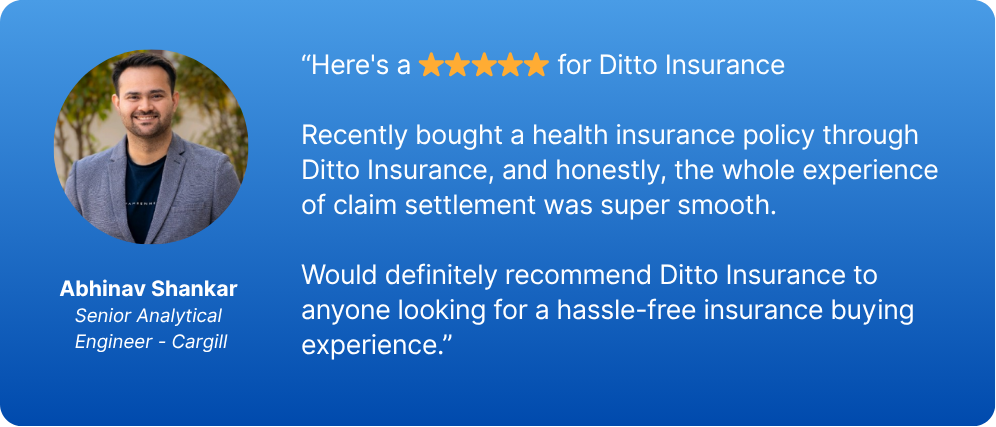
At Ditto, we’ve assisted over 8,00,000 customers with choosing the right insurance policy. Here’s why customers like Abhinav love us:
- No Spam & No Salesmen
- Rated 4.9/5 on Google Reviews by 15,000+ happy customers
- Backed by Zerodha
- 100% Free Consultation
You can book a FREE consultation. Slots are running out, so make sure you book a call now or chat on WhatsApp with our expert IRDAI-certified advisors.
Ditto’s Take
Super top ups may look attractive because they offer higher coverage at lower premiums, but they are not always seamless in practice. Underwriting can be stricter, and claims may involve additional steps since the deductible must be established first. Even when both policies are with the same insurer, settlement can require extra coordination and documentation compared to a single comprehensive plan.
Recently, many customers with larger budgets are opting for comprehensive base health insurance plans with a higher sum insured (around ₹20–₹50 lakh). These plans often include features like loyalty bonuses, unlimited restorations, and consumables cover, delivering coverage comparable to a base plus super top up structure while being easier to manage. Although premiums are higher, the experience is typically more straightforward.
The right choice depends on your health profile, expected medical needs, and budget. A higher sum insured base plan suits those who prefer simplicity and predictability, while a base plan plus super top up can still work for those aiming to optimize premiums and build a larger safety net.
For Ditto’s methodology on how we assess insurers and plans, please refer to Ditto’s Cut.
Frequently Asked Questions
Last updated on: