

Overview
If you're a Jharkhand government employee, pensioner, MLA, or advocate, understanding your health benefits under the State Employees Health Insurance Scheme (SEHIS) can help you plan your medical expenses better. While the scheme provides cashless treatment at empanelled hospitals, the coverage structure, beneficiary categories, and contribution rules can be confusing.
This guide covers what the State Employees Health Insurance Scheme (SEHIS) is, who is eligible, the benefits and coverage it offers, how to enroll and make claims, and whether you should consider private health insurance alongside it.
What Is the State Employees Health Insurance Scheme (SEHIS)?
The State Employees Health Insurance Scheme (SEHIS) is Jharkhand's cashless health insurance scheme for serving and retired state government employees, MLAs, advocates, and their eligible dependents. It provides cashless treatment at 1,000 empanelled hospitals, including 250 hospitals within Jharkhand, with health cover of up to ₹10 lakh for eligible claims. The scheme currently covers over 6.17 lakh beneficiaries, including 1.67 lakh primary members and 4.50 lakh dependents.
Unlike fully government-funded health schemes, SEHIS follows a contributory model. Serving employees contribute ₹500 per month (₹6,000 annually) through salary deductions, while eligible Category B beneficiaries pay the same amount annually through the official SEHIS portal.
The scheme is funded through a combination of the insurer's annual premium and the JSAS Corpus Fund. While the insurer's premium is around ₹4,850 per family per year, the remaining contribution is credited to the corpus fund to support eligible claims beyond the insurer's standard sum insured.
Note: Although several states have similar employee health insurance schemes, SEHIS in this article refers specifically to Jharkhand's State Employees Health Insurance Scheme.
SEHIS Eligibility: Category A, B, and C Beneficiaries
The State Employees Health Insurance Scheme (SEHIS) classifies beneficiaries into three categories based on their employment status and eligibility.
1) Category A (Mandatory)
Category A includes all serving Jharkhand state government employees and sitting MLAs. Enrollment under the scheme is mandatory, and beneficiaries are automatically covered through their respective departments.
2) Category B (Optional)
Category B is an optional, self-funded category. Eligible beneficiaries can enroll by paying ₹6,000 annually through the official SEHIS portal. This category includes:
- Retired Jharkhand state government employees
- Family pensioners
- Former MLAs
- Serving or retired All India Services (AIS) officers who opt in
- Regular employees of state boards, corporations, and government institutions
- Teaching and non-teaching staff of state universities and constituent colleges
3) Category C
Category C covers advocates registered under the Jharkhand Advocate Welfare Fund Trustee Committee.
Note: The January 2026 amendment restructured the State Employees Health Insurance Scheme (SEHIS) framework, shifting sitting and former MLAs, ministers, and their families to Category B so they can receive healthcare access on par with IAS and IPS officers. Meanwhile, Category A remains the mandatory, premium-based tier for current serving employees of the Jharkhand government.
Who Can Be Covered as Dependents?
Eligible beneficiaries can also add the following dependents under SEHIS:
- Spouse
- Sons (including legally adopted sons) up to 25 years of age, provided they are unemployed
- Unmarried, widowed, or divorced daughters
- Minor brothers and unmarried sisters
- Dependent parents (for pensioners, only if the parent's pension is below ₹9,000 per month plus dearness relief).
- Disabled dependents, who remain eligible regardless of age.
Note:
- Women employees can include either their parents or their parents-in-law, but not both.
- If both spouses are Jharkhand government employees, they cannot list each other as dependents.
- Children can be covered under only one parent's SEHIS policy.
Talk to an expert
today and
find
the right
insurance for you.


Benefits: ₹5 Lakh to ₹10 Lakh Cover Under SEHIS
The State Employees Health Insurance Scheme (SEHIS) offers cashless treatment at empanelled hospitals across Jharkhand and selected hospitals outside the state. The scheme follows a two-tier coverage structure to provide financial protection against hospitalization expenses.
Coverage Under SEHIS
- Up to ₹5 Lakh: Covers hospitalization expenses for general illnesses and medical treatments.
- Up to ₹10 Lakh: For 25 eligible critical illnesses, beneficiaries can receive enhanced coverage through a combination of the insurer's payout and the JSAS Corpus Fund, subject to the scheme's terms and conditions.
What's Covered?
SEHIS provides cashless treatment at empanelled hospitals for a wide range of medical needs. The scheme generally covers:
- Hospitalization expenses
- Surgeries and major medical procedures
- Treatment for serious and critical illnesses
- Emergency hospitalization
- Other approved treatments covered under the scheme
The exact list of covered procedures, critical illnesses, treatment packages, and applicable limits may be updated by the Jharkhand government from time to time. Before planning treatment, beneficiaries should check the latest guidelines on the official SEHIS portal or consult their department.
Note: If the cost of an eligible treatment exceeds the insurer's standard sum insured, additional financial assistance may be available through the JSAS Corpus Fund, subject to the scheme's terms, conditions, and approvals.
How to Enroll on the SEHIS Portal?
Category A beneficiaries, including serving state government employees and sitting MLAs, are enrolled automatically through their respective departments. Once the monthly salary deduction is initiated, there's usually no separate application required apart from verifying and updating dependent details.
Category B and Category C beneficiaries must register through the official SEHIS portal. Before starting the application, keep the following documents ready:
- Aadhaar of the applicant and eligible dependents
- Service ID, GPF/CPF/PRAN, PPO, or Employee ID (as applicable)
- Passport-size photographs
- Documents proving the age and relationship of dependents
Steps to Register on the SEHIS Portal
- Visit the official SEHIS portal and create an account using your name, email address, mobile number, and a password.
- Log in and select a new application.
- Choose your beneficiary category (A, B, or C) and enter your employee or pension details. The portal will automatically fetch your basic information where applicable.
- Complete the application by filling in any remaining details.
- Add eligible dependents by providing their Aadhaar details, photographs, and supporting documents.
- Submit the application. Category B beneficiaries must also pay the annual contribution through the portal's payment gateway.
After submission, the application is forwarded to the concerned Drawing and Disbursing Officer (DDO) or approving authority for verification. Once approved, you can download your SEHIS cashless health card from the portal and use it to avail cashless treatment at empaneled hospitals.
Note: If you face technical issues during registration or data retrieval, you can raise a grievance through the SEHIS portal or contact the official toll-free helpline at 1800-3455-027.
SEHIS vs. Private Health Insurance: Do You Need Extra Cover?
The State Employees Health Insurance Scheme (SEHIS) provides cashless treatment and health cover of up to ₹10 lakh, making it a valuable safety net. However, it covers only a defined list of dependents and may not be enough for high-cost treatments or families needing higher coverage.
Since SEHIS is a government-sponsored scheme, its benefits and coverage are fixed and cannot be tailored to individual healthcare needs.
Ditto's Take: If you need coverage beyond ₹10 lakh or want to insure family members who aren't eligible under SEHIS, consider buying a private health insurance policy. It doesn't replace SEHIS. Instead, it complements your existing cover by providing higher coverage and broader protection.
Why Choose Ditto for Health Insurance?
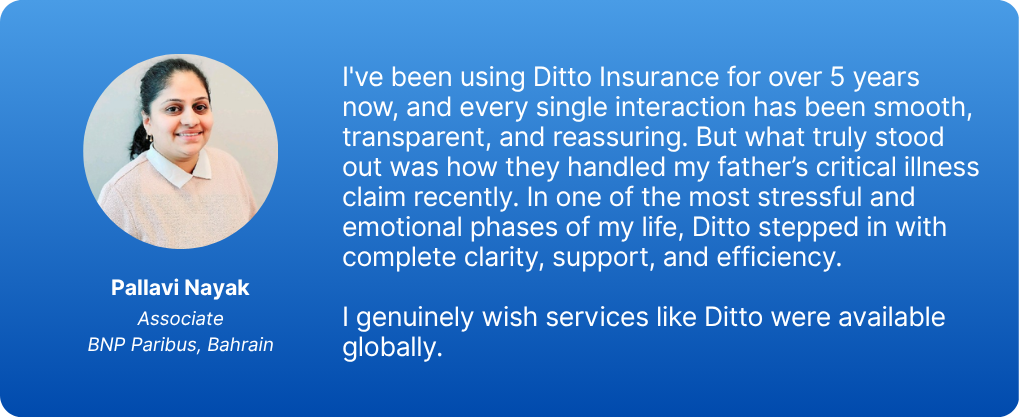
At Ditto, we’ve assisted over 8,00,000 customers with choosing the right insurance policy. Why customers like Pallavi below love us:
- No-Spam & No Salesmen
- Rated 4.9/5 on Google Reviews by 30,000+ happy customers
- Backed by Zerodha
- Dedicated Claim Support Team
- 100% Free Consultation
Confused about the right insurance? Speak to Ditto’s certified advisors for free, unbiased guidance. Book your call now or chat with our advisors on WhatsApp.
Conclusion
SEHIS is a valuable health insurance scheme that helps reduce the financial burden of medical emergencies for Jharkhand's government employees, pensioners, MLAs, advocates, and their eligible dependents. With cashless treatment at empanelled hospitals and coverage of up to ₹10 lakh, it offers meaningful financial support for a wide range of medical expenses.
Before relying solely on the scheme, review your healthcare needs and check whether its coverage limit and dependent eligibility are sufficient for your family. If you identify any gaps, adding a private health insurance plan can provide broader protection and greater peace of mind.
Frequently Asked Questions
Last updated on: