


Quick Overview
For many families in Punjab, an unexpected hospitalization can disrupt monthly budgets and force difficult financial decisions. Medical inflation in India continues to rise year on year, making even routine treatments costlier and pushing more households toward private hospitals for timely care.
Recognizing this gap, the state recently upgraded the Sarbat Sehat Bima Yojana (SSBY) to the Mukh Mantri Sehat Yojana (MMSY), marking a significant shift that consolidates earlier categories into a streamlined, cashless health protection system. With a higher annual cover, standardized treatment packages, and a single health card, MMSY aims to make essential hospital care predictable and accessible for every bona fide resident.
This article outlines how the scheme works today, what it covers, who qualifies, and how it fits into your overall health protection strategy, especially if you’re deciding whether a private insurance plan is still necessary alongside this government benefit.
Key Features of Sarbat Sehat Bima Yojana
Coverage
One Scheme for All
Extensive Hospital Network
Wide Procedure Coverage
Growth Perspective
Inclusions and Exclusions of Sarbat Sehat Bima Yojana
Note: Ayushman Bharat Pradhan Mantri Jan Arogya Yojana (AB PM-JAY) MMSY also covers tests, medicines, and consultations related to the admitted illness: 3 days before hospitalization and 15 days after discharge.
Eligibility and Application Process for Sarbat Sehat Bima Yojana
Eligibility Criteria for Sarbat Sehat Bima Yojana
To qualify under the Sarbat Sehat Bima Yojana (SSBY) in Punjab, a family must meet the following conditions:
- Be a bona fide resident of Punjab, verified through Aadhaar or Voter ID.
- Belong to one of the 2019 eligible groups: Smart Ration Card holders, J-Form farmers, registered small traders, registered construction workers (BOCWB), accredited/yellow-card journalists, or families listed under SECC 2011 data.
- Under the MMSY expansion, all other Punjab residents, including general-category families, government employees, and pensioners, are eligible with no income cap.
- Be part of a household where all members are linked to the same ration card or family unit, with no limit on family size or age.
How to Apply for Sarbat Sehat Bima Yojana?
How to Apply for SSBY (2019 Model)
This scheme followed an entitlement-based system where eligible families could generate their e-card through:
- Ayushman App or National Portal
- Empaneled hospitals (helpdesks generate e-cards)
- Common Services Centers (CSC) / Sewa Kendras (for printed cards)
Once the e-card is issued, beneficiaries can immediately avail cashless treatment.
How to Register for MMSY (Universal Model)
1. Home Visit and Appointment Slip: Previously, a Sehat Mitra visited households to issue an appointment slip for the CSC visit. As of February 23, 2026, this step has been discontinued, and the slip is no longer needed.
2. CSC Visit: Visit your nearest CSC on the designated date, carrying the required documents for all family members.
3. Bring Valid ID Proofs: All members must be bona fide residents of Punjab and carry Aadhaar and Voter ID.
4. Receive Instant SMS Confirmation: You get a message confirming successful registration and activated benefits.
5. Sehat Card Collection: Your MMSY Sehat Card will be available at the CSC within 2–3 weeks.
Documents Required to Apply for Sarbat Sehat Bima Yojana
- Aadhaar Card (primary identity and residency proof)
- Smart Ration Card (for original SSBY categories)
- J-Form (for farmers)
- Building and Other Construction Workers' Welfare Board (BOCWB) registration ID (for construction workers)
- Voter ID (for MMSY registration)
Sarbat Sehat Bima Yojana Contact Directory
SSBY Vs Private Insurance: Is It Enough on Its Own?
Government schemes like SSBY are excellent as a base layer as they’re economical and cover essential hospitalization through approved packages. However, fixed package rates, room restrictions, non-payable consumables, and limited hospital networks can still lead to out-of-pocket expenses.
Adding a comprehensive private health plan offers higher coverage, greater hospital choice, flexible room options, and fewer restrictions. With medical costs rising every year, relying solely on a ₹10 lakh government cover may not be sufficient for long-term or complex illnesses.
The good news is that you can have both government coverage and private insurance working together. Hence, use SSBY as your primary free layer, but rely on private insurance for flexibility and comprehensive coverage. And if you're comparing options, this guide on the best health insurance plans in India is a good place to start.
Why Choose Ditto for Health Insurance?
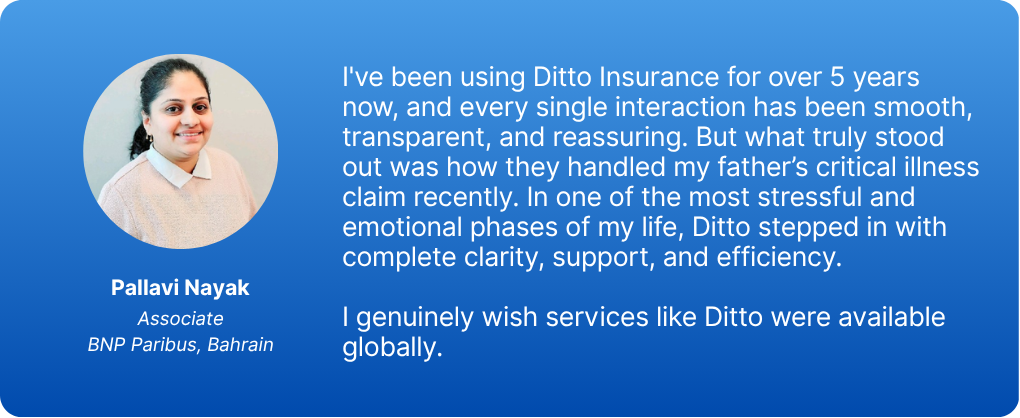
At Ditto, we’ve assisted over 8,00,000 customers with choosing the right insurance policy. Why customers like Pallavi below love us:
- No-Spam & No Salesmen
- Rated 4.9/5 on Google Reviews by 15,000+ happy customers
- Backed by Zerodha
- Dedicated Claim Support Team
- 100% Free Consultation
Not sure where to start? You can book a FREE consultation with us, and we'll help you find the right plan for your needs. Slots are filling up quickly, so be sure to book a call now or chat with us on WhatsApp!
Ditto’s Take
SSBY and its expanded MMSY version serve as a state-backed safety net for residents of Punjab, offering a straightforward way to access essential hospital care without upfront costs. The scheme simplifies eligibility through a single health card and provides standardized treatment packages, making hospitalization more predictable for families who would otherwise struggle to manage sudden medical expenses. However, because it operates on fixed package rates and a defined hospital network, the scope of treatment and the flexibility you get are naturally limited. It’s important to understand these boundaries, so you know exactly what to expect at the time of admission.
If you’re eligible, this scheme is worth keeping as it offers meaningful protection during medical emergencies. But if you need broader hospital choice, more generous room options, and better treatment coverage, pairing it with a comprehensive health insurance plan is the safest approach.
Disclosure
Frequently Asked Questions
Last updated on: