

Overview
India's push toward universal, cashless health coverage didn't start with Ayushman Bharat. It began over a decade earlier, in 2007, when the government launched the Rashtriya Swasthya Bima Yojana (RSBY) to provide below-poverty-line households with access to hospitalization without having to pay upfront. The scheme's cashless, portable, paperless design became the template on which PM-JAY was later built, before RSBY itself was subsumed into that larger scheme in 2018.
This guide walks you through the Rashtriya Swasthya Bima Yojana card benefits, how its eligibility worked, how it evolved into PM-JAY, and exactly where to check your status now
What Is Rashtriya Swasthya Bima Yojana?
Rashtriya Swasthya Bima Yojana (RSBY) was a centrally sponsored health insurance scheme launched by the Ministry of Labour and Employment, Government of India. It provided cashless health insurance to identified beneficiaries in the unorganized sector, mainly households below the poverty line.
To enroll, beneficiaries paid a nominal ₹30 registration fee for a biometric-enabled smart card carrying their fingerprints and photographs. This card was used to access up to ₹30,000 in inpatient medical care per family per year at any empaneled hospital, with an additional provision for transport expenses.
The premium itself was funded jointly by the Center and the states, with the Center contributing 75% of the estimated annual premium and the state government covering the remaining 25%, a split that shifted to 90% Center and 10% state for the northeastern states and Jammu and Kashmir.
How Did RSBY Evolve Into PM-JAY?
As of early 2026, RSBY no longer functions as a standalone program. Most states migrated existing beneficiary data into the PM-JAY database, and all new enrollments now run entirely through PM-JAY.
Rashtriya Swasthya Bima Yojana Card: Benefits and Coverage
Here's what the card actually offered while the scheme was active:
These Rashtriya Swasthya Bima Yojana benefits were considered generous for their time, particularly the absence of an age limit and day-one coverage for pre-existing conditions. Many private health insurance policies still don't offer these features. That said, the ₹30,000 family floater cover was minimal, especially considering hospitalization costs. This is one of the reasons the scheme was eventually replaced by PM-JAY, which offers a much higher ₹5 lakh cover.
Talk to an expert
today and
find
the right
insurance for you.
Eligibility Criteria for Rashtriya Swasthya Bima Yojana
RSBY's eligibility rules evolved over its lifetime, expanding well beyond its original BPL-only mandate:
- Original Eligibility (2008): Below-poverty-line (BPL) households, identified through state-level BPL lists, primarily in the unorganized sector.
- Expanded Eligibility (2011–2014): 11 additional worker categories were added, including building and construction workers, street vendors, and domestic workers.
- Senior Citizens (2016 Onward): Individuals aged 60 and above from BPL households or the 11 additional categories became eligible for the SCHIS top-up, in addition to their existing RSBY entitlement.
How to Apply for the Rashtriya Swasthya Bima Yojana Card?
There is no active application process for a Rashtriya Swasthya Bima Yojana card. RSBY stopped accepting new enrollments once it was absorbed into PM-JAY in 2018. If you're eligible for government-funded health cover today, you'll need to apply through PM-JAY instead, which follows a similar but updated process:
- Through the PM-JAY Website: Visit the official PM-JAY portal, select "Am I Eligible," log in with your registered mobile number and OTP, and search for your beneficiary record using your state, district, Aadhaar number, family ID, or PM-JAY number. Complete Aadhaar-based e-KYC, and once approved, download your card directly from the same page.
- Through the Ayushman App: Install the official Ayushman app on Android or iOS, log in with your mobile number and OTP, and follow the same verification steps as on the website.
- In Person at a Common Service Centre (CSC): Visit your nearest Atal Seva Kendra or CSC, request card generation, verify your mobile number and OTP, and submit the required documents. Staff will process the request, and the card is typically ready within a few days.
If you were previously an RSBY beneficiary, it's worth checking with your state health department or a CSC to confirm whether your family's records have been migrated to the PM-JAY database, as this can sometimes speed up verification.
How to Check Rashtriya Swasthya Bima Yojana Status?
A Rashtriya Swasthya Bima Yojana status check today won't return an active enrollment confirmation because the scheme no longer exists as a standalone program. If your family was enrolled in RSBY and you're unable to find a matching record in PM-JAY, it's worth visiting your nearest CSC or Ayushman Arogya Mandir with your old RSBY card and identity documents, as manual verification is sometimes required for older records.
Rashtriya Swasthya Bima Yojana vs Ayushman Bharat PM-JAY
The comparison makes it clear that PM-JAY isn't a wholly separate concept from RSBY. A parliamentary panel has actually described Ayushman Bharat as essentially a modification of RSBY. PM-JAY retained the cashless, portable, public-private empanelment approach that made RSBY workable, but scaled up coverage and modernized eligibility criteria to reach a much larger population.
Why Choose Ditto for Health Insurance?
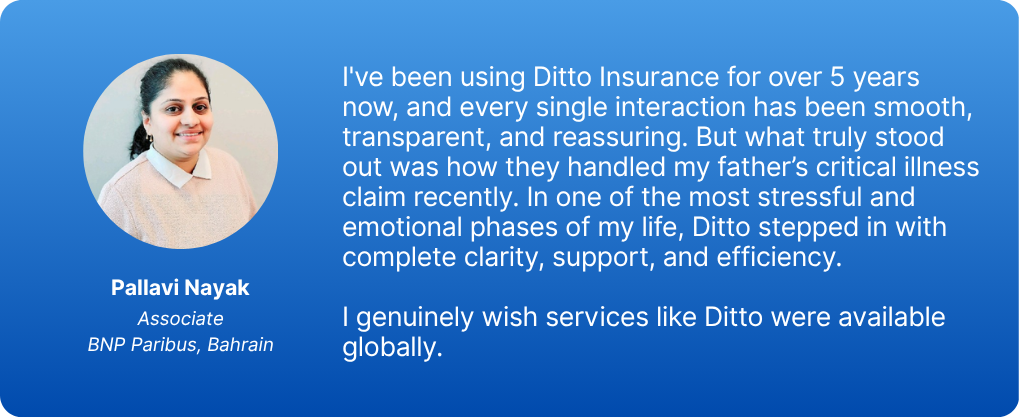
At Ditto, we’ve assisted over 8,00,000 customers with choosing the right insurance policy. Why customers like Pallavi below love us:
- No-Spam & No Salesmen
- Rated 4.9/5 on Google Reviews by 25,000+ happy customers
- Backed by Zerodha
- Dedicated Claim Support Team
- 100% Free Consultation
Confused about the right insurance? Speak to Ditto’s certified advisors for free, unbiased guidance. Book your call now or chat with our advisors on WhatsApp.
Conclusion
Rashtriya Swasthya Bima Yojana played a genuine role in India's health insurance history. It was the first scheme to prove that a cashless, portable, paperless cover could work at scale for low-income households.
But it's been discontinued since 2018, with Ayushman Bharat PM-JAY taking over its role with much broader coverage and eligibility. If you're checking eligibility or status today, PM-JAY is where to start your search, not RSBY.
While government-funded, social-security-based health plans are excellent safety nets for the lower and middle classes, they often face tight budgets, policy changes, and operational delays. Therefore, individuals who prefer high-quality care, such as specific doctor choices, private rooms, and personalized coverage, should always invest in a comprehensive personal health insurance policy rather than relying solely on government schemes.
If you want a comprehensive plan backed by insurers with a strong claims track record, start with the best health insurance plans in India.
Frequently Asked Questions
Last updated on: