




Overview
According to the Times of India, around 54% of all deliveries in Indian private hospitals now happen through C-section, well above what health experts consider medically necessary. This shift matters for your wallet, too, since a C-section costs roughly 1.5 to 2.5 times as much as a normal delivery. Combine that with rising medical inflation and newborn care costs, and the bills can go through the roof.
And most base health plans don't cover any of it. That's where maternity add-ons come in. They cover this exact gap, either as a rider on your existing plan or through a policy with built-in maternity coverage.
This guide walks through popular maternity add-ons and built-in plans from major insurers, compares their waiting periods and limits, and helps you find the one that fits your timeline.
Why Add Maternity Cover to Your Health Insurance?
Pregnancy and childbirth aren't automatically covered by most health plans. Insurers treat maternity as a separate, opt-in benefit because a claim is almost certain once you buy it. That's exactly why timing this add-on matters so much.
Add maternity cover early, and your waiting period is already served by the time you conceive. Skip it, and you could end up paying delivery costs entirely out of pocket, right when you need support most.
HDFC ERGO Optima Secure Plus: Parenthood Rider
The Parenthood rider on Optima Secure Plus covers maternity expenses for up to 2 deliveries, pre- and post-natal care within 180 days, embryo freezing, and up to 2 In Vitro Fertilization (IVF) cycles, all under the sum insured of ₹50,000 to ₹2 lakh.
There is a lifetime cap of at most 2 deliveries or 2 lawful terminations, or 1 delivery and 1 termination.
Waiting Period: There is a 2-year waiting period for each delivery. Newborn expenses after delivery are not covered, and surrogacy or donor eggs are excluded.
Note: The premiums for maternity coverage remain constant regardless of age or location.
A Few Things Worth Knowing:
- The rider requires at least one female insured member aged 18 or older.
- Claims made for maternity do not reduce your base policy sum insured.
- This can be added at purchase or renewal. If removed and added again, a fresh waiting period applies.
ICICI Lombard Elevate: Maternity Benefit Rider
ICICI Lombard Elevate offers an add-on to cover maternity expenses. It covers delivery and related costs up to a chosen sum insured and is available to women aged 18 to 50. Here’s how the coverage stacks up:
- Maternity expenses are covered up to 10% of the sum insured. A maximum limit of ₹1 lakh for the delivery of a baby and expenses related to the medically recommended lawful termination of pregnancy is provided.
- Coverage is limited to a maximum of 3 deliveries or terminations during the lifetime of the female insured person.
- A 2-year waiting period applies to maternity coverage, which can be reduced to 1 year with a paid add-on.
- This cover is available provided that both the self and the spouse are covered under the same family floater policy.
Key Highlight: You can stack this with the Newborn Baby Cover and Vaccination of Newborn riders for fuller coverage. Since Elevate is fully modular, your final premium depends entirely on which riders you pick alongside your base sum insured.
Talk to an expert
today and
find
the right
insurance for you.


Star Super Star: Maternity Rider
Super Star's maternity cover comes in two options, and the one you get depends on your chosen sum insured:
- Option A: Covers maternity expenses up to ₹50,000 or ₹1 lakh, with a 2-year waiting period.
- Option B: Covers maternity expenses up to ₹30,000, with a shorter 1-year waiting period.
Key Highlight: Both options cover up to 4 deliveries over the policy's lifetime, and once you clear the waiting period for your first delivery, subsequent deliveries incur no fresh waiting period. This makes Super Star one of the more generous plans for families planning more than one child.
Newborn hospitalization is covered from day one of birth all the way to the policy's expiry date, up to these limits:
- Option C for Assisted Reproduction Treatment (ART): This covers ART cycles for subfertility, with a 24-month waiting period from when you first bought the policy or opted for this cover, whichever is later. Both you and your spouse need to be on the policy for a continuous 24 months to use this, and the company pays for one ART cycle per policy year. You do not need to be hospitalized to claim this benefit.
Here’s how the premiums look for some common profiles:
Note: In this table, A denotes adult and C stands for child. These premiums are illustrative, based on a ₹15 lakh cover for healthy individuals residing in Delhi (110010). Your final premium may vary based on your age, city, and medical history.
Observation: The add-on cost is constant across profiles. It varies by the option chosen for maternity coverage, not profiles.
Tata AIG Medicare Select: Maternity Care
The Maternity Care add-on on Medicare Select works as one cover with three parts, all sitting on a separate limit over and above your base sum insured. Making a claim here does not affect your no-claim bonus. Coverage is capped at 10% of Sum Insured (SI), with a maximum of ₹1 lakh per policy year.
- Maternity Expenses: Covers childbirth and lawful medical termination of pregnancy. It does not cover pre- or postnatal care, pre- or post-hospitalization expenses, or voluntary termination of pregnancy.
- Delivery Complications of the Newborn: If your maternity claim is admissible, this covers medically necessary treatment for the baby during that same hospitalization.
- First-Year Vaccinations: Covers the child's vaccinations up to their first birthday, again only if the maternity claim was admissible. This is a lifetime limit per child, and continuity of your policy is required.
Waiting Period: 2 years of continuous coverage are required. But you can opt for the Reduction of Maternity Care Waiting Period add-on, which, if you want, can reduce the waiting period to 1 year and is available for an additional premium.
Which Plans Offer Built-In Maternity Coverage
Some insurers build maternity benefits directly into their flagship plans. Here are some examples.
Niva Bupa Aspire: M-iracle Benefit
M-iracle covers maternity, IVF, adoption, and surrogacy costs. Any M-iracle sum insured you leave unused doesn't lapse at renewal. It carries forward along with your Booster+ limit instead, so your maternity cover keeps growing over time. Plus, your newborn is covered from day 1, up to the base sum insured.
Coverage includes prenatal vaccines for the expecting mother, normal or C-section delivery, delivery by a surrogate mother, medical termination of pregnancy, assisted reproduction and infertility treatment, and charges for legally adopting a child.
Here's how the waiting period and coverage compare across variants:
At Ditto, we recommend Platinum+ or Titanium+ if a shorter wait matters to you, since both bring the waiting period down to just 9 months, among the lowest in the market.
Aditya Birla Activ Fit Preferred
Maternity benefits are only available on the Preferred variant, not on Activ Fit Plus.
What's Covered: Delivery (including C-section and twins) or lawful termination of pregnancy, up to 2 events in the insured's lifetime (2 deliveries, 2 terminations, or 1 of each), plus pre- and post-natal expenses.
Newborn Coverage: The baby is covered for 90 days from delivery, within the maternity limit above, and vaccinations are covered until age 2. Stem cell preservation is also covered within the same maternity limit.
Manipal Cigna Sarvah Uttam
This cover is available only on the Uttam and Param variants of Sarvah, not on the Pratham variant.
- Maternity Cover: Up to 20% of your base sum insured, capped at ₹5 lakh, over and above the base sum insured.
- Newborn Baby Cover: Inpatient hospitalization expenses for the newborn, up to the same limit as the maternity expenses cover.
- First-Year Vaccination: Covered as per the national immunization program, up to the same maternity expenses limit.
Waiting Period: The female insured must be continuously covered under the base policy and maternity benefit for at least 36 months.
How to Choose the Right Maternity Cover?
Match Your Timeline
Check the Sub-Limits
Newborn and Vaccination Cover
Factor in the Premium
Why Choose Ditto for Health Insurance?
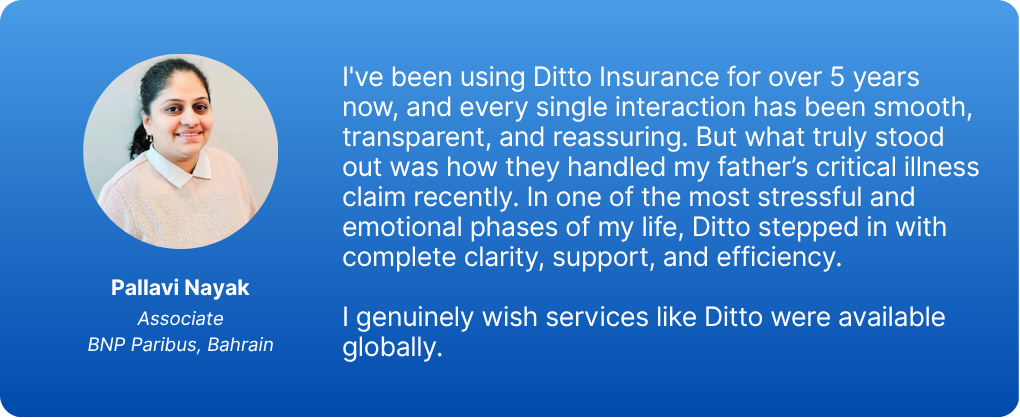
At Ditto, we’ve assisted over 8,00,000 customers with choosing the right insurance policy. Why customers like Pallavi below love us:
- No-Spam & No Salesmen
- Rated 4.9/5 on Google Reviews by 25,000+ happy customers
- Backed by Zerodha
- Dedicated Claim Support Team
- 100% Free Consultation
Confused about the right insurance? Speak to Ditto’s certified advisors for free, unbiased guidance. Book your call or chat on WhatsApp with us now!
Conclusion
A maternity add-on is useful, but it is not a complete safety net. It only solves one problem: helping offset delivery and newborn costs up to a set sub-limit. But it does not remove the waiting period, cover pre- or post-natal expenses in most cases, or guarantee that the payout matches what a private hospital actually charges.
So, start with the basics. First, check whether maternity cover is available on your base plan or any of its variants, since some, like Activ Fit Plus, skip it entirely. Then match the waiting period to your family planning timeline. After that, compare the sub-limit against real delivery costs in your city. Finally, weigh the extra premium this add-on costs against what you would actually claim.
Ditto's Take: We usually don't recommend buying a health plan only for its maternity cover. Sub-limits are often modest, waiting periods are long, and the premiums for maternity variants can be steep for what you eventually claim. If your employer offers a corporate health plan with maternity benefits, use that first. Otherwise, a dedicated maternity fund or savings set aside specifically for delivery costs often works out cheaper than paying years of higher premiums for a capped payout.
As your next step, list out your timeline and city hospital costs, then compare at least two plans against that list before you buy. If you're still comparing options, you can refer to our guide on maternity health insurance for comprehensive options.
Frequently Asked Questions
Last updated on: