



Quick Overview
Struggling with rising hospital bills and unsure how to afford quality treatment? If you are a permanent resident of Rajasthan, the Mukhyamantri Chiranjeevi Swasthya Bima Yojana offers cashless health coverage to families, making critical healthcare accessible and affordable.
This guide walks you through the scheme benefits, coverage, eligibility, and how to access treatment under the scheme.
Did You Know?
Key Features of Mukhyamantri Chiranjeevi Swasthya Bima Yojana
- No Age or Family Size Limit: Your entire family is covered, with no restrictions on age or the number of members.
- Covers Newborns: Even if a newborn has not yet been added to the family card, they can still receive benefits for up to 1 year.
- Access to a Wide Hospital Network: You can avail of cashless treatment at government as well as empaneled private hospitals across Rajasthan. Additionally, Rajasthan’s 2025–26 budget press note highlights interstate portability under MAA Yojana, allowing beneficiaries to access healthcare services outside the state.
- Covers Multiple Specialities: The scheme provides treatment across 31 medical specialities under defined packages.
- Pre-existing Disease Coverage: The scheme covers existing illnesses, allowing beneficiaries to access treatment without exclusion for prior conditions.
- Pre and Post Hospitalization Cover: Includes expenses for the same illness up to 5 days before admission and 15 days after discharge, if incurred at the same hospital.
- Premiums: Eligible families receive free coverage, while others can enroll by paying a nominal premium, with the government covering a significant portion of the cost.
Take Note: Treatment under the scheme follows predefined medical procedures. It is important to check the package details in advance to understand what is included and what expenses may not be covered.
Inclusions and Exclusions of Mukhyamantri Chiranjeevi Swasthya Bima Yojana
Note: It is advisable to visit the official website to check the inclusions and exclusions under the scheme.
Eligibility Criteria and Application Process for Mukhyamantri Chiranjeevi Swasthya Bima Yojana
Eligibility Criteria
- Eligible families under the National Food Security Act (NFSA) and the Socio-Economic and Caste Census (SECC) 2011 are covered.
- Contract workers in Rajasthan government departments, boards, corporations, and government companies are eligible.
- Small and marginal farmers and vulnerable families that received Covid-19 ex gratia support are also covered.
Note: Besides the above-listed categories that receive free benefits, other families can enroll by paying ₹850 per year.
How to Apply for Mukhyamantri Chiranjeevi Swasthya Bima Yojana?
- Check Eligibility: If you belong to the National Food Security Act (NFSA) or Socio-Economic Caste Census (SECC) 2011 categories, separate registration is not required.
- Get Jan Aadhaar (if Not Available): Ensure your family is registered in the Jan Aadhaar database. If not, enroll online or visit the nearest e-Mitra center.
- Register on Single Sign-On (SSO) Portal: New users need to create an account on the SSO portal, while existing users can log in directly.
- Apply for the Scheme: After logging in, select the MAA-YOJANA option and complete the application process.
- Alternative Registration Option: Eligible families, such as farmers or contractual workers, can also register through an e-Mitra center.
- Track Application Status: You can check your policy registration status anytime on the portal.
Documents Required to Apply for Mukhyamantri Chiranjeevi Swasthya Bima Yojana
To apply for the scheme, you need basic documents such as a copy of your Jan Aadhaar and your Aadhaar card. A Jan Aadhaar number or enrollment receipt is mandatory for the application. If you do not have a Jan Aadhaar yet, you must complete the enrollment process first before applying.
Note: You can easily find nearby empaneled hospitals by using the Jansoochna MAA Yojana hospital search tool.
Mukhyamantri Chiranjeevi Swasthya Bima Yojana Vs Private Insurance: Is It Enough on Its Own?
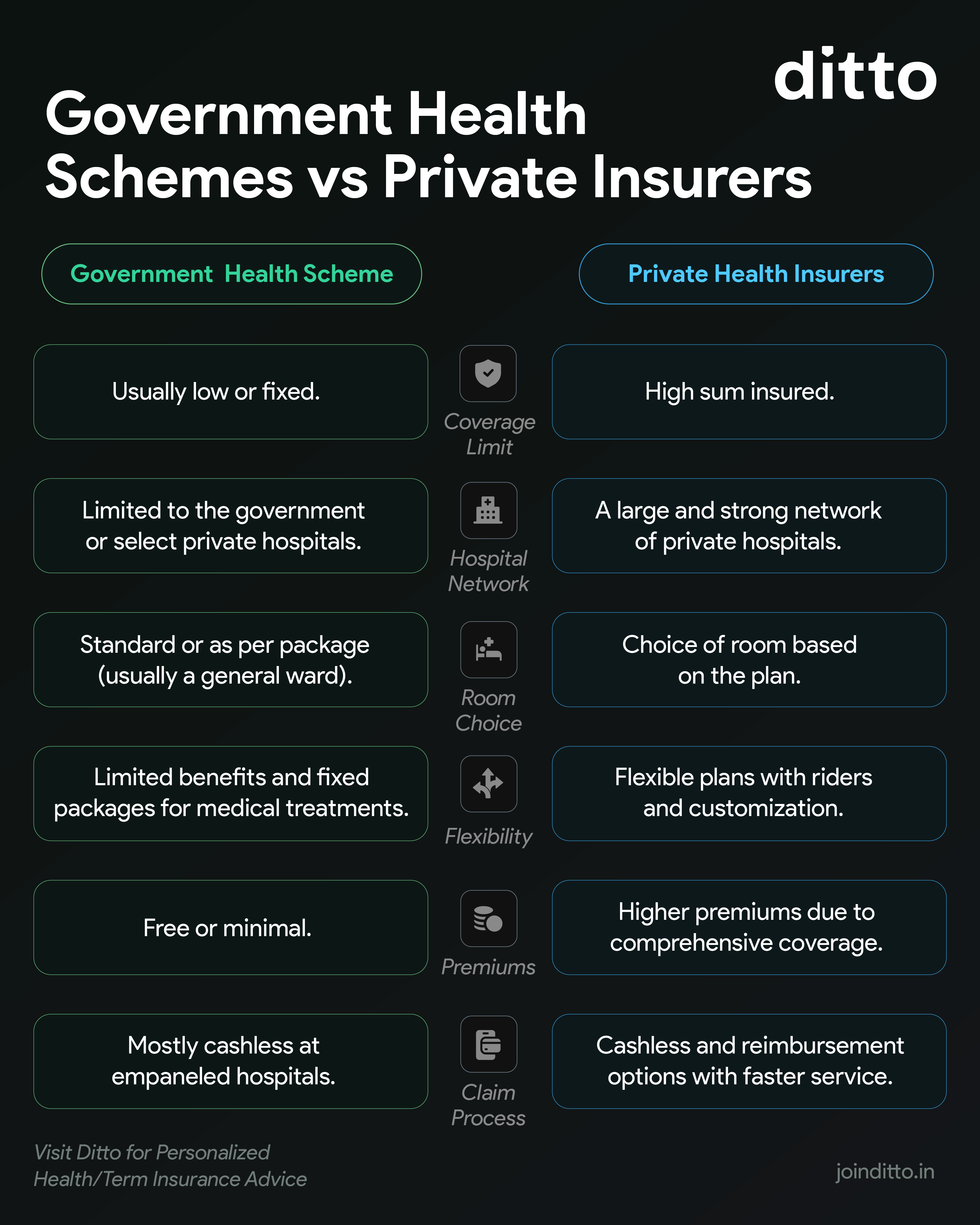
Government schemes like Mukhyamantri Chiranjeevi Swasthya Bima Yojana provide a strong base layer for essential hospitalization under defined packages. However, fixed package rates, room limits, and non-payable items can still result in out-of-pocket expenses.
Adding a comprehensive private health plan gives you higher coverage, wider hospital choice, and fewer restrictions.
Take a look at the infographic for a clearer understanding of the differences between private insurers and government schemes:
Why Choose Ditto for Health Insurance?
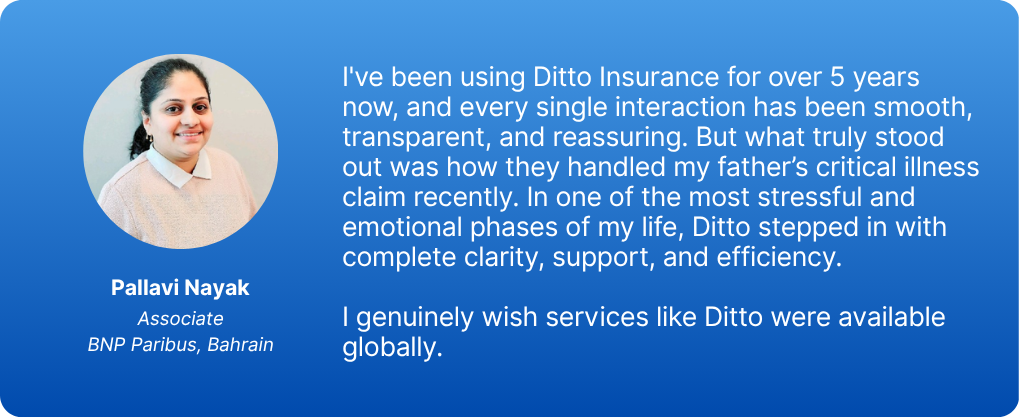
At Ditto, we’ve assisted over 8,00,000 customers with choosing the right insurance policy. Why customers like Pallavi below love us:
- No-Spam & No Salesmen
- Rated 4.9/5 on Google Reviews by 20,000+ happy customers
- Backed by Zerodha
- Dedicated Claim Support Team
- 100% Free Consultation
Confused about the right insurance? Speak to Ditto’s certified advisors for free, unbiased guidance. Book your call or chat on WhatsApp with us now!
Conclusion
Government health schemes like Mukhyamantri Chiranjeevi Swasthya Bima Yojana provide robust financial protection against hospitalization costs, especially for vulnerable families. But they are built as basic safety nets, with limits on hospital choice, package-based treatments, and the scope of coverage. Furthermore, such schemes depend on empaneled networks and evolving administrative rules.
A private health insurance plan adds flexibility and control. You can choose hospitals, adjust coverage, and plan for long-term healthcare needs without relying only on scheme structures. For many, it becomes an important layer of financial security beyond government support.
If you are looking for a health plan from insurers with established track records, we recommend the best health insurance plans.
Frequently Asked Questions
Last updated on: