



Quick Overview
KASP insurance is Kerala’s main government-backed health protection scheme for eligible families. It is the state’s implementation of Ayushman Bharat Pradhan Mantri Jan Arogya Yojana (AB PM-JAY) and is run by the Kerala State Health Agency. The scheme also brings together other government-backed health support systems in the state, including the Karunya Benevolent Fund and earlier public health insurance programs, to make hospital care more accessible through a cashless network of empaneled hospitals.
According to the State Health Agency Kerala’s latest public statistics, KASP covers 43,07,073 families and 78,83,794 beneficiaries in Kerala. Each eligible family gets up to ₹5 lakh a year for covered hospitalization expenses.
Key Features of KASP Insurance
- Coverage of Up to ₹5 Lakh Per Family: The scheme offers health coverage of up to ₹5 lakh per family per year for approved secondary and tertiary hospitalization (that is, treatment that needs specialist care, advanced procedures, or hospital admission beyond basic medical care). Since it works on a family floater basis, the entire sum insured can be used by one member or shared across multiple members.
- Cashless Treatment Facility: KASP provides cashless treatment at empanelled hospitals. Eligible beneficiaries can access treatment without paying upfront, as expenses for approved procedures are directly settled through the scheme at the hospital.
- No Restrictions on Family Composition: There are no limits on family size, age, or gender under KASP. Additionally, pre-existing diseases are covered from day one, making it especially beneficial for families with elderly members or existing health conditions.
- Wide Range of Covered Procedures: The scheme covers 1,500+ medical procedures under predefined treatment packages, with each package covering the related hospitalization costs such as doctor fees, diagnostic tests, medicines, ICU charges, room rent, and surgery expenses. It also covers 3 days of pre-hospitalization expenses and 15 days of post-hospitalization expenses, subject to the package terms.
- Fully Government-Funded Scheme: Unlike private health insurance, KASP is a fully government-funded scheme, not a retail product, and is available only to families identified as eligible by the state.
A key upgrade with KASP-PMJAY is the higher cover amount. Earlier government-funded health insurance schemes in India usually offered annual family cover ranging from ₹30,000 to ₹3 lakh, leading to a fragmented system across states. KASP-PMJAY improves on this by offering cashless coverage of up to ₹5 lakh per eligible family per year for listed secondary and tertiary care conditions.
Note: To check the KASP hospital list, readers should visit the official State Health Agency (SHA) Kerala website. It provides a district-wise list of empanelled public and private hospitals across Kerala, including major cities such as Thiruvananthapuram, Ernakulam, Kozhikode, Thrissur, and Kannur.
For assistance, beneficiaries can contact the State Health Agency via helpline 1056 or phone 0471-4063121, or email at statehealthagencykerala@gmail.com. The official address is Artech Meenakshi Plaza, Thycaud, Thiruvananthapuram – 695014.
Inclusions and Exclusions of KASP Insurance
Eligibility Criteria and Application Process for KASP Insurance
1) Eligibility Criteria: KASP is not a plan you can purchase at will. It is available only to pre-identified beneficiaries. As per official guidelines, the scheme covers:
- Families enrolled under the Rashtriya Swasthya Bima Yojana (RSBY or the Comprehensive Health Insurance Scheme (CHIS) with a valid card from the 2018-19 period
- Families identified through the Socio-Economic Caste Census (SECC) 2011 data who received the Prime Minister’s letter
No new registrations have been widely opened beyond these categories.
2) How to Apply for KASP Insurance: Eligible families do not need to buy a policy. Instead, they need to verify their eligibility and identity to get their beneficiary card generated.
- Visit an empanelled hospital or authorized centre
- Search beneficiary details in the official database
- Complete e-KYC and Aadhaar verification
- Link family members (if required)
- Get the AB PMJAY-KASP card generated
If a new family member needs to be added, the existing beneficiary and the new member must visit an empanelled hospital to complete the process.
3) Documents Required: To complete beneficiary verification and enrollment under KASP, families are usually asked to submit the following documents:
- Aadhaar card for identity verification and e-KYC
- Ration card to confirm family details and household members
- Birth certificate if a new family member is being added
- Marriage certificate if a spouse is being added
- Prime Minister’s letter or proof of inclusion in a government-approved beneficiary list, where applicable
4) KASP Insurance Card Download: Once e-KYC is completed and the beneficiary is approved, the card can be downloaded from the PMJAY beneficiary portal or accessed through empanelled hospitals.
Note: The AB PMJAY-KASP card does not require annual renewal, and there is no fixed validity period defined for existing cards. This means beneficiaries are not required to renew it every year, unlike private health insurance policies.
KASP Insurance vs Private Insurance: Is It Enough on Its Own?
KASP is a useful base cover for eligible families, but it may not be enough on its own. Government schemes often come with limits such as restricted hospital access, package-based coverage, possible shortages in beds or infrastructure, and a sum insured cap of ₹5 lakh per family per year. It is also mainly useful within Kerala’s scheme network.
Private health insurance offers more flexibility. You can choose a higher sum insured, access a wider hospital network, and get cover that is not tied to government eligibility rules or package limits.
Why Choose Ditto for Health Insurance?
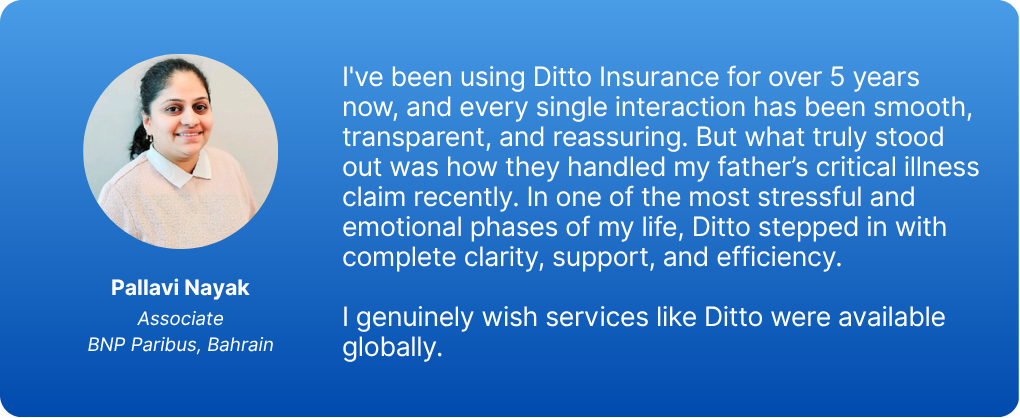
At Ditto, we’ve assisted over 8,00,000 customers with choosing the right insurance policy. Why customers like Pallavi below love us:
- No-Spam & No Salesmen
- Rated 4.9/5 on Google Reviews by 15,000+ happy customers
- Backed by Zerodha
- Dedicated Claim Support Team
- 100% Free Consultation
Confused about the right insurance? Speak to Ditto’s certified advisors for free, unbiased guidance. Book your call now or chat on WhatsApp, slots fill up fast!
Ditto’s Take on KASP Insurance
KASP is a strong safety net for eligible families in Kerala and can greatly reduce hospitalization costs through cashless, government-funded coverage. But it is still a limited public scheme, not a customizable insurance plan.
That is why we see KASP as a useful base layer, not a complete replacement for private health insurance. If you want higher coverage, wider hospital choice, and more control over your healthcare access, a private plan is worth considering alongside it. To understand what to look at beyond KASP, readers can also go through our guide to the top 5 health insurance plans.
Frequently Asked Questions
Last updated on: