

Quick Review
The landscape of Jharkhand health insurance has been redefined by the launch of the Mukhyamantri Abua Swasthya Suraksha Yojana (MASSY) that offers substantial coverage to eligible beneficiaries at no cost. However, a critical challenge persists: dependence on state schemes alone is insufficient.
Data indicates that while hospital costs are covered, expenses for routine care, high-end diagnostics, and access to premium facilities in cities like Ranchi and Jamshedpur still force many families to exhaust their savings.
This guide provides a crucial perspective for 2026 where we also explain how Jharkhand health insurance programs work, where they fall short, and how private plans can help bridge those gaps.
State-Sponsored Jharkhand Health Insurance Schemes
(1) Mukhyamantri Abua Swasthya Suraksha Yojana (MASSY)
MASSY is a flagship Jharkhand Health Insurance scheme launched in June 2024. It is designed as a state top-up to Ayushman Bharat in Jharkhand.
(a) Sum Insured and Coverage
- Total Annual Cover: ₹15,00,000 (Fifteen Lakh Rupees) per family per year.
- Basis: This is offered on a family floater basis. This means the entire family shares the ₹15 lakh limit.
- Coverage Structure: The scheme operates in a hybrid mode.
- First ₹1 Lakh: Covered via Insurance Mode (Managed by National Insurance Company).
- Next ₹14 Lakhs: Covered via Trust Mode (Funded directly by the Jharkhand State Arogya Society).
- Scope of Treatment: Covers secondary and tertiary care hospitalization, including 2,300+ medical and surgical procedures.
(b) Eligibility Criteria
(c) Treatment and Benefits
- Day 1 Coverage: All pre-existing diseases (PEDs) are covered from the moment you get your card. There is no waiting period.
- Cashless Treatment: MASSY provides cashless treatment through the Ayushman Bharat empanelled hospital network across Jharkhand. You have to simply present your Abua Swasthya Card at any empanelled hospital.
- Critical Care: Includes coverage for 21 major life-threatening diseases previously under the Mukhyamantri Gambhir Bimari Upchar Yojana (MGBUY) (e.g., cancer, kidney failure, heart surgery).
- Free Medicines: Treatment for certain chronic conditions like diabetes and high blood pressure includes free medicines at government hospitals.
(d) Important Limitations and Notes
- Portability: Since MASSY is implemented on the Ayushman Bharat (PM-JAY) platform, beneficiaries can generally access cashless treatment at PM-JAY–empanelled hospitals across India, including select national centres like Tata Memorial Hospital. However, coverage beyond the ₹5 lakh PM-JAY limit may require state approval, so prior confirmation is recommended.
- Review your Card: Ensure every family member's name is on the Ration Card; otherwise, they cannot generate their individual health card.
- Application Process: Application and verification are done online through the State Health Portal using Mobile Number, Aadhaar and Ration Card details.
(2) Ayushman Bharat: Pradhan Mantri Jan Arogya Yojana (PM-JAY)
Ayushman Bharat is the world’s largest government health insurance scheme and plays a key role in providing health coverage to vulnerable families in Jharkhand. This central government scheme applies across India and offers ₹5,00,000 per family per year for secondary and tertiary hospitalization.
Eligibility is based on SECC 2011 data, and beneficiaries receive an Ayushman Card, which enables cashless treatment at empanelled public and private hospitals nationwide.
A major advantage of PM-JAY is its portability which allows treatment outside Jharkhand if needed. Pre-existing diseases are covered from the first day.
Want more details on eligibility, benefits, and hospital lists? Read more in our comprehensive guide on Ayushman Bharat Health Insurance.

Limitations of Government Health Schemes in Jharkhand
Fixed Packages vs. Modern Medicine
State schemes use rigid health benefit packages health benefit packages with fixed rates. These often do not cover expensive modern treatments like robotic-assisted surgeries, advanced biological therapies, or premium room choices, which are standard in high-quality private insurance.
The "Pre-Admission" Cost Trap
On paper, PM-JAY and MASSY packages include coverage for up to 3 days of pre-hospitalization diagnostics and 15 days of post-hospitalization medicines. However, in practice, many families still end up paying out of pocket for costly pre-admission tests like MRIs or advanced blood work due to low awareness, hospital process gaps, or system and software issues before cashless treatment is activated.
Severe Infrastructure and Specialist Gaps
A ₹15 lakh cover is only useful if there is a doctor to perform the surgery. As of 2025, Jharkhand has one of the lowest doctor-to-population ratios in India (1:4,673, i.e., 1 doctor per 4673 people) , with over 60% vacancy rate for specialists in rural areas. This forces families in smaller districts to travel to Ranchi or Jamshedpur, incurring massive non-medical costs for travel and lodging that no scheme covers.
Eligibility-based Access
Government health schemes depend strictly on socio-economic criteria. This means many middle-income families: small business owners, self-employed professionals, and private-sector workers, are often excluded despite having limited savings and no employer health cover. As incomes or documents change, eligibility can also be lost over time. This makes long-term coverage uncertain.
These gaps explain why government schemes alone may not be sufficient for long-term or comprehensive healthcare needs.
Private Health Insurance vs Government Schemes
Compared to Government health schemes, private health insurance plans are flexible and customizable and cater to different budgets, family sizes, and healthcare needs across income groups.
Here’s how private health insurance stands apart:
- Higher Sum Insured Options: Coverage can range from ₹10 lakh to ₹1 crore or more that helps protect against rising medical costs and multiple hospitalizations.
- No Eligibility Restrictions and Wider Hospital Choice: Private health plans do not require any socio-economic eligibility checks and allow access to a broader hospital network across the country.
- Restoration Benefit: After a claim exhausts your sum insured, private plans automatically restore the cover. This helps manage multiple hospitalizations in the same policy year.
- No-claim Bonus: For every claim-free year, your sum insured increases, usually without a proportional rise in premium.
- Domiciliary Treatment: Private health plans cover treatments taken at home when hospitalization isn’t possible due to medical advice, bed unavailability, or the patient’s condition, something government schemes usually don’t include.
- Covers More Than Hospitalization: Private plans let you add OPD (outpatient department), maternity, and preventive check-ups as optional benefits, giving flexibility to suit your needs.
- Tax Benefits: Premiums qualify for deductions under Section 80D of the Income Tax Act (under the old tax regime).
Note: For many families, private insurance acts as a strong upgrade or backup to existing Jharkhand health insurance coverage. For a clearer view of the most reliable options available today, check our guide on the: Best Health Insurance Plans in India.
Why Choose Ditto for Health Insurance?
At Ditto, we have assisted over 8,00,000 customers with choosing the right health insurance policy according to their needs and goals. Why customers like Aaron love us:
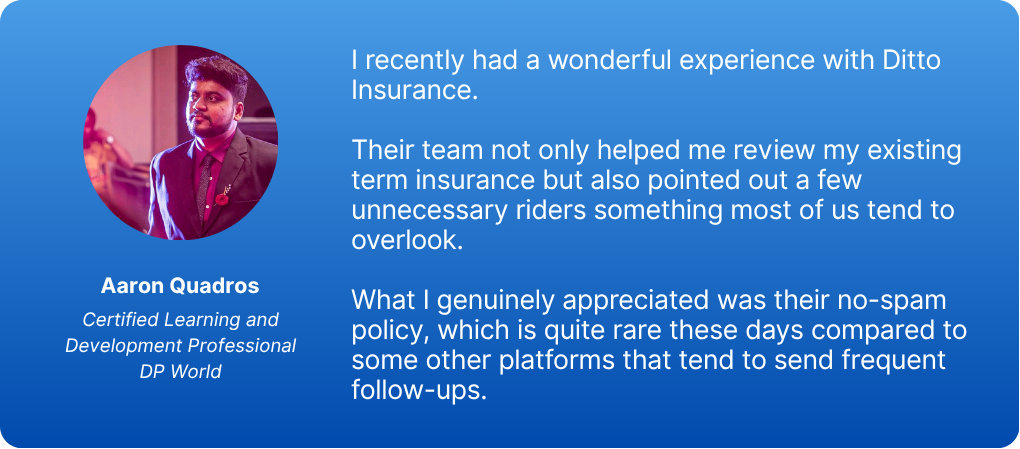
- No-Spam & No Salesmen
- Rated 4.9/5 on Google Reviews by 15,000+ happy customers
- Backed by Zerodha
- Dedicated Claim Support Team
- 100% Free Consultation
You can book a FREE consultation. Slots are running out, so make sure you book a call now!
Final Thoughts
Jharkhand health insurance works in layers. MASSY and Ayushman Bharat form a strong base for low-income families by covering major hospitalization costs. But their scope is limited and eligibility-dependent.
For the nearly 2 lakh state government employees and pensioners, the JSEPHIS (Jharkhand State Employees Cashless Health Insurance Scheme) offers a dedicated ₹5–10 lakh cover.
However, for the middle income groups, a private health insurance plan remains the primary form of protection. As government and employer schemes are tied to specific eligibility rules or employment status, they are best used as a base layer.
Hence, the most reliable approach is a layered strategy: use any government or employer scheme you’re eligible for as the base, and add a private health plan to ensure higher coverage and long-term broad protection.
Frequently Asked Questions
Last updated on: