



Quick Overview
Ever wondered why some medical bills hit harder than others? That’s because hospital treatments fall into two different categories: inpatient department (IPD) and outpatient department (OPD). So, which one would you choose for your health insurance? The one that saves you from burning your savings for routine visits or the other that protects you during a medical emergency?
In this guide, we will help you understand how IPD and OPD coverage types actually work, the key differences between the two, and what is covered under them.
IPD vs OPD: Differences
Note: OPD supports your regular healthcare needs, but IPD keeps you safe during emergencies.
Common Treatments Covered in IPD vs OPD
IPD treatments can be either planned (scheduled surgeries or procedures) or emergency admissions (accidents, sudden illness, or critical conditions).
Common inclusions under IPD are:
- Hospitalization Costs: Room charges, nursing expenses, and other costs associated with the hospital stay.
- Surgical Expenses: Operation theater charges, surgeon's fees, anesthesia, and related costs.
- Diagnostic Tests: X-rays, MRIs, blood tests, and other investigations conducted during the stay.
- Medications: Cost of medicines and drugs prescribed during hospitalization.
- Pre- and Post-Hospitalization: Most IPD policies cover expenses incurred before admission and after discharge for a defined period, typically 30 to 60 days before and 60 to 90 days after hospitalization.
Key Insight
An OPD health insurance policy covers:
- Consultation Fees: The charges for visiting a physician or specialist.
- Diagnostic Tests: Costs associated with initial tests and screenings.
- Medications: The expense of prescribed drugs or medications.
- Dental and Vision Care: Coverage for eye examinations, dental checkups, and related costs.
- Preventive Care: Expenses for vaccinations, health checkups, and various wellness programs.
Benefits of OPD and IPD Treatment
How Do OPD and IPD Claims Work?
IPD Claims
- Cashless: For planned hospitalizations, inform your insurer at least 48 hours in advance. For emergencies, notify them within 24 hours of admission. The hospital directly settles the bill with the insurer. You only pay for items not covered under your policy.
- Reimbursement: If cashless is not available, you have to pay the bill yourself. Collect all documents, including discharge summary, medical bills, prescriptions, and diagnostic reports. Submit your claim within the deadline your insurer specifies, usually 15-30 days from discharge.
OPD Claims
- Reimbursement (Most Plans): You have to collect all medical bills and submit them to the insurer for reimbursement. Options like Care Supreme offer OPD benefits as a paid add-on. Care OPD offers general physician and 4 specialist consultations per year (from a list of 14 specialists), capped at ₹500 per visit on a reimbursement basis.
- Cashless (Select Plans): For cashless OPD claims, you have to book the visit at a partner hospital of the insurer, and you don’t have to pay anything yourself. Plans like HDFC Ergo Optima Secure with the Optima Wellbeing add-on offer cashless OPD benefits at network clinics, which is far more convenient than chasing reimbursements.
Bottom Line: Keep every bill, prescription, and lab report handy. Always notify your insurer on time.
Talk to an expert
today and
find
the right
insurance for you.


Things To Keep In Mind Before Buying IPD & OPD Cover
- Assess Your Needs: Consider your medical history and frequency of hospital visits to help you determine your IPD or OPD coverage requirements.
- Have a Comprehensive IPD Plan: Every health insurance plan already includes IPD cover. Opt for at least ₹15 lakh to ₹25 lakh sum insured with no room rent capping, disease-wise sub-limits, and co-payment. Look for insurers with strong key metrics like claim settlement ratio (CSR), incurred claim ratio (ICR), and complaint volumes.
- Compare Premiums: OPD benefits are available as add-ons and can bump up your premiums significantly while offering minimal coverage. It’s better to check how cost-effective the add-on is. Here’s a sample premium of the OPD add-on offered in HDFC Ergo Optima Secure: Optima Wellbeing.
- Consider Age and Family Size: Older individuals or larger families with frequent medical needs may benefit more from OPD coverage, while younger, healthier individuals can rely primarily on IPD.
- Look for Network Hospitals: A wide hospital network ensures smoother cashless claims for IPD treatments. Limited networks can force you into reimbursement, which is less convenient.
Why Choose Ditto for Health Insurance?
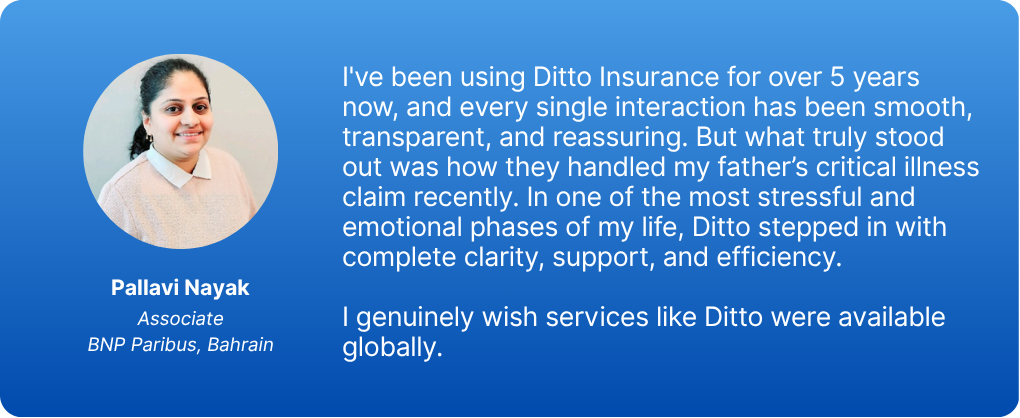
At Ditto, we’ve assisted over 8,00,000 customers with choosing the right insurance policy. Why customers like Pallavi below love us:
- No-Spam & No Salesmen
- Rated 4.9/5 on Google Reviews by 15,000+ happy customers
- Backed by Zerodha
- Dedicated Claim Support Team
- 100% Free Consultation
Confused about the right insurance? Speak to Ditto’s certified advisors for free, unbiased guidance. Book your call now or chat over WhatsApp with our advisors.
Conclusion
Consider Adding OPD Cover if you:
- Visit doctors regularly for chronic conditions like diabetes or hypertension
- Have dependent children or elderly parents who need frequent consultations
- Regularly spend on diagnostics, tests, or follow-ups
Skip OPD Cover if you:
- Are young and healthy, and rarely visit a doctor
- Want to keep your premiums low
- Would rather pay out-of-pocket for occasional checkups
Bottom Line:
Pick your health insurance plan based on IPD coverage, hospital network, and performance. OPD cover is worth considering only if your outpatient spend is high enough to justify the added premium. Otherwise, treat it as a bonus if your shortlisted plan already offers it. If you're just starting your health insurance search, our guide on the best health insurance plans in India is a good place to begin.
Frequently Asked Questions
Last updated on: