

Quick Overview
Many people feel comfortable buying health insurance through their bank. You trust the bank, the paperwork starts quickly, and the premium can be paid straight from your account. However, IDFC health insurance works differently from what most people assume.
In this article, we’ll explain how IDFC FIRST Bank health insurance works, which partner insurers it sells policies for, and the key checks you should make before committing to any plan.
IDFC Health Insurance: Overview
IDFC FIRST Bank is one of India’s growing private sector banks. It is also registered as a Composite Corporate Agent under the IRDAI framework (licence number CA0106). This authorizes the bank to distribute health insurance plans.
However, IDFC FIRST Bank does not:
- Underwrite the policy
- Design policy terms or benefits
- Decide or influence claim outcomes
- Take legal responsibility for approvals, rejections, or payouts
All core policy decisions, including underwriting, renewals, and claims, are handled entirely by the insurer. Any support provided by the bank is administrative, not authoritative.
Which Health Insurers Partner With IDFC
As per IDFC FIRST Bank’s health insurance website, the bank distributes health insurance products from:
- General insurers: ICICI Lombard, SBI General, Generali Central
- Standalone health insurers: Aditya Birla Health, Niva Bupa, Star Health
Popular Health Insurance Plans Available Through IDFC
Note: The list of plans depends on availability, insurer arrangements with the group, and campaigns. Always confirm the latest options before deciding.
Pros of Buying Health Insurance via IDFC Bank
- Access to Established Insurers: IDFC FIRST Bank distributes health insurance from well-known partner insurers across both general insurance and standalone health insurance categories, giving you access to recognized brands from a single channel.
- Convenience: Many customers like the ease of buying through the bank. The bank-led journey can feel smoother because the relationship manager often helps coordinate paperwork, medicals (if required), and onboarding.
- Single Point of Contact: If you prefer guided assistance, the bank can act as your primary touchpoint while you’re buying the policy, helping you navigate the process and connect with the insurer where needed.

Things to Keep in Mind When Buying Health Insurance through a Bank
Bank Is Not The Insurer
A common misconception is that banks can influence claims. They cannot. The insurer handles underwriting, policy terms, renewals, and claim approvals or rejections. The bank is only the distributor.
Limited Choices
A Corporate Agent can have only a limited number of tie-ups (up to 9 insurers per category). So you are choosing from the bank’s partner list, not the full market.
Group Plans Can Change
Some banks sell group covers for customers. They can look affordable, but continuity depends on the bank-insurer arrangement. If that changes, renewal pricing, terms, or availability can change too.
Suitability Checks
The right plan depends on age, health history, city and hospital preferences, employer cover, maternity needs, and budget. Bank conversations are often short, so these may not be assessed deeply.
Documentation
Forms can be filled quickly, and customers sometimes sign without verifying health details. Incorrect or incomplete disclosures can create issues later during claims. Review what is submitted and keep a copy.
Limited Claim Support
Bank staff help with purchase, not end-to-end claims. In an emergency, support may stop at connecting you to the insurer, which may not be enough when documentation and coordination matter most.
How does IDFC Earn Revenue on Health Insurance?
IDFC Bank earns commissions from insurers for distributing their insurance products. This revenue is governed by IRDAI’s Expenses of Management (EoM) and commission regulations. This is a standard model across banks and distributors.
A few things to remember:
- Your premium remains the same, and the bank doesn’t add any extra fee.
- Some insurers offer a small online discount (5% to 10%), but base pricing is standardized across channels.
For transparency, IDFC Bank also publishes its annual commission earnings in an official commission disclosure document.
Why Choose Ditto For Health Insurance?
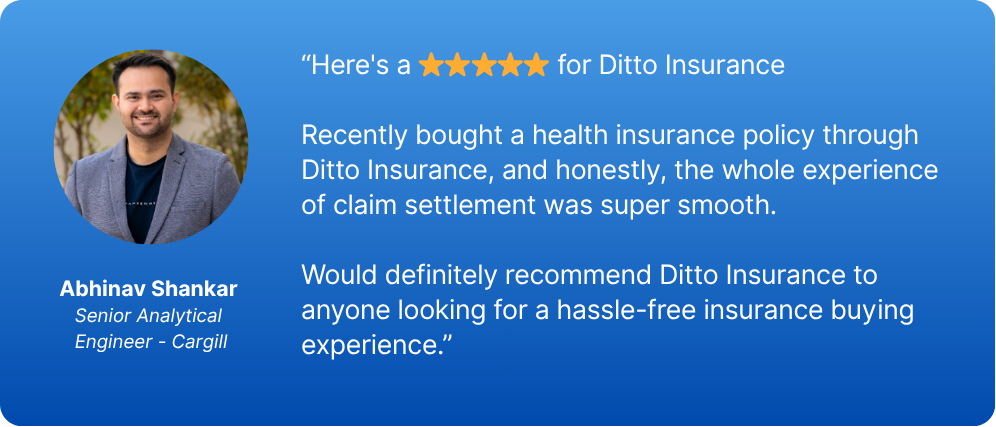
At Ditto, we’ve assisted over 8,00,000 customers with choosing the right insurance policy. Here’s why customers like Abhinav love us:
- No-Spam & No Salesmen
- Rated 4.9/5 on Google Reviews by 15,000+ happy customers
- Backed by Zerodha
- 100% Free Consultation
You can book a FREE consultation with us. Slots are filling up quickly, so be sure to book a call now!
Ditto’s Take on IDFC Health Insurance
If you’re considering a health plan through IDFC FIRST Bank, make sure you understand how these offerings work. The bank typically distributes policies from a limited set of partner insurers.
Some bank-led offerings can be structured as group plans or campaign-specific products. These can evolve, which means the pricing, availability, or even certain terms may change at renewal depending on the insurer bank tie-up. This isn’t automatically a negative, but it is a feature of how bancassurance and group-type setups work, and it’s worth being aware of.
Ditto, too, is an IRDAI-licensed Corporate Agent (Licence No. CA0738). Insurance is our primary business, and our work focuses on suitability checks, long-term servicing, documentation accuracy, renewals, and claims support. So you get help not just while buying a policy, but throughout the policy’s life.
Disclosure
Frequently Asked Questions
Last updated on: