



Quick Overview
If you’ve seen HealthIndia Insurance TPA mentioned on your health insurance card or policy document, it’s natural to wonder what role it actually plays during a claim.
A TPA like HealthIndia acts as the operational bridge between you, your insurer, and the hospital. The insurer decides the policy rules, the hospital provides treatment, and the TPA coordinates approvals, documents, and claim communication.
This article explains HealthIndia Insurance TPA’s role, how cashless and reimbursement claims work, the documents required, how to track your claim, and how to contact Health India.
About HealthIndia Health Insurance TPA
HealthIndia Insurance TPA Services Private Limited is a third-party administrator operating in India under registration No. 022 (valid till 17 Nov 2026).
HealthIndia states it was established in 2002 and supports cashless hospitalisation and claim servicing for policyholders.
HealthIndia's core responsibilities include:
- Coordinating cashless hospitalization approvals
- Helping process reimbursement claims
- Verifying medical and billing documents
- Coordinating between hospitals and insurers
Note: HealthIndia does not issue policies or decide coverage. All approvals, deductions, or rejections are based on your insurer’s policy wording. A TPA only executes those rules during the claim process.
What is The Cashless Claims Settlement Process at HealthIndia TPA?
Step 1: Choose A Network Hospital
To avail cashless treatment, ensure the hospital is part of HealthIndia’s network. You can check network status on their website or confirm via their call center.
Step 2: Patient Identification At Hospital
At the hospital’s insurance/TPA desk, share your Health India ID card details and a valid photo ID. (Carrying past medical records also helps speed up approvals.)
Step 3: Submit The Pre-authorization Request
The hospital fills and sends the cashless request (authorization) form to the TPA with required details and ID proof.
Step 4: Cashless Approval Decision
HealthIndia verifies: policy coverage and terms, medical details and hospital details. If everything is in order, an authorization letter is issued with an approved amount. If details are incomplete, the hospital is asked to submit more information first.
Step 5: Discharge And Non-payables
At discharge, you sign the bills and typically pay for non-medical / inadmissible items (or amounts not approved).
Note: HealthIndia states that an authorization letter for emergency hospitalization can be issued within 24 hours.
What Is The Reimbursement Claims Settlement Process At HealthIndia TPA?
If you don’t use cashless (for example, a non-network hospital or a cashless not approved), you can file a reimbursement claim.
Step 1: Claim Intimation
Register claim intimation as early as possible through Health India’s online claim intimation option or support channels available on their portal. Also, IRDAI regulations say insurers should consider and process claims even if there is a delay in intimation, if valid reasons exist.
Step 2: Submission Of Claim Documents
After discharge, pay the bill, fill the claim form, and submit documents. Health India also enables online claim submission in PDF format (file size limit mentioned as 15MB) via location-mapped email IDs for scanning.
Step 3: Settlement Timelines
As per IRDAI Health Insurance Regulations, an insurer must generally settle or reject a claim within 30 days of receiving the last necessary document. The regulation also says document requirements should not be raised in a piecemeal manner.
Documents Required for Reimbursement Claims
- Duly filed claim form
- Copy of HealthIndia ID card and health policy document
- Photo ID proofs (Aadhaar, PAN, employee ID, CKYC documents if applicable)
- Original prescriptions and consultation notes
- Final hospital bill with a detailed break-up
- Discharge summary
- Original cash receipts
- Investigation and diagnostic reports
- Cancelled check with IFSC code
Remember: Additional documents are often requested on a case-to-case basis.
How Do I Track A Claim Status With HealthIndia TPA?
Once registered, every claim is mapped to your policy/TPA details and can be tracked through HealthIndia’s online services.
You can usually track claim status via:
- Health India’s portal features like e-card and claim status
- Online claim intimation and support tools
- Their mobile app (Android/iOS)
Network Hospitals Partnered With HealthIndia
HealthIndia reports an 8,650+ hospital network, present across 1,200+ cities and locations. Before admission, always:
- Reconfirm the hospital is active in the Health India network
- Double-check your policy exclusions, sub-limits, and waiting periods (these come from your insurer, not the TPA)
How Can I Contact HealthIndia TPA?
Health India’s registered office is in Mumbai, and their helplines include:
- Toll Free: 1800 2201 02
- Senior Citizen Helpline: 1800 2269 70
- Phone: 022-40881000
Health India’s website also lists support emails like customersupport@healthindiatpa.com and a general contact email contact@healthindiatpa.com.
For hospitalization issues, coordinating through the hospital’s insurance desk along with Health India customer care is usually the fastest route.
Why Choose Ditto for Health Insurance?
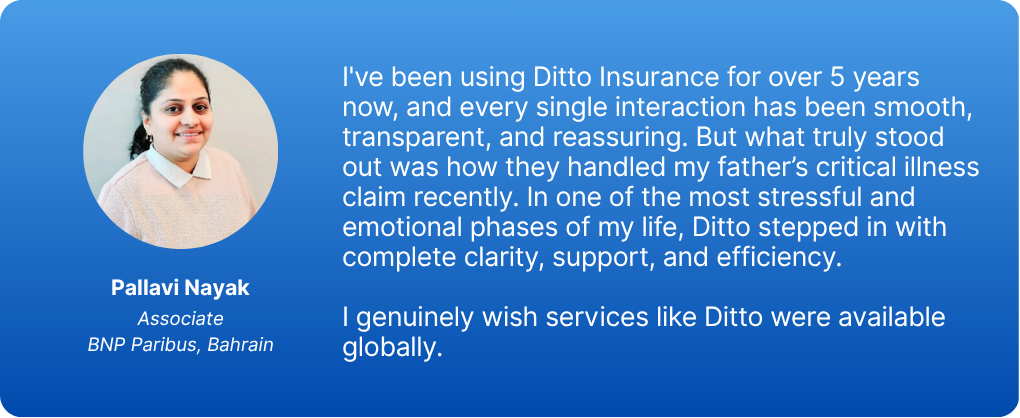
At Ditto, we’ve assisted over 8,00,000 customers with choosing the right insurance policy. Why customers like Pallavi below love us:
- No-Spam & No Salesmen
- Rated 4.9/5 on Google Reviews by 15,000+ happy customers
- Backed by Zerodha
- Dedicated Claim Support Team
- 100% Free Consultation
Confused about the right insurance? Speak to Ditto’s certified advisors for free, unbiased guidance. Book a free call or chat on WhatsApp with a Ditto advisor now.
Conclusion
When a TPA like HealthIndia is involved, the health insurance claim process becomes more layered than it needs to be. Instead of dealing directly with your insurer, your claim passes through an additional party. This often results in:
- Slower approvals because multiple teams need to review the same claim
- More paperwork and repeated document requests
- Delays caused by coordination between the hospital, the TPA, and the insurer
- Lower accountability, since the insurer isn’t handling the claim from start to finish
TPAs are generally appointed by insurers to manage and reduce claim costs. This can mean stricter checks, more queries, or guidance toward certain hospitals, even when the policy technically allows your claim.
At Ditto, we usually do not recommend TPAs for retail health insurance policies and prefer insurers that handle claims in-house.
When the insurer manages the claim directly, there’s no third party involved, fewer handovers, and clearer responsibility if something goes wrong.
Frequently Asked Questions
Last updated on: