


Quick Overview
India's armed forces are among the largest in the world, with over 14 lakh active personnel. Every year, nearly 60,000 of them retire, adding to a veteran population of approximately 35 lakh. Most rely on government schemes that don't fully cover the cost of private hospital treatment.
That’s exactly why health insurance for defence personnel matters, whether you’re actively serving or recently retired.
In this article, we’ll walk you through the government coverage, types of army health insurance, what’s covered and what isn’t, how claims work, and how to choose the right military health insurance plan.
Why Defence Personnel Need Health Insurance Beyond Government Schemes
Serving in the armed forces comes with risks such as long deployments, physical strain, and postings in extreme weather. But beyond the occupational side, there’s a more practical challenge: government medical facilities aren’t always close by, and service benefits have real coverage limits.
- For families stationed at home while a soldier is deployed, access to military hospitals is even more restricted.
- For retired veterans, the ECHS (Ex-Servicemen Contributory Health Scheme) provides some support, but it doesn’t always cover high-cost treatments at private hospitals or newer procedures.
- Defence personnel relocate very frequently, sometimes every two to three years. If your health plan is tied to one city or a small hospital network, you’re in trouble the moment you get transferred.
Private health insurance bridges these gaps by covering:
- Treatment at private hospitals outside military networks.
- Medical emergencies for dependents who aren’t near a service facility.
- Post-retirement healthcare when ECHS coverage runs thin.
- Coverage continuity after retirement, so you're not starting fresh on waiting periods at 55 or 60.
Types of Army and Military Health Insurance Plans Available
Government Schemes
- ECHS: For retired defence personnel and their dependents. Covers treatment at empaneled hospitals. Requires a one-time contribution during service.
- Service Medical Benefits: For active-duty personnel. Covers treatment at Military Hospitals. Dependents have limited access depending on the posting location.
- CGHS: Central Government Health Scheme is available to defence civilians and certain paramilitary employees in select cities.
Private Health Insurance Plans
- Most private insurers in India don’t ask about your occupation on the proposal form. Being in the armed forces does not affect your eligibility or your premium. You can buy any standard health plan, just like any other individual.
- Check out the best health insurance plans in India to see what suits you best.
Which Plan Type Works Best for You?
Still Actively Serving
Already Retired
Approaching Retirement
Family Members Not Near a Military Facility
Key Benefits and Coverage Offered
Important: As per IRDAI, private health insurance specifically excludes hospitalization caused by war, armed conflict, or injuries sustained in the line of duty. This is a standard exclusion across all private plans.
Eligibility, Documents, and Claim Process
Who Can Apply
- Active serving personnel (Army, Navy, Air Force, paramilitary forces like CRPF, BSF, CISF)
- Retired veterans and ex-servicemen
- Dependents and family members
Documents Typically Required
- KYC documents: Aadhaar, PAN
- Medical history declaration
- Nominee details
- Service ID or pension documents (only if asked by the insurer, which is rare)
Remember: You don’t need to disclose your profession unless specifically asked proactively. That said, don't assume occupation is irrelevant to underwriting. Always disclose exactly what the proposal form asks. If it asks for your profession, answer accurately. Non-disclosure at the time of buying can complicate claims later.
Cashless Claims
Get admitted to a network hospital, show your insurance card, and, in most cases, the insurer settles directly with the hospital.
Reimbursement Claims
Pay the bills yourself, collect all original documents and discharge summary, and submit with a claim form to your insurer.
How to Choose the Best Military Health Insurance Plan
Here’s a simple checklist:
- Know what your government scheme already covers. Identify the gaps before buying a private plan.
- Prioritize pan-India cashless coverage. Frequent postings make a wide hospital network essential.
- Check the claim settlement ratio. Look for an insurer with a 90% or higher ratio.
- Check the number of complaints. Fewer complaints relative to insurer size is a good sign.
- Look at the Gross Written Premium (GWP). A higher GWP generally means a larger, more established insurer.
- Pick an adequate sum insured. Given healthcare inflation, ₹15-25 lakhs is a reasonable starting range.
- Read the waiting periods. For the first 30 days, only accidents are covered; for the first 2 years, slow-growing conditions such as cataracts and hernias are usually not covered. Pre-existing conditions often have waiting periods of 2-3 years.
Why Choose Ditto for Health Insurance?
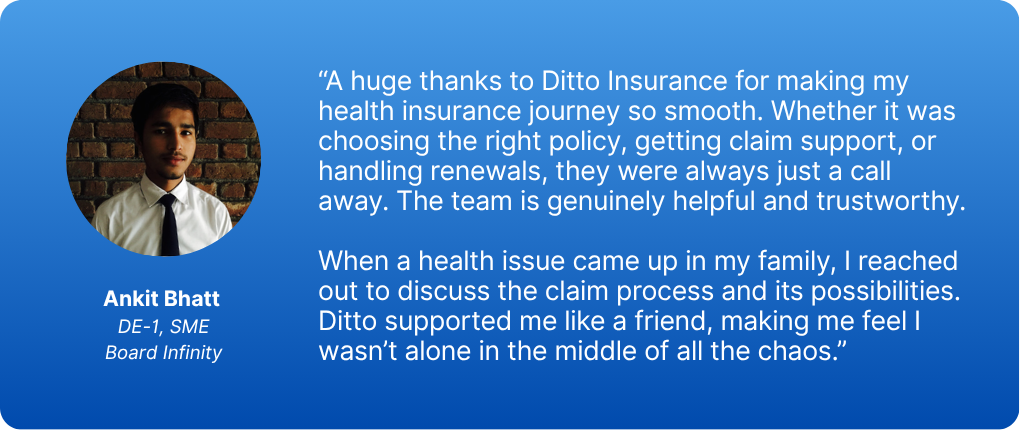
At Ditto, we’ve assisted over 8,00,000 customers with choosing the right insurance policy. Why customers like Ankit below love us:
- No-Spam & No Salesmen
- Rated 4.9/5 on Google Reviews by 15,000+ happy customers
- Backed by Zerodha
- Dedicated Claim Support Team
- 100% Free Consultation
Confused about the right insurance? Speak to Ditto’s certified advisors for free, unbiased guidance. Book your call or chat on WhatsApp with us now!
Ditto’s Take
If you’re in the defence forces, you already have a baseline of healthcare support through government schemes. That’s a good starting point. But it has gaps that can get expensive.
The good news? You can easily buy private health insurance. Your occupation doesn’t typically affect how the insurer treats your application. Hence, make sure to get a private plan or a super top-up policy to cover the difference. Remember to focus on pan-India cashless access since you move around a lot.
Disclaimer
Frequently Asked Questions
Last updated on: