



Introduction
According to the National Cancer Registry Programme's Cancer Incidence Estimates for 2022, India's cancer cases are projected to rise to about 15.7 lakh in 2025, and one in nine Indians is likely to develop cancer at some point in their life.
So if you are a cancer survivor searching for the right health insurance, you are not alone.
But the problem is that most insurers treat cancer history as high risk because of the potential for costly and frequent future claims. This can mean longer waiting periods, higher premiums, stricter medical underwriting, permanent exclusions, or even outright rejection in some cases. That does not mean survivors have no options.
This is where Ditto helps. Our advisors explain your options based on your cancer type, stage, remission period, and treatment history. We also help you read the fine print before you buy, so you know exactly what is covered and what is not.
This guide breaks down what health insurance for cancer survivors covers, what it can cost, and which plans are worth considering. We also discuss how Ditto helps you find the best health insurance for cancer survivors in India.
Common Questions Cancer Survivors Ask
What Is Health Insurance for Cancer Survivors?
Health insurance for cancer survivors is specialized coverage that helps pay for any potential hospitalization if the cancer comes back. Since existing cancer counts as a Pre-Existing Disease (PED), you must disclose your full medical history when you apply for a health insurance policy.
Insurers assess your risk through underwriting (an assessment of your health risks). They may approve your application with a higher premium, called loading charges, or add a waiting period of up to 3 years before cancer-related claims are paid. In some cases, the insurer may permanently exclude cancer-related claims.
Standard plans often require 3-5 years in remission just to consider your application in the first place, not to guarantee approval. Until then, options like Arogya Sanjeevani or a dedicated cancer plan such as Star Health Cancer Care Platinum may be worth exploring, though acceptance into any of these still depends on underwriting.
Can a Cancer Survivor Buy Health Insurance in India?
Yes, a cancer survivor can buy health insurance in India, though it takes more effort. Insurers treat cancer as a high-risk PED, so approval depends heavily on how long you have been cancer-free. Insurers usually look at two things:
- Remission Period: If you are within 2 years of finishing treatment, most standard health plans will decline your application outright. The risk is still considered too fresh to issue a policy. Cross the 3 to 5 year mark with good follow-up reports, and your odds improve a lot.
- Loading and Waiting Period: If you are accepted into a standard plan, expect premium loading of roughly 25% to 50% above normal rates. A waiting period of 1-3 years for cancer-specific claims usually applies on top of that.
Ditto’s Advice: Whichever route you choose, be ready to share your full medical history, including your cancer stage and grade, treatment dates, and your most recent clearance letter from your oncologist. Non-disclosure is one of the most common reasons for claim rejection.
Which Cancer Survivors Are Most Likely to Be Approved?
Cancer survivors most likely to get approved are those with early-stage cancers, like Stage 1 thyroid or prostate cancer, who have been in remission for 3 to 5 years or more. Insurers also favor those with clear follow-up records and no ongoing complications.
Underwriting is not random. It follows a fairly predictable pattern based on a few key factors.
- The stage and type of cancer at diagnosis matter most, along with whether treatment is complete. Insurers also weigh your years in remission, since more follow-ups mean better terms, and any recurrence resets that clock.
- Age and other health conditions, such as diabetes or heart disease, are also added to the assessment. As a general trend, childhood cancer survivors with a decade of clean records tend to get the most favorable terms as compared to those with a recent diagnosis as an adult.
Please Note: These are tendencies, not fixed rules. Two insurers can look at the same file and reach completely different decisions. Based on our experience, it is always better to apply after the remission period is completed to increase the chances of acceptance.
What Is the Best Health Insurance Plan for Cancer Survivors?
There is no single best cancer insurance plan in India, since so much depends on your specific diagnosis, how long ago you finished treatment, and whether you have had a recurrence.
If you already have a diagnosed cancer history, you may need to look at niche, cancer-focused plans built to accept applicants that comprehensive insurers might otherwise decline.
Ditto's Advice: Before choosing, look closely at the copayment clauses, disease-wise sub-limits, and room rent caps on each of these plans. A lower premium or an easier approval often comes with one or all of these trade-offs built in, and they can affect how much you actually receive at claim time.
What Pre-Existing Disease Waiting Period Applies to Past Cancer?
For a past cancer diagnosis, insurers may apply a PED waiting period of up to 3 years (36 months) under current IRDAI rules. During this time, cancer-related treatments and recurrences are not covered. This waiting time starts from the day your policy is issued.
Depending on your medical profile, an insurer might decline your application outright, accept you with a waiting period, or reconsider you after a few more years in remission. Sometimes cancer and related conditions can also be permanently excluded rather than just delayed.
Pro Tip: Whatever happens, always disclose your full medical history. Hiding a past diagnosis is far riskier than any waiting period, since it can cost you the entire claim later, even after paying hefty premiums throughout the policy lifetime.
What Cancer Treatments and Procedures Does Health Insurance Cover?
Health insurance covers essential cancer treatments like hospitalization expenses (room rent, ICU), chemotherapy and radiotherapy, and diagnostic tests (biopsies, PET scans). It also covers surgery costs and certain day care treatments that do not require an overnight stay. Comprehensive plans cover a broader list of expenses, but for cancer survivors looking to buy a new plan now, the options are fairly limited.
Diagnosis and Testing
Core Cancer Treatments
Hospitalization and Day Care
Recovery and Supportive Care
What Is Usually Excluded?
It is important to know what your insurance will not cover unless it is specifically added to the plan.
- Pre-Existing Conditions: If you already had cancer before buying the policy, it will not be covered until a specific waiting period passes, usually 2-3 years.
- Experimental Treatments: Treatments that are not proven or approved by medical authorities.
- Cosmetic or Plastic Surgery: Surgeries done purely to change your appearance are not covered. The exception is reconstruction needed after an accident, burns, or cancer, or if a doctor certifies it as medically necessary to remove an immediate health risk.
- Non-Medical Expenses: Travel costs to the hospital or other non-medical expenses are not covered by the plans unless they are covered by default or through an add-on.
How Many Years in Remission Do Insurers Want Before Approving?
Insurers typically require 2 to 5 years of complete remission before approving a policy following a cancer diagnosis. Early-stage cancers may need just two to three years, while advanced cases may need 5-10 years.
The exact timeline shifts based on cancer stage and type, your age, and how you were treated. Surgery alone is often viewed more favorably than chemotherapy or radiation.
What If You Develop Cancer After Buying Health Insurance?
How Does Cancer History Affect Your Health Insurance Premium?
A history of cancer usually raises your health insurance premium, since insurers view it as a condition with a higher chance of future medical costs.
Your exact premium depends on how long you have been in remission, with most insurers requiring 2 to 5 clean years. It also depends on the cancer's type and stage, since early-stage cases cost less to insure than advanced ones.
Some basic plans exclude cancer treatment altogether. Others allow coverage with a copayment, meaning you pay a share of every cancer-related bill yourself. Some insurers may apply loading charges between 10% and 50% (up to 100-150%), depending on the product and the insurer's underwriting. However, insurers usually decline/postpone rather than apply a very high loading.
What Happens if You Don't Disclose a Past Cancer Diagnosis While Buying Health Insurance?
Hiding a past cancer diagnosis is genuinely risky. If the insurer finds out later, they can reject your claim, cancel your policy, and keep every premium you have already paid. Health insurance operates on the principle of utmost good faith, which means you are legally required to be honest. Breaking that trust breaks the contract too.
Insurers usually dig into your history only when you file an expensive claim, which is exactly when you need the payout most. That is the worst possible time to discover a hidden gap in coverage.
A common myth is that the moratorium period protects you no matter what you hid. It does not work that way. Once 60 months of continuous coverage are complete, insurers can no longer contest a policy or claim on the basis of honest non-disclosure or misrepresentation, but established fraud and permanent exclusions remain valid grounds for rejection even after that.
If you just bought your policy, use the free-look period, now extended to 30 days, to correct any missed details without penalty. Beyond that, always declare your full history upfront, even if it costs you a loading or a waiting period.
Are Dedicated Cancer Insurance Plans Better Than a Regular Health Plan for Survivors?
For everyday healthcare, a regular health plan usually serves survivors better. A dedicated cancer insurance plan works best as extra, supplemental cover rather than your only policy.
Regular health insurance pays the hospital directly and covers a broad range of illnesses, surgeries, and routine visits. As a survivor, though, expect longer waiting periods, often 2-3 years, and higher premiums.
Dedicated cancer plans instead pay you a lump sum the moment you are diagnosed, which you can use for rent, food, or lost income while you recover. Many even waive future premiums after a severe diagnosis.
The catch is that most dedicated cancer plans are built for people who are still healthy. If you already have cancer, insurers usually decline you or permanently exclude it from a fresh cancer-specific policy.
Neither option replaces the other. A regular health plan is your foundation, and a cancer-specific plan is a useful add-on if you can get one before any future diagnosis.
How Does Ditto Help Cancer Survivors Find the Right Health Insurance?
Underwriting for cancer survivors is genuinely restrictive in India, and getting it wrong can mean a claim being rejected months or years down the line, exactly when you need the money most.
This is where Ditto's advisors step in. Our IRDAI-certified team works directly with you to understand your specific diagnosis, treatment history, and follow-up record, and then matches you against insurers whose current appetite fits your profile.
We help you navigate underwriting practices that vary widely among insurers, ensure your medical disclosures are precise and complete so a future claim doesn't get rejected over a technicality, and explain which waiting-period reductions genuinely help and which look good on paper but offer little real benefit.
If a comprehensive plan isn't realistic for your situation, we'll walk you through specialized cancer-focused and other fallback options instead of leaving you to figure it out on your own.
For policies purchased through Ditto, support does not end after purchase. Ditto also provides claims assistance and follows up with the insurer if your family needs help during the claim process, at no extra cost.
Ditto's Unique Insights on Health Insurance for Cancer Survivors
Here are a few things we've learned from helping cancer survivors through this process that aren't always obvious from a policy brochure.
- Apply for Less First: If you're facing rejections, applying for a large sum insured upfront often increases your chances of decline. Starting with a smaller base cover and building up over time as your remission record grows can be a more realistic path to getting approved. Having some coverage is better than having no coverage at all.
- Accept a Few Trade-Offs: Agreeing to a copayment clause, room rent limits, disease-wise sub-limits or a longer waiting period, where you bear a share of each claim or wait longer for cancer-related cover, can make an insurer more comfortable accepting your application, since it reduces their exposure.
- Approval Beats Extra Features: Don't over-prioritize restoration or lump-sum payout riders. A feature-rich plan sounds great, but a basic plan that actually gets approved protects you far more than one you can't qualify for.
- Ask How Each Insurer Actually Underwrites: Different insurers weigh cancer history differently, and appetites shift over time. An experienced health insurance advisor, like Ditto, can review your case and present it effectively to the insurer's underwriting team. This helps determine if they are open to considering your application through a pre-approval or official login process.
- Keep Your Health Records Organized: Consistent follow-ups, clean scans, and a clear oncologist's clearance genuinely help during future underwriting, whether that's adding a rider, porting to a new insurer, or increasing your cover down the line.
- Know Your Realistic Options Upfront: Fresh cancer-specific critical illness plans are largely closed to you once you have a diagnosis, and a truly comprehensive plan may not be realistic right away. Knowing this upfront helps you apply to the right products rather than chasing options that were never available in the first place.
Your biggest deciding factor is time in remission, not the specific plan you pick. If a comprehensive plan isn't realistic right now, employer- or bank-provided group health cover usually waives pre-existing disease waiting periods from day one, and government schemes like PM-JAY can cover eligible lower-income families regardless of history.
Why Choose Ditto for Health Insurance?
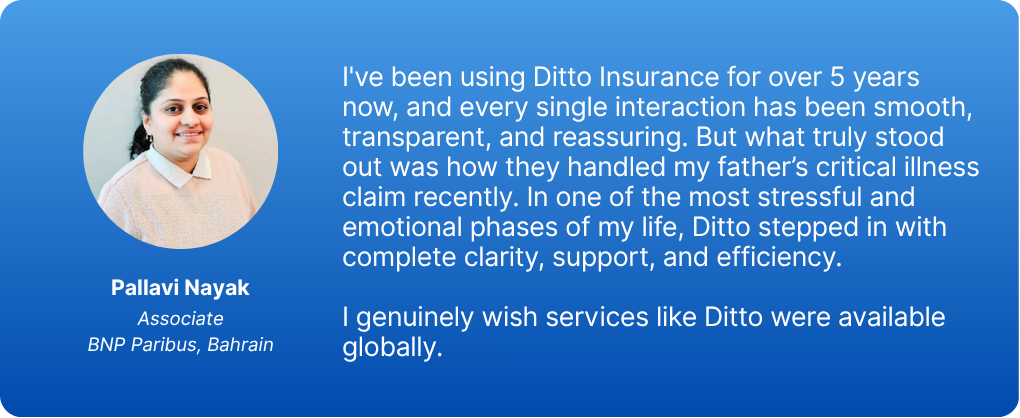
At Ditto, we’ve assisted over 8,00,000 customers with choosing the right insurance policy. Why customers like Pallavi below love us:
- No-Spam & No Salesmen
- Rated 4.9/5 on Google Reviews by 25,000+ happy customers
- Backed by Zerodha
- Dedicated Claim Support Team
- 100% Free Consultation
Confused about the right insurance? Speak to Ditto’s certified advisors for free, unbiased guidance. Book your call now or chat with our advisors on WhatsApp.
Conclusion
Getting covered after a cancer diagnosis simply demands more patience than a routine policy search, but it can be done. Which route makes sense depends entirely on where you currently stand.
If you have no history of cancer yet, buy a comprehensive cover now and stay mindful about how you disclose things later, since that habit matters more than any single feature. You can check our guide on the best health insurance plans in India. If you are already a survivor, look toward cancer-focused products, declare your full history without shortcuts, and be willing to start with a modest plan that actually says yes rather than holding out for an ideal one that may never come through.
If nothing strong is within reach just yet, that isn't the final outcome. Underwriting standards across Indian insurers keep shifting, and better offers can open up as your remission record grows and insurers reassess their risk appetite.
Last updated on: