



Quick Overview
Switching your health insurer feels appealing at first, especially when a new plan promises better coverage at a lower price. But porting your health insurance is more complicated than it sounds.
The disadvantages of health insurance portability are real: your medical history gets re-evaluated, which can lead to higher premiums or rejection of your application.
In this article, we walk you through what portability of health insurance is, its disadvantages, key benefits, and the IRDAI rules for porting in India.
What Is Health Insurance Portability?
Health insurance portability is an option that allows you to transfer your existing health insurance policy from one insurer to another at renewal. The core promise of portability is that you can carry forward the waiting-period credits you have already served.
Let’s say you are with Insurer A and have already completed two years of your pre-existing disease (PED) waiting period. If you port to Insurer B, the new insurer must give you credit for those two years.
Think of it as porting your SIM card: you switch providers and keep the same number.
IRDAI introduced this right to portability in 2011 to encourage competition and protect policyholders from being stuck with poor service. But as you will see below, the right to port and the reality of porting are two different things.
Disadvantages of Health Insurance Portability
1) Re-evaluation of Medical History
When you port, the new insurer treats you like a new customer for underwriting purposes. They will review every claim you have made, every condition you have disclosed, and your current health profile.
If someone’s health has changed since they first bought the policy, for example, they developed diabetes, the new insurer may apply loading charges, add fresh waiting periods, or new exclusions.
2) Bonus Does Not Transfer
Many policyholders assume their no-claim bonus (NCB) follows them when they port. However, the actual bonus accumulated with your old insurer does not transfer as an extra sum insured.
Let’s say you have a ₹10 lakh policy currently with a ₹5 lakh bonus. If you port for an increased base sum insured (SI) of ₹15 lakh, you carry forward the waiting periods for the entire ₹15 lakh. But if you were to port only for ₹10 lakh, the bonus amount does not carry forward.
3) Time Sensitive Process
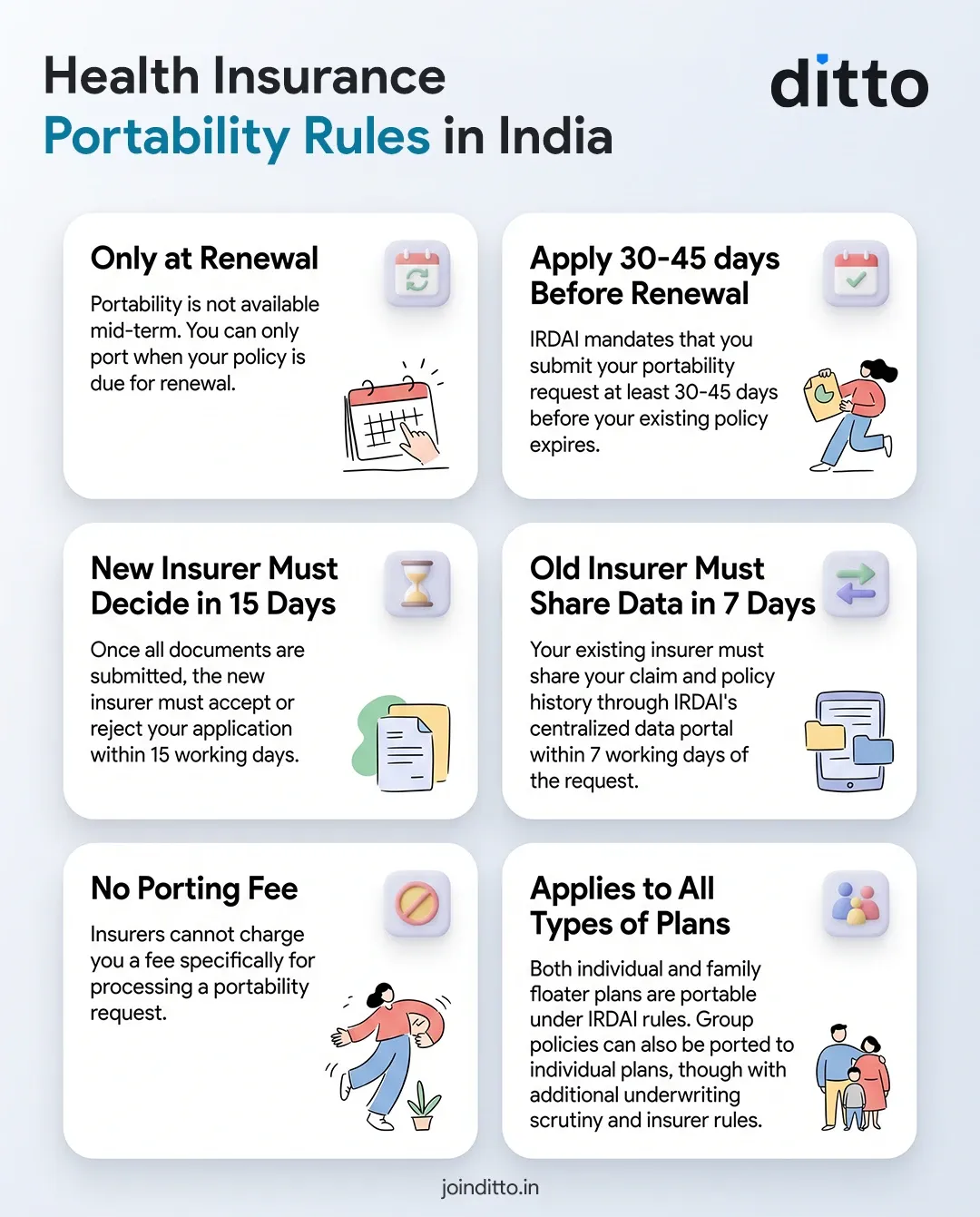
As per the health insurance portability rules in India, you should submit your porting request at least 30-45 days before your renewal date, though insurers may accept it up to the last date itself. If you miss this window, you cannot port that year. On top of that, porting is a time-consuming and documentation-heavy process, and any delays can push the entire timeline past your renewal date.
4) Chances of Rejection with New Insurer
Porting is your right in theory, but it is not always guaranteed in practice. The new insurer has full authority to reject your application after reviewing your medical history. Worse, if the rejection happens close to or after your renewal date, you could face a coverage gap.
5) Higher Premiums than Expected
The quote you see initially and the premium after underwriting can be very different numbers. Insurers may apply loading charges based on your age, health history, and risk profile. Many applicants go through the whole porting process, and then receive a premium so high that the switch makes no financial sense.
6) Difficulty in Increasing Sum Insured
If you want to port and also increase your sum insured, that additional coverage is subject to fresh waiting periods. So, if you are moving from a ₹15 lakh plan to a ₹20 lakh plan, the extra ₹5 lakh will come with fresh waiting periods.
7) Claim Rejection Due to Non-disclosure
The new insurer evaluates your application freshly. Anything you do not disclose will not be covered. For example, if a policyholder had a claim for heart disease with their old insurer but ported to a new insurer without disclosing this condition, any related claim may be rejected. So, any condition that existed but was not properly declared becomes grounds for claim rejection, even if it was covered under your old policy.
8) Porting Is Discouraged in Practice
Insurers are not strongly incentivized to support porting. A customer who ports their policy is often older, more likely to raise claims, and has a clearer medical history than a first-time buyer. Because of this, insurers may see them as less attractive.
As a result, some customers run into issues such as slow underwriting, rejections, or mandatory add-ons that may be unnecessary, making the switch feel like it's not worth it.
Talk to an expert
today and
find
the right
insurance for you.


Key Benefits of Porting Your Health Insurance
The disadvantages are real, but to give you the full picture, here are some of the benefits of porting your health insurance.
Waiting Period and Moratorium Credit
Access to Better Plans
Escape Poor Service
No Coverage Gap
Health Insurance Portability Rules in India
Here is a quick summary of the key health insurance portability rules by IRDAI that you need to know.
Why Choose Ditto for Health Insurance?
At Ditto, we’ve assisted over 8,00,000 customers with choosing the right insurance policy. Why customers like Abhinav below love us:
- No-Spam & No Salesmen
- Rated 4.9/5 on Google Reviews by 15,000+ happy customers
- Backed by Zerodha
- Dedicated Claim Support Team
- 100% Free Consultation
Speak to Ditto’s certified advisors for free, unbiased guidance. Book your call or chat on WhatsApp with us now!
Ditto's Take on the Disadvantages of Health Insurance Portability
At Ditto, we advise most customers to stay with their existing insurer rather than porting to a new one. Around 7 out of 10 people who come to us considering a switch are better off staying where they are if:
- They have been with the old insurer for 3 or more years
- Their health profile is not perfectly clean, or new ailments have been diagnosed
- They are expected to undergo a treatment soon
- They are already with a reasonably good insurer
The important thing to remember is that you are not carrying forward your relationship. You are only carrying forward the waiting period clock. Do not trade the loyalty you have built for a slightly better-looking plan because, in most cases, the disadvantages outweigh the benefits.
Frequently Asked Questions
Last updated on: