



Quick Review
When you rely on insurance to protect yourself or your family, sticking with an unreliable insurer isn’t really an option. This is where health insurance portability becomes relevant. It allows you to switch to a different insurer while retaining the benefits you’ve already earned, instead of starting over.
In this guide, we break down how health insurance porting works, outline when it makes sense and when it doesn’t, and highlight critical points you must be aware of before making the decision.
Health Insurance Portability Rules
Below are the general IRDAI guidelines for porting health insurance, as of 2026:
For a full breakdown of timelines, eligibility, and rights, you can read our detailed article on health insurance portability rules by IRDAI.
Documents Required for Health Insurance Portability
- Duly filled proposal form and health insurance portability form from the new insurer
- Current policy document, latest renewal notice, and past 2–3 years’ policy copies for continuity proof
- Endorsement letters (for added members, for new medical condition disclosure, sum insured enhancement, or other policy changes)
- Records of any claims made (or a 'No Claim Declaration', if asked)
- Medical reports, prescriptions and clear declarations of all medical history to the best of your knowledge
- Valid ID and address proof such as Aadhaar and PAN
Note: Additional documents may be requested by the insurer depending on age, medical history, or underwriting requirements.
Process for Health Insurance Portability
- A policyholder who wishes to port health insurance must apply to the new (acquiring) insurer along with all covered family members, if applicable.
- The request should be submitted at least 30 days before the policy renewal date, but not earlier than 60 days prior to renewal. However, insurers may also consider requests made up to 15 days before the renewal date, provided the acquiring insurer ensures there is no break in coverage during the process of porting health insurance.
- The acquiring insurer provides the policyholder with a portability form, authorizing the transfer of policy and claim-related information from the existing insurer. The policyholder must complete this portability form along with the proposal form and submit both documents to the acquiring insurer to initiate health insurance portability.
- Once the portability form is received, the acquiring insurer requests policy details and past claim information from the current insurer through the Insurance Information Bureau of India (IIB) portal. The existing insurer is required to share the requested data within 72 hours of receiving the request.
- On receiving data, the new insurer must underwrite and communicate acceptance/rejection within 15 days. If a decision is not communicated, the proposal must be accepted automatically.
- If your porting health insurance request is approved, the new policy will count your coverage as continuous from the date you first bought your health insurance, so all benefits you’ve earned (like waiting period credits or no-claim bonuses) are retained. The new policy is issued with a start date matching the end date of your current policy, ensuring uninterrupted coverage. Hence, it’s advisable to keep complete records of past policies and claim histories, whether or not you port your policy.
Health Insurance Portability for Different Policy Types
When Should You Opt for Health Insurance Portability?
Poor Claims Servicing & Cashless Hospital Network
Inadequate Coverage or Unfavourable Policy Terms
Inadequate Coverage or High Premium
Changes in Health Needs or Family Size
When Should You Not Port Health Insurance
1) Satisfied with Current Insurer’s Claims and Service
If claims and service have been smooth, porting offers limited value. Avoid switching insurers solely for marginal feature upgrades, cheaper premiums, or minor discounts, as insurers generally treat long-term premium-paying customers more favorably during claims.
In such cases, policy migration within the same insurer can be a better way to enhance benefits while retaining continuity.
2) Close to or Past the 5-Year Moratorium Period
If you are in your 4th or 5th policy year, porting does not reset the moratorium, but the new insurer will still underwrite afresh. Holding a policy for a long time builds loyalty and a strong track record, reducing the risk of claim rejection.
Any gaps or inaccuracies in past disclosures can still cause scrutiny. So if your history is clean and service is satisfactory, continuing with the same insurer often minimizes unnecessary risk.
3) Diagnosed with a Critical Illness
If you have been diagnosed with serious conditions such as cancer, heart disease, or kidney failure, porting health insurance is risky. New insurers often reject high-risk profiles or impose strict exclusions during underwriting.
4) Senior Citizen with Limited Options
For individuals typically above 65 years of age, health insurance portability may involve stricter underwriting, higher premiums, co-payments, and fewer plan choices, making continuity with the existing insurer more practical.
5) Multiple Pre-Existing Diseases or Complex Medical History
If you have multiple PEDs or a complicated health history, porting health insurance may lead to loadings, permanent exclusions, or proposal rejection by the new insurer.
6) Upcoming Hospitalization or Planned Treatment
If you are expecting hospitalization or have a scheduled medical procedure, attempting to port my health insurance can backfire. The new insurer may decline the portability request or exclude coverage for the planned treatment.

Common Mistakes to Avoid While Porting Health Insurance
Assuming Approval Is Guaranteed
Porting is not guaranteed and requires the new insurer’s approval. The new insurer does fresh underwriting based on your age, medical history, disclosures, and past claims afresh, and may apply exclusions, charge a higher premium, or reject the proposal.
Not Disclosing Your Medical History Fully
Insurers check disclosures more strictly during porting. Missing even small past illnesses or consultations can lead to claim problems later. Always disclose your medical history completely and honestly.
Ignoring Policy Terms Behind Similar Plan Names
Plans with similar names can have very different coverage rules, exclusions, room rent limits, and co-pay clauses. Do not compare policies only by sum insured, read the fine print carefully.
Believing the Higher Sum Insured Gets Full Benefits
Only your existing cover carries waiting period benefits. Any increase in sum insured is treated as new coverage and may come with fresh waiting periods or exclusions.
Poor Timing or Unnecessary Porting
Applying late, submitting incomplete documents, or porting frequently can cause delays or loss of continuity. If your current policy works well, especially for senior citizens, staying put may be the safer choice.
Why Approach Ditto for Health Insurance?
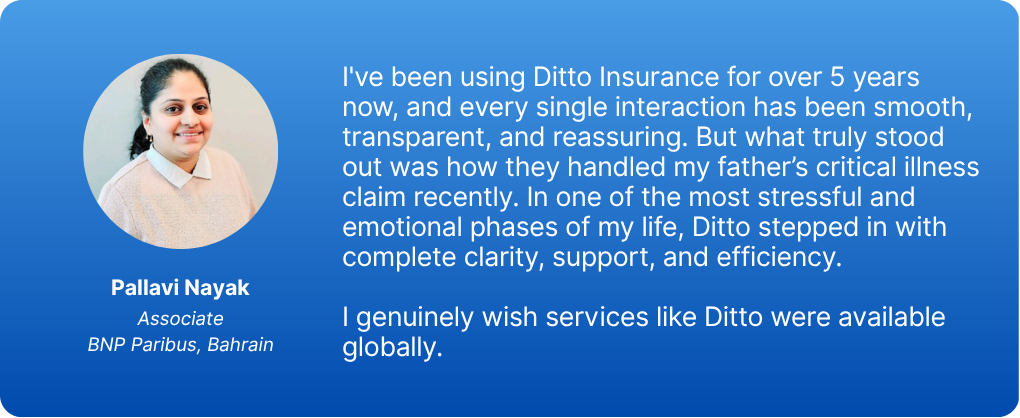
At Ditto, we’ve assisted over 8,00,000 customers with choosing the right insurance policy. Why customers like Pallavi below love us:
- No-Spam & No Salesmen
- Rated 4.9/5 on Google Reviews by 15,000+ happy customers
- Backed by Zerodha
- Dedicated Claim Support Team
- 100% Free Consultation
Confused about the right insurance? Speak to Ditto’s certified advisors for free, unbiased guidance. Book your call now, slots fill up fast!
Conclusion
Health insurance porting works best when you plan it carefully and execute it step by step. Start by selecting the right new plan, submit all required documents at once, and keep your existing policy active until the new policy is issued with the same start date.
Apply for health insurance porting within the correct pre-renewal window so the new insurer has enough time to collect data, complete underwriting, and arrange medical tests if needed, without creating a coverage gap. Before making payment, review the policy schedule carefully to confirm that all continuity benefits are correctly carried forward from day one.
In practice, we find that nearly 7–8 out of 10 policyholders seeking a review are better served by continuing with their existing insurer when the policy is comprehensive and has been renewed consistently for 3–4 years or more, rather than porting unnecessarily.
Frequently Asked Questions
Last updated on: