



Overview
Most insurance products require proof of actual loss and verification of expenses before any claim is settled. However, there is a different type of insurance that pays a pre-agreed amount as soon as a defined trigger event crosses a set threshold. This is known as parametric insurance.
The concept may seem technical at first, but the idea is simple and increasingly relevant for people and businesses exposed to weather and climate risks. It is an innovative insurance model that is changing how financial protection works in fast-moving and unpredictable environments.
Parametric Insurance Meaning: How Does It Work?
The simplest way to understand parametric insurance is that it does not compensate for actual loss or damage. Instead, it provides a fixed payout when a predefined event or measurable trigger (called a parameter or index) occurs.
For example, when rainfall in a region falls below the set threshold of 50 mm during the monsoon season, the policy automatically releases the agreed payout. The policyholder does not need to submit proof of crop damage or calculate the total financial loss, as the payment is based entirely on the recorded weather data.
How Does Parametric Insurance Work?
Parametric insurance works on clearly defined parameters that can be measured and verified through trusted data sources such as weather stations, satellite data, and official agencies like the India Meteorological Department.
Key Components
- Trigger Event: This is a clearly defined and measurable event agreed upon at the time of purchase. It can include rainfall levels, cyclone wind speeds, earthquake magnitudes, temperature levels, or any other parameter monitored by a reliable, verified data source.
- Threshold Level: The specific point at which the trigger activates the policy. For example, rainfall dropping below a set level or wind speed crossing a defined limit. It ensures that payouts are linked to the severity of the event.
- Payout Structure: Once the threshold is crossed, the policy pays the pre-agreed amount. The payout does not depend on actual damage and may follow a fixed or graded structure based on event severity. In a fixed structure, the policy pays a set amount once the trigger is met, while in a graded structure, the payout increases as the severity of the event rises. This ensures fast, clear, and hassle-free settlement without any loss assessment.
Traditional Indemnity vs Parametric Insurance
Common Parametric Insurance Products and Examples
- Moisture Index-Based Crop Insurance in Rajasthan: Go Digit paid one of India's first moisture index-based parametric claims to approximately 500 farmers from 30 villages in Rajasthan's Tonk district. The payout was released the moment soil moisture data crossed the pre-agreed Water Balance Index threshold. No loss assessment was required.
- Weather-Based Crop Insurance Under RWBCIS: India’s Restructured Weather-Based Crop Insurance Scheme (RWBCIS) is the largest parametric crop program. It uses weather triggers like rainfall, temperature, and humidity across many states and crops. Payouts depend on deviations recorded at nearby Automatic Weather Stations (AWS), with premiums subsidized for small farmers. However, low station density creates basis risk, as farmers far from stations may face losses without payouts if recorded data does not reflect local conditions.
- State-Level Rainfall Trigger Plan in Nagaland: Another parametric insurance example comes from Nagaland, which launched India’s first state-level parametric scheme, the Disaster Risk Transfer Parametric Insurance Solution (DRTPS), in partnership with SBI General Insurance. The plan triggers payouts when cumulative monsoon rainfall crosses defined thresholds between 1,500 mm and 2,200 mm from June to October. In March 2025, it released over ₹1 crore based on 2024 rainfall data to support the state government’s disaster response and recovery efforts, without any field visits or loss assessment.
- Catastrophe Risk Pool Model in the Caribbean: A global parametric insurance example comes from the Caribbean Catastrophe Risk Insurance Facility. Governments there receive automatic payouts when a hurricane’s modeled parameters, such as wind speed, storm track, and intensity, cross a pre-agreed threshold calculated by an independent catastrophe model. This ensures emergency funds are released quickly, even before full damage assessments are completed.
Talk to an expert
today and
find
the right
insurance for you.


The Future of Parametric Insurance in India
Parametric insurance in India is still in an early phase, but the direction is clear. New India Assurance has received IRDAI approval to launch parametric insurance products for farmers under the "use and file" category. These products cover excessive rainfall and flooding, high-velocity winds, and drought.
The National Disaster Management Authority (NDMA) has also explored parametric insurance in India to protect heat-vulnerable outdoor workers during extreme summer events. This reflects strong government interest in the model beyond just agriculture.
The regulatory environment in India is also shifting in favor of parametric products. IRDAI’s approach has evolved significantly in recent years:
- Regulatory Sandbox Framework: The IRDAI Regulatory Sandbox was initially introduced on July 26, 2019, to allow InsurTech and insurance companies to test new products (such as parametric and usage-based models) on a limited scale before receiving full market approval. Recently, the framework was expanded and notified under the IRDAI (Regulatory Sandbox) Regulations, 2025 (notified on January 3, 2025). This update shifted the framework to a more principle-based structure and introduced provisions for an inter-regulatory sandbox cutting across different financial sectors.
- IRDAI Insurance Products Regulations 2024: In the IRDAI Insurance Products Regulations, 2024, insurers are allowed to design innovative and flexible insurance products using a principle-based approach. The regulations recognize index-linked products, where policy benefits can be tied to publicly available data or measurable indices. This creates a clearer regulatory foundation for data-driven and trigger-based models, such as parametric-style insurance, by reducing earlier ambiguity around how such products can be structured and approved.
- Bima Vistaar Initiative: Bima Vistaar is a proposed all-in-one insurance product designed to provide simple and affordable coverage for rural households, combining life, health, accident, and property risks. It is not yet available. As per reports, the property component may use predefined parameters for payouts instead of detailed loss assessment, indicating limited use of parametric-style features within the overall product.
India has a growing base of agrometeorological data, built mainly by the India Meteorological Department and the Indian Space Research Organization's satellite programs. This data infrastructure already supports schemes such as the Pradhan Mantri Fasal Bima Yojana (PMFBY) and can enable future parametric models across the country.
Together, these changes show that parametric insurance in India is moving from a niche concept toward wider adoption.
Why Is Parametric Insurance Becoming More Important?
Climate change is increasing the frequency and severity of extreme weather events across India, from erratic monsoons and prolonged droughts to cyclones and heat waves. Traditional insurance struggles to keep pace because it depends on physical loss assessments that take weeks or months to complete. Parametric insurance bridges this gap by releasing payouts the moment a verified trigger is met. This gives farmers, businesses, and governments access to funds when they need them most.
Why Choose Ditto for Your Insurance?
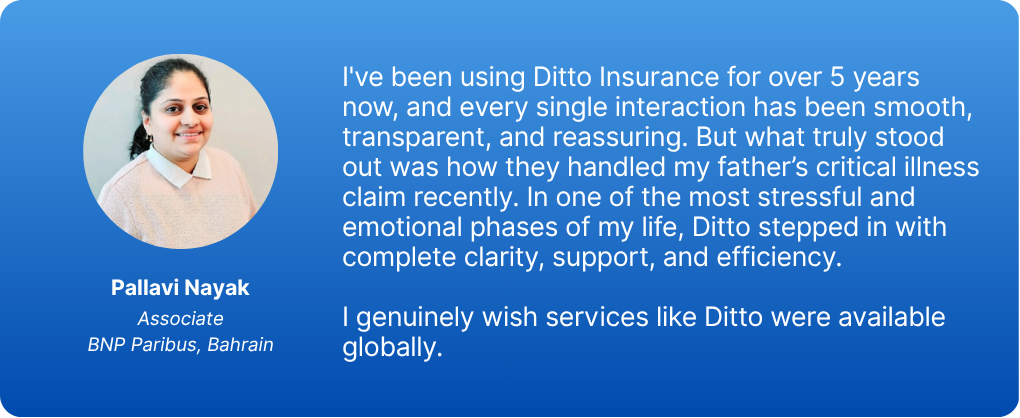
At Ditto, we’ve assisted over 8,00,000 customers with choosing the right insurance policy. Why customers like Pallavi below love us:
- No-Spam & No Salesmen
- Rated 4.9/5 on Google Reviews by 15,000+ happy customers
- Backed by Zerodha
- Dedicated Claim Support Team
- 100% Free Consultation
Confused about the right insurance? Speak to Ditto’s certified advisors for free, unbiased guidance. Book your call or chat on WhatsApp now!
Conclusion
Parametric insurance offers a fast and practical solution for individuals and businesses exposed to unpredictable climate and weather risks. It provides transparent, pre-agreed payouts without the delays, disputes, or lengthy assessments common in traditional insurance claims. As climate volatility increases in India, its relevance continues to grow.
However, it is not a complete replacement for traditional insurance. Payouts may not always match actual losses, and it does not cover all types of risks, such as property damage, liability, or health emergencies. There are also practical limitations in India today. Most parametric insurance products are still very new or offered through government programs and business partnerships. Even for individuals, it is still difficult to buy these products directly. Standalone options for risks like floods or cyclones are not yet widely available in the retail market.
The most effective approach is to use parametric insurance as an additional layer alongside health, term, and property insurance to build broader, more balanced financial protection.
Frequently Asked Questions
Last updated on: