



Quick Overview
If you have held your insurance policy for years, you may wonder: Is claim settlement guaranteed once the moratorium period is over?
In both health and life insurance, the moratorium period is meant to protect long-term policyholders from late-claim disputes, especially those linked to old non-disclosures. But while this protection is strong, it is not absolute.
In this guide, we explain what the moratorium period means, how it works, and what it really means for your claim.
What Is Moratorium Period?
The moratorium period is a defined timeframe after which an insurer can no longer question your policy based on past non-disclosures or misstatements.
In simple terms, it acts as a cutoff, limiting how far back insurers can go to review your original proposal form. After this period, claims cannot be denied on disclosure grounds, except in cases of fraud or permanent exclusions.
Moratorium Period in Health Insurance
The moratorium period in health insurance is five years of continuous, uninterrupted coverage, after which an insurer cannot contest claims on the grounds of non-disclosure or misrepresentation. This includes cases where pre-existing conditions or medical history were not disclosed at the time of purchase.
However, this does not apply in cases of proven fraud or permanent exclusions.
Did You Know?
Moratorium Period in Term or Life Insurance
For term and life insurance, the concept is governed by Section 45 of the Insurance Act, 1938. The 3-year moratorium period is counted from the latest of the policy issuance date, the commencement of risk, the policy's revival, or the addition of a rider.
After these 3 years, a life insurance claim cannot be rejected for non-disclosure or misrepresentation unless the insurer can conclusively prove intentional fraud. This assures families that a valid claim will not be arbitrarily denied years after the policy was bought.
Is Claim Settlement Guaranteed After the Moratorium Period Ends?
The answer is mostly yes, but not absolutely. While claim settlement becomes easier, it still isn’t 100% guaranteed. This is because tThe moratorium period does not expand what your policy covers. It only limits the insurer’s ability to question disclosures. Policy terms and exclusions still govern the coverage.
Once the moratorium period is over, here's what changes:
- Protection Against Non-Disclosure and Misrepresentation Applies: The insurer cannot reject a claim by saying you failed to disclose a pre-existing condition or past medical detail when buying the policy.
- Claims Become Non-Contestable on Disclosure Grounds: The insurer cannot go back to your original proposal form to reject a claim citing old non-disclosures or misrepresentations.
- Continuous Renewal Strengthens Your Protection: If you renew your policy without a break, you benefit from the moratorium shield. That said, two exceptions apply regardless of how long your policy has been running:
- Proven Fraud: If the insurer can demonstrate intentional deception, such as forged documents, fake hospitalization records, or knowingly fraudulent claims, they can still reject the claim. However, the burden of proof lies with the insurer and is subject to a strict standard of proof. This means the insurer must provide clear, credible evidence of deliberate fraud, not just suspicion or minor inconsistencies, before denying a claim.
- Permanent Exclusions: Conditions explicitly and permanently excluded in the policy contract will never be covered, even after the moratorium period ends. Common examples include substance abuse and cosmetic procedures in health insurance. Additionally, any approved claim amount remains subject to policy terms, such as room-rent sub-limits, co-payments, and deductibles.

Why Does the Moratorium Period Matter in Insurance?
Protects Long-Term Policyholders
After the moratorium period, insurers cannot reject claims due to past non-disclosures, giving you stronger claim security.
Shifts Burden of Proof
Once the 3- or 5-year period is over, the burden of proof shifts to the insurer, who must provide clear, documented evidence of intentional fraud.
Reduces Claim Disputes
It limits unnecessary back-and-forth at claim time, making the process smoother and more predictable.
Encourages Early Purchase
Buying insurance early helps you complete the moratorium period before major health risks arise.
Rewards Continuous Renewal
Maintaining your policy without breaks ensures you benefit from this protection.
Supports Portability
The moratorium period carries forward when you switch or port insurers, so you don’t lose your progress.
Moratorium Period Vs. Pre-Existing Disease Waiting Period
Why Choose Ditto for Insurance?
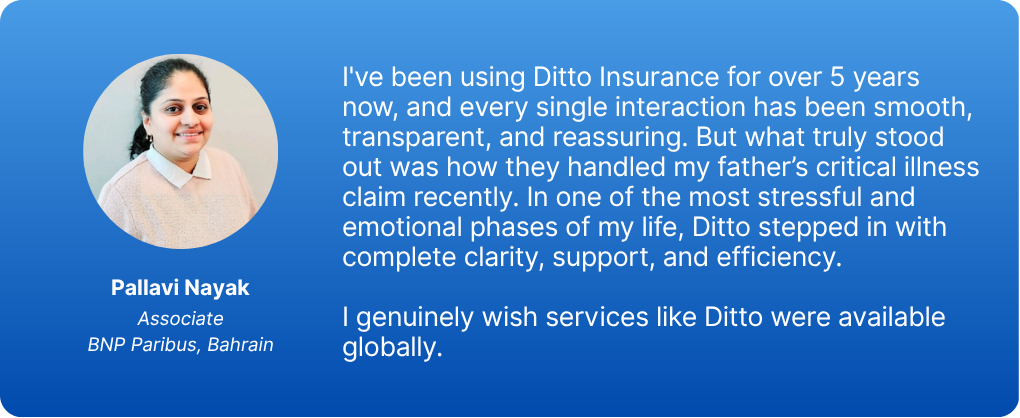
At Ditto, we’ve assisted over 8,00,000 customers with choosing the right insurance policy. Why customers like Pallavi below love us:
- No-Spam & No Salesmen
- Rated 4.9/5 on Google Reviews by 15,000+ happy customers
- Backed by Zerodha
- Dedicated Claim Support Team
- 100% Free Consultation
Confused about the right insurance? Speak to Ditto’s certified advisors for free, unbiased guidance. Book your call or chat on WhatsApp with us now!
Conclusion
Is claim settlement guaranteed after moratorium period is over? For most honest policyholders, yes, largely. But the moratorium is a safety net, not a reason to disclose carelessly. Many claim disputes happen in the first few years, before moratorium protection starts. The best approach is to disclose everything correctly, renew on time, and understand the policy exclusions. If you’re unsure about your policy or coverage, speak to a certified advisor for clear, unbiased guidance.
Frequently Asked Questions
Last updated on: