




Quick Overview
Imagine your health insurance claim gets rejected without a clear reason, or your insurer simply stops responding after you raise a grievance. You're frustrated and confused, and probably wondering whether you have to hire a lawyer and drag this through court. Most people don't know there's a much faster, completely free alternative, the Insurance Ombudsman.
In this article, we'll walk you through when and how to approach an Insurance Ombudsman, the time limits you need to know, and a full list of offices across India.
What Is Insurance Ombudsman? Meaning and Role Explained
The offices of the Insurance Ombudsman operate under the administrative control of the CIO, established under the Insurance Ombudsman Rules, 2017. IRDAI oversees the overall framework, while the CIO manages the ombudsman offices.
The term ‘ombudsman’ means an independent official who investigates complaints, in this case, insurance-related ones. This scheme was set up to resolve insurance disputes quickly and fairly, without going to court.
Here's what an Insurance Ombudsman can look into:
- Delay in claim settlement beyond the time specified under IRDAI regulations.
- Partial or full rejection (repudiation) of a claim by a life, general, or standalone health insurer.
- Disputes over premiums paid or payable under a policy.
- Misrepresentation of policy terms at the time of sale or in the policy document.
- Non-issuance of a policy document after the insurer receives the premium.
- Any other matter that violates IRDAI regulations or the terms of your policy contract.
Did You Know?
When Should You Approach a Health Insurance Ombudsman?
The Health Insurance Ombudsman handles the same set of complaints as any other ombudsman.
You can approach the health insurance ombudsman when:
1. Your insurer has rejected your complaint in writing, and you're not satisfied with their response.
2. You've filed a complaint with your insurer but haven't heard back within one month.
3. You're unhappy with how your claim got settled, partially paid, or rejected.
However, there are a few situations where the ombudsman cannot step in. For instance,
- If the same matter is already pending before or has been decided by a court, consumer forum, or arbitrator.
- If the complaint is not related to a personal insurance policy (i.e., individual or family policies).
- If the complaint has not been taken to the insurer in writing.
Think of the ombudsman as a last resort. Something that can help before a legal court battle, but not as a first stop. You need to give your insurer a fair chance to fix things first.
Real-life Claim Story: Denied, Then Paid Back

How to File a Complaint With an Insurance Ombudsman in India
Complain to the Insurer
Send a written complaint to your insurance company's Grievance Redressal Officer (GRO). Keep a copy and note the date. The insurer is expected to respond within 30 days.
Wait for Response
If you receive an unsatisfactory response or no reply within one month, you're eligible to escalate.
Find the Right Ombudsman Office
Identify the ombudsman office that covers your residential address or the branch of your insurer. There are 18 offices across India, which are listed later in the article.
Submit Your Complaint
You can file a complaint online or offline via email, post, or in person. Your written complaint must include your name, address, insurer name and branch, description of the grievance with supporting documents, a copy of the complaint made to the insurer, and the resolution you are seeking.
Wait for Resolution
If both parties agree to mediation, the ombudsman gives a recommendation within 1 month. Otherwise, an award is passed within 3 months of receiving all required documents. The award is binding on the insurer, who must comply within 30 days.
If you accept the award, it's treated as a full and final settlement. If you're still not satisfied, you can take the matter to a consumer or civil court because the ombudsman route doesn't waive your legal rights.
What Is the Time Limit for Approaching an Insurance Ombudsman?
You must file your complaint with the Insurance Ombudsman within one year of:
- The date you received the insurer's rejection of your complaint, or
- The date you received a response from the insurer that didn't satisfy you, or
- One month after you sent your written complaint to the insurer, if they have not replied.
Missing the one-year window doesn't automatically close the door. The Insurance Ombudsman can accept the delay in certain situations if there's a reasonable cause. However, it's always safer to act within the deadline.
What’s New With the IRDAI?
List of Insurance Ombudsman Offices in India and Contact Details
There are 18 Insurance Ombudsman centers across India, governed by the Council for Insurance Ombudsmen. Here is a list of the major offices:
For the full list with addresses and phone numbers, visit the CIO website.
Why Choose Ditto for Insurance?
At Ditto, we’ve assisted over 8,00,000 customers with choosing the right insurance policy. Why customers like Pallavi below love us:
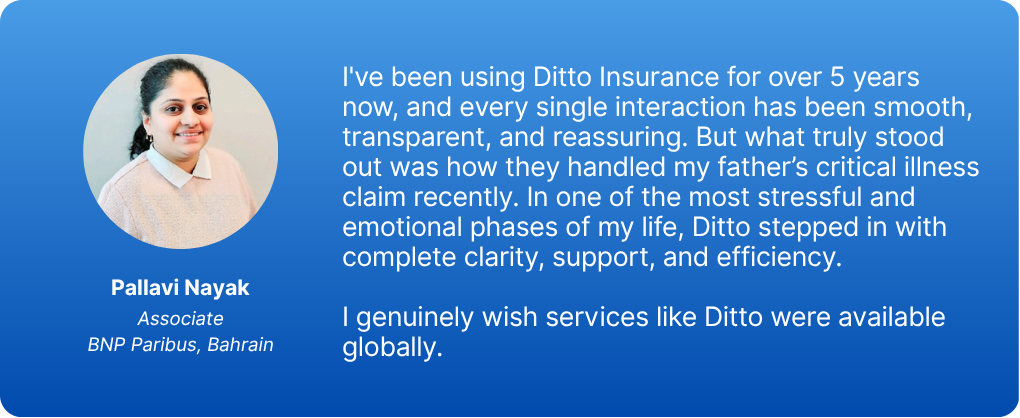
- No-Spam & No Salesmen
- Rated 4.9/5 on Google Reviews by 15,000+ happy customers
- Backed by Zerodha
- Dedicated Claim Support Team
- 100% Free Consultation
Confused about the right insurance? Speak to Ditto’s certified advisors for free, unbiased guidance. Book your call or chat on WhatsApp with us now!
Ditto's Take
If your insurer has rejected your claim or gone silent on your complaint, don't accept it. Sometimes, simply filing with the ombudsman is enough to signal you mean business, and insurers often fast-track settlements before a formal hearing even begins. Since April 2000, the CIO has resolved over 5.7 lakh complaints, and the entire process costs you nothing.
The Insurance Ombudsman is designed for real-life claim disputes: quick, free, and far less stressful than a long legal fight. Keep everything in writing, track dates carefully, and file within the one-year window.
Disclaimer: This article is intended for general informational purposes only and does not constitute legal or financial advice. While we have made every effort to ensure accuracy, insurance regulations, ombudsman rules, and IRDAI guidelines are subject to change. We recommend verifying the latest rules, time limits, and office details directly with the Council for Insurance Ombudsmen (CIO) or IRDAI before filing a complaint.
Frequently Asked Questions
Last updated on: