



Overview
Imagine you're shopping for a term plan today. You check quotes on one insurer's app, compare a few more on an aggregator site, then call an agent to confirm the numbers, and you're still not fully sure which insurer's claims settlement record is actually the best. That back-and-forth is the everyday reality of buying insurance in India, and the exact gap Bima Sugam is meant to close.
In this article, we'll walk you through what Bima Sugam is, how it works, its key features, and how you'll eventually register and use the portal. We will also discuss how it compares with Bima Central and private aggregators, as well as its real benefits and limitations.
What Is Bima Sugam?
Bima Sugam is a Digital Public Infrastructure (DPI) project for insurance, legally established under the IRDAI (Bima Sugam: Insurance Electronic Marketplace) Regulations, 2024, notified on 20 March 2024.
In simple terms, it's meant to work like a neutral, government-backed marketplace where you can view and buy policies from every registered insurer on a single screen, instead of hopping between insurers' websites, agents, and private aggregators.
IRDAI positions it as a core pillar of the “IRDAI Mission 2047”, alongside two other initiatives that together form the “Bima Trinity”:
1) Bima Sugam IRDAI
The digital marketplace for comparing, buying, and servicing insurance.
2) Bima Vistaar
A low-cost, rural-focused bundled product that covers life, personal accident, health, and property.
3) Bima Vahak
A women-led, village-level distribution network that sells Bima Vistaar through the Sugam platform.
As you can see, Bima Sugam is the technological backbone on which the other two initiatives depend. It's run by the Bima Sugam India Federation, with no single insurer holding a controlling stake, so it functions neutrally.
How Bima Sugam Works
The Bima Sugam India Federation (BSIF) is a not-for-profit Section 8 company that owns and runs the platform. Its share capital is held collectively by life, standalone health, and general insurers.
At the center of how the Bima Sugam portal IRDAI is meant to work is Bima Pehchaan, a lifelong insurance ID, similar in concept to Aadhaar, but specific to your insurance history.
Every policy you've ever bought from any insurer is linked to this one ID. Alongside it, an Electronic Insurance Account (e-IA) stores your policies digitally, which is the insurance equivalent of a demat account for shares.
Here's how the timeline has actually played out:
The recurring reason for delays: bringing dozens of insurers, intermediaries, and government databases onto a shared platform, securing APIs is genuinely hard, especially for life and health products, which are far less standardized than motor insurance.
Key Features and Services on the Bima Sugam Portal
Once fully functional, the Bima Sugam portal is designed to offer:
- A single dashboard to view and compare life, health, motor, travel, property, and agriculture policies from every registered insurer.
- Digital KYC and paperless policy issuance, so you don't repeat the same documentation for every purchase.
- End-to-end claims support, including tracking and grievance redressal, alongside the existing Bima Bharosa system.
- Policy portability and servicing, like address or nominee updates, from one login instead of many.
- Minimal, transparent fees, since the platform isn't built to run on commission the way private aggregators do.
As of mid-2026, the rollout has been sequenced motor-first, since motor policies are relatively standard. Life and health products are taking longer because fitting them into one comparable, common format is central to what makes Bima Sugam useful in the first place.
What Is the Bima Sugam Registration Process Expected to Look Like?
Right now, the official Bima Sugam website functions mainly as an information and guidance hub rather than a fully transactional marketplace. Once the platform's initial products go live, expected by the end of September 2026, registration is expected to work along these lines:
- Visit the Bima Sugam website or app and choose the option to create your account.
- Verify your identity using your Aadhaar, PAN, and mobile number to generate your Bima Pehchaan ID.
- Link any existing Electronic Insurance Account (e-IA) or open a new one to view your policies in a single dashboard.
- Browse, compare, and buy policies across insurers, or raise service and claim requests from the same login.
Until then, you can still buy and manage policies the usual way, directly through insurers, via existing repositories, or through Ditto Insurance’s advisors, who can compare options for you.
Talk to an expert
today and
find
the right
insurance for you.

Bima Sugam vs Bima Central vs Private Aggregators
Bima Central is a repository-linked servicing portal built by CAMSRep, one of four IRDAI-licensed insurance repositories, and it's been live since June 2024. It helps you view and manage policies you've already purchased that are linked to your CAMS e-IA.
Bima Sugam India Federation, in contrast, is building an industry-wide marketplace designed to cover comparison, purchase, and claims across all insurers, not just policy storage.
Note: Ditto Insurance sits right at this juncture as a corporate agent. Insurance in India is still largely a push product, sold rather than bought, and the burden of dense terms and mis-selling often falls on an unsuspecting buyer. That's precisely the gap an advisory like ours exists to close, helping you compare honestly, understand the fine print, buy with confidence, and rightfully claim when needed.
Benefits and Limitations of Bima Sugam
Benefits
- Neutral comparison across every registered insurer, without commission-driven bias.
- One login for buying, servicing, porting, and claiming policies, instead of many.
- Standardized, digital formats that should cut down on paperwork and confusion.
- Built on IRDAI-mandated security and DPDP Act-aligned data protection standards.
Limitations
- Repeated delays mean the full marketplace isn't functional yet, only an information hub.
- Early rollout is motor-first, while life and health integrations are still catching up.
- A neutral marketplace doesn't automatically tell you if a plan actually fits your needs. That still needs independent advice.
- It doesn't replace the consumer-protection rules already in place, like health insurance master circulars and life insurance surrender-value norms, which continue to apply regardless of where you buy.
Why Choose Ditto for Insurance?
At Ditto, we’ve assisted over 8,00,000 customers with choosing the right insurance policy. Why customers like Aaron below love us:
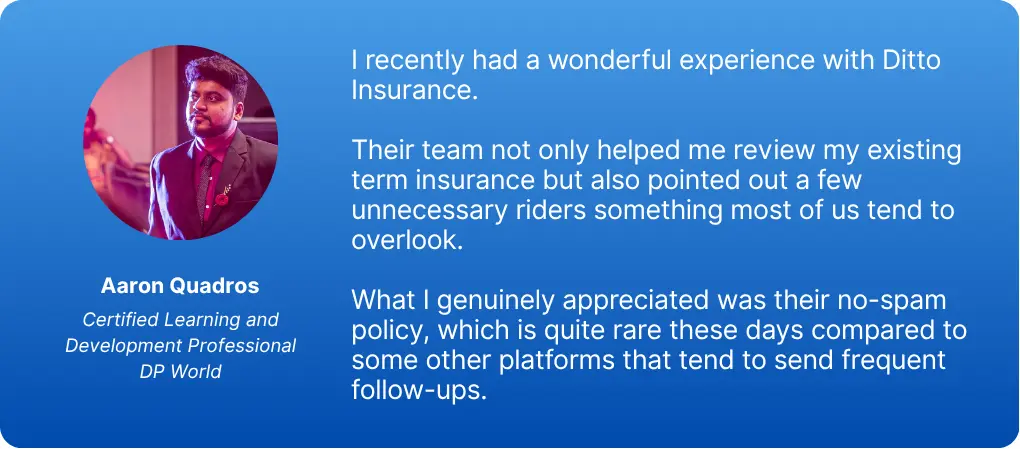
- No-Spam & No Salesmen
- Rated 4.9/5 on Google Reviews by 25,000+ happy customers
- Backed by Zerodha
- Dedicated Claim Support Team
- 100% Free Consultation
You can book a FREE consultation. Slots are running out, so make sure you book a call or chat on WhatsApp now!
Conclusion
Bima Sugam is a good initiative with the right intent: a neutral, IRDAI-backed marketplace that could genuinely make it easier for every Indian to compare and manage insurance. Execution and implementation, however, remain to be seen, given how many deadlines have already slipped.
Any positive change in the industry is one Ditto Insurance completely welcomes, since it's the customer, especially, who stands to gain. Until Bima Sugam is fully live, the simple, actionable step is to not wait to get covered. Compare your options carefully, read the policy wording before you buy, and if you'd like a second, unbiased opinion, talk to a Ditto advisor.
Note: All the details mentioned above are subject to change and will be finalized by the entity at launch.
Frequently Asked Questions
Last updated on: