



Health insurance tax benefits 80D are one of the most effective ways the Insurance Regulatory and Development Authority of India (IRDAI) and the government encourage citizens to expand their insurance coverage while saving on taxes. If you’re wondering whether you can save tax on your health insurance premiums, you’ve come to the right place.
Through Section 80D of the Income Tax Act, 1961, policyholders can claim deductions on the premiums paid for health insurance for themselves and their families. Understanding the health insurance tax benefit 80D limit can help you make smarter financial and healthcare decisions.
In this detailed guide, we delve into Section 80D health insurance tax benefits, covering eligibility, deduction limits for self, family, and parents, preventive health check-ups, senior citizen provisions, multi-year policies, group insurance rules, and tips to maximize your tax savings.
Health Insurance Tax Benefit (Overview)
Health Insurance Tax Benefit 80D Limit
The maximum deduction limits under Section 80D are based on the age of the individuals covered.

Important Notes on Health Insurance Tax Benefits
Senior Citizen Threshold
The higher deduction limit of ₹50,000 applies if the eldest insured person in a block (self/spouse/children in Block 1 or parents in Block 2) is 60 years or above at any time during the financial year. This maximizes the health insurance tax benefit 80D.
Old Tax Regime Only
The tax benefit on health insurance premium under Section 80D is available only under the Old Tax Regime and cannot be claimed under the New Tax Regime (Section 115BAC).
Maximum Deduction Cap
A taxpayer can claim a total health insurance tax benefit 80D limit of up to ₹1,00,000: ₹50,000 for self/family and ₹50,000 for parents, if both blocks qualify as senior citizens.
Shared Premium Payments
If multiple people contribute to one health insurance premium (e.g., siblings paying for parents), each person can claim 80D deduction only for the amount they actually paid, without exceeding the total premium amount or statutory limits.
Talk to an expert
today and
find
the right
insurance for you.


Section 80D – Health Insurance Tax Deduction Explained
Section 80D is a key deduction available only under the old tax regime that allows individuals and Hindu Undivided Families (HUFs) to claim health insurance tax benefits for various medical-related expenses.
These health insurance tax benefit 80D provisions apply to premiums paid for health insurance policies, preventive health check-up costs, and expenses incurred for resident senior citizens who do not have health insurance. The income tax benefit on health insurance under this section covers self, spouse, dependent children, and parents.
As it directly reduces taxable income while promoting financial protection against medical risks, Section 80D remains one of the most widely utilized tax-saving avenues after Section 80C.
Who Can Claim Health Insurance Tax Benefit?
Deductions under Section 80D can be claimed by:
- Individuals
- Hindu Undivided Families (HUFs)
What Payments Are Eligible for Health Insurance Tax Benefit?
An individual can claim the deduction for health insurance premiums paid for:
- Self, Spouse, and Dependent Children
- Parents (whether dependent or not)
Health Insurance Tax Benefits of Section 80D
- Tax Savings on Health Insurance Premiums: Section 80D enables taxpayers to reduce their taxable income by claiming deductions on health insurance premiums. These deductions help families lower their tax burden while ensuring that essential health coverage is in place.
Whether the policy is individual or family floater, the premiums paid contribute toward significant tax relief within the specific limits defined under the law. - Tax Deduction for Preventive Health Check-Ups: An additional benefit under Section 80D is the deduction available for preventive health check-up expenses. Taxpayers can claim up to ₹5,000 for preventive check-ups conducted for themselves or their family members, including parents.
This amount forms part of the overall 80D limit, not over and above it. The provision encourages individuals and families to undergo routine medical evaluations, focusing on early detection and proactive healthcare. - Health Insurance Tax Benefit for Senior Citizens: One of the most impactful benefits of Section 80D is the higher deduction limit available for senior citizens. Individuals aged 60 years and above, as well as senior citizen parents, are eligible for deductions of up to ₹50,000.
In cases where senior citizens cannot obtain health insurance due to age or pre-existing medical conditions, medical expenses incurred for their treatment can also be claimed within this ₹50,000 limit. - Encouragement Toward Proactive Health Planning: Beyond tax savings, Section 80D actively promotes a culture of preventive and long-term health planning. By offering deductions on health insurance premiums and preventive check-ups, it encourages individuals to secure medical coverage early and maintain it consistently.
The section is designed to motivate households to prioritize healthcare, stay prepared for medical emergencies, and build financial resilience over time.
What Health Insurance Tax Benefits Are Covered Under Section 80D?
- Health Insurance Premiums
The deduction can be claimed for premiums paid for the following family members:
- Self (The Taxpayer)
- Spouse
- Dependent Children:
- Children must be financially dependent on the taxpayer.
- There is no strict legal age limit specified in the Income Tax Act; however, in practice, insurers typically treat children as dependents up to 25 years of age, provided they are unmarried and not earning.
- Premiums paid for working children who are not financially dependent are not eligible.
- Parents (Mother/Father):
- They are covered irrespective of whether they are financially dependent on the taxpayer or not.
- Preventive Health Check-Ups
- Up to ₹5,000
- Allowed even if paid in cash
- Counted within the overall block limit
- Medical Expenses for Senior Citizens Without Insurance
- Up to ₹50,000
- Only for resident senior citizens
- Applicable when no insurance policy exists for that person.
- Modes of Payment Under Section 80D
Allowed (Non-cash only):
- Debit card
- Credit card
- Net banking
- UPI
- Cheque / DD
- Bank transfer
- Payroll deduction into group insurance
Not Allowed: Cash payments for health insurance premiums or medical expenses (Exception: preventive check-ups can be paid in cash).
Health Insurance Tax Benefit for Senior Citizens Under Section 80D
Section 80D offers special benefits for senior citizens (age 60 and above) because their medical costs tend to be higher. If you pay health insurance premiums for your parents who are 60 or older, you can claim a parents health insurance tax benefit of up to ₹50,000 per year, regardless of whether they are financially dependent on you. This health insurance tax benefit 80D is available in addition to the deduction you can claim for yourself and your family.
What Happens If Parents Don’t Have Health Insurance?
Many senior citizens find it difficult to purchase health insurance due to high premiums or pre-existing medical conditions. Section 80D provides a special provision for such cases:
- Special Benefit: If your parent is a Resident Senior Citizen (aged 60 or above) and you have not paid any premium to buy or maintain a health insurance policy for them during the financial year, you can claim a deduction for the actual medical expenses you incur for them.
- Limit: This deduction is capped at ₹50,000, which is the maximum health insurance tax benefit 80D limit available for senior citizens.
- Exclusion: You can claim this benefit only if your parent has no active health insurance coverage of any kind. This includes:
- Individual health insurance
- Family floater coverage
- Group health insurance (including employer-provided policies)
- CGHS/ESIS or similar government schemes
If any such coverage exists, you cannot claim the medical expenditure benefit.
Group Health Insurance Tax Benefit Under Section 80D
Eligibility to claim group health insurance tax benefits under Section 80D for an employer-sponsored health insurance policy depends entirely on who actually pays the premium for the coverage.
The fundamental rule of Section 80D is that the deduction can only be claimed on an expenditure that the taxpayer personally incurs.
- When the Employee Is NOT Eligible for Tax Benefit
- Premium Fully Paid by Employer: If your employer pays the entire premium for your group health insurance policy (covering you, your spouse, and/or children) without deducting any amount from your salary, you cannot claim a tax benefit on health insurance premium under Section 80D.
- Reason: Since the employee does not bear the cost, the health insurance tax benefit 80D is not available. In such cases, the employer may claim the premium as a business expense.
- When the Employee IS Eligible (Fully or Partially)
An employee may claim the benefit of health insurance in income tax under Section 80D in the following situations:
- Employee Contribution: If the employer deducts a portion of the group health insurance premium directly from the employee’s salary, the employee becomes eligible to claim the health insurance premium tax benefit.
- Deduction: The employee can claim a Section 80D deduction for the amount personally contributed through non-cash modes, subject to the applicable limits of ₹25,000 or ₹50,000.
- Top-up or Coverage Enhancement: If the employee pays an additional premium from their own pocket to enhance the group health insurance policy, such as opting for a higher sum insured, upgrading room rent limit, or adding non-dependent family members, then the tax benefit on health insurance premium applies to this additional amount.
- Deduction: The full amount paid by the employee is eligible for deduction under Section 80D, within the prescribed limits.
Summary Table
The mode of payment for the employee's contribution must be non-cash (e.g., deducted via payroll, bank transfer, cheque) to be eligible.
Health Insurance Tax Benefit Under Section 80D for NRIs
Non-Resident Indians (NRIs) can claim deductions under Section 80D of the Income Tax Act, but their eligibility is subject to a few key conditions and restrictions, particularly regarding the enhanced senior citizen benefits.
Here is a breakdown of the specifics for NRIs claiming 80D deductions:
- General Eligibility
NRIs are fully eligible to claim Section 80D deductions if they have taxable income in India (e.g., from rental properties, business income, or interest).
- Policy Issuer: The health insurance policy must be purchased from an insurer registered in India. Policies bought from foreign insurers are not eligible.
- Payment Source: The premium must be paid using funds from the NRI's NRO (Non-Resident Ordinary) account or equivalent banking channels, as the deduction must relate to income taxable in India.
- Deduction Limits for NRIs
For NRI taxpayers, Section 80D deduction limits follow the same age-based structure as for residents: if you, your spouse, or children are below 60, the limit is ₹25,000; if 60 or above, it is ₹50,000. Similarly, for parents, the deduction is ₹25,000 if they are below 60 and ₹50,000 if they are 60 or older, provided the premiums are paid in India.
- Special Restriction for Medical Expenses
The ₹50,000 deduction for actual medical expenses (in lieu of premiums) applies only to Resident Senior Citizens. If the NRI taxpayer or their senior citizen parents are non-resident, a conservative ₹25,000 cap is applied for that block.
In short: NRIs can claim the full health insurance premium deduction limits (up to ₹1,00,000 if applicable), but deductions for medical expenses without insurance are restricted to resident senior citizens. Consulting a tax expert is advisable for clarity in such cases.
Health Insurance Tax Benefit for Preventive Health Check-Up Under Section 80D
The provision for preventive health check-ups under Section 80D is a valuable health insurance tax benefit designed to promote proactive healthcare and the early detection of diseases.
- Maximum Deduction Available: The maximum deduction available for preventive health check-ups is a sub-limit of ₹5,000 per financial year under this health insurance tax benefit.
- Sub-Limit Rule: This ₹5,000 is not an additional deduction; it is included within the overall maximum limit applicable to the category (i.e., the ₹25,000 limit for non-senior citizens or the ₹50,000 limit for senior citizens) when claiming the health insurance tax benefit.
Example: If you pay ₹20,000 in health insurance premiums for yourself and spend ₹5,000 on a preventive check-up, your total deduction under the health insurance tax benefit is ₹25,000. If you spend ₹22,000 on premiums and ₹5,000 on a check-up, your deduction remains capped at ₹25,000. - Who Can Claim This Benefit: The deduction for the preventive health check-up sub-limit can be claimed as part of the health insurance tax benefit for expenses incurred for:
- Yourself (The Taxpayer)
- Your Spouse
- Your Dependent Children
- Your Parents
The total expenditure on check-ups for all these individuals combined cannot exceed the ₹5,000 sub-limit for the financial year.
- Eligible Expenses Under Preventive Check-ups: This deduction covers payments made towards any medical check-up or investigation carried out to assess general health or monitor specific health conditions of the insured individuals.
Eligible expenses include, but are not limited to:
- General medical consultations for monitoring health
- Annual full body check-up packages
- Basic diagnostic tests like blood tests, urine analysis, lipid profile, and blood sugar tests
- Scans or tests required as part of a routine check-up
How to Calculate Section 80D Deductions?
USE CASE 1: When you are purchasing a health insurance plan for yourself.
If You Are Below 60
If You Are Above 60
USE CASE 2: When you are purchasing a health insurance plan for yourself and your spouse
If Both of You Are Below 60
If You Are Above 60 and Your Spouse is Below 60
If You Are Below 60 and Your Spouse is Above 60
If Both of You Are Above 60
USE CASE 3: When you are purchasing a health insurance plan for yourself and your parents
If You And Your Parents Are Below 60
If You Are Below 60 and One of Your Parents is Above 60
If You And Your Parents Are Above 60
Key Points to Remember While Claiming Health Insurance Tax Benefit
To claim Section 80D deductions successfully and avail the health insurance tax benefit, you must follow rules on payment methods, policy types, and maintain proper documentation. Failure to comply with these requirements may result in your health insurance tax benefit claim being rejected.
Importance of Maintaining Proof of Payments
While filing your Income Tax Return (ITR), you are generally not required to upload supporting documents for claiming the health insurance tax benefit. However, you must keep proper records in case the tax department asks for them later.
- Mandatory Documents: You must retain original documents, bills, and premium receipts attached in the policy document, for a minimum of six years from the end of the relevant assessment year to substantiate your health insurance tax benefit claim.
- Proof: This includes premium payment receipts issued by the insurer (showing the GST components separately, where applicable) or receipts for contributions made to the Central Government Health Scheme (CGHS).
- For Senior Citizen Medical Expenses: Maintain all original bills, prescriptions, and bank statements showing the non-cash payment made to the hospital or doctor.
- Accuracy: Ensure the name on the payment proof matches the name of the taxpayer or the family member for whom the premium was paid.
Only Non-Cash Payments Are Eligible
Health-related tax deductions that qualify for the health insurance tax benefit must be paid through traceable, non-cash methods so the tax department can verify them and prevent misuse.
Expense Types and Permitted Payment Modes
Latest GST & Tax Deduction Rule for Section 80D (Post-2025 Update)
The 56th GST Council’s landmark decision, effective September 22, 2025, has significantly enhanced the health insurance tax benefit by reducing the GST rate on retail plans including individual and family floater plans, to Nil (0%). This move aligns with IRDAI’s “Insurance for All by 2047” mission to improve affordability and expand insurance penetration across India. As a result, the entire premium you pay now counts as the base premium and is fully eligible for deduction under Section 80D, subject to the prescribed limits.
However, group health insurance policies such as employer-sponsored plans, bank-provided group covers, or corporate health insurance schemes, continue to attract 18% GST. In such cases, tax experts generally treat the total amount the employee actually pays (including any GST embedded in that payment) as the eligible figure for deduction, allowing the income tax benefit on health insurance to be claimed within the applicable Section 80D limits.
What Happens to Section 80D Tax Benefits for Multi-Year Health Insurance Policies?
If you pay a lump-sum premium for a health insurance policy covering more than one year (most commonly 2 or 3 years), you can still claim the health insurance tax benefit under Section 80D. The Income Tax Act allows two distinct ways to claim the deduction, depending on how you want to use your limits.
Two Ways to Claim Section 80D for Multi-Year Policies
How the Pro-Rata Method Works: Under the pro-rata approach, the total premium paid upfront is divided by the number of years the policy covers. You then claim the resulting amount each year.
- Maximum annual deduction allowed:
- ₹25,000 if the insured is below 60 years
- ₹50,000 if the insured is 60 years or above
This method ensures you don’t exhaust your Section 80D limit in the first year and can continue claiming deductions over the policy term.
Illustrative Examples
Can You Claim Multiple Policies Under Section 80D?
Yes, you can claim deductions for multiple policies, and this flexibility further enhances the health insurance tax benefit available under Section 80D. The section considers the total premium paid for eligible family members, not the number of policies held.
- Aggregate Premiums: If you hold multiple policies (for example, a family floater for yourself and an individual policy for your father), combine all premiums paid for Block 1 (self, spouse, dependent children) and compare them against the Block 1 limit. Similarly, aggregate premiums paid for Block 2 (parents) to assess the parents health insurance tax benefit.
- Total Deduction: The total deduction is the sum of eligible amounts from Block 1 and Block 2, capped at the overall maximum of ₹1,00,000, ensuring the full health insurance tax benefit 80D limit is applied correctly.
Example: You can claim premiums paid for a basic health policy, a critical illness policy, and a super top-up policy, provided they cover eligible family members under Section 80D.
Sections 80C and 80D are the two most popular tools for reducing taxable income, but they are fundamentally distinct in their purpose, eligible expenses, and deduction limits.
Section 80D vs Section 80C
Verdict on Tax Saving: An optimal tax strategy requires fully utilizing both sections. Section 80C is the foundation (up to ₹1.5 lakh), and Section 80D offers a crucial, non-competitive benefit (up to ₹1 lakh) on top of that foundation.
Why Approach Ditto for Health Insurance?
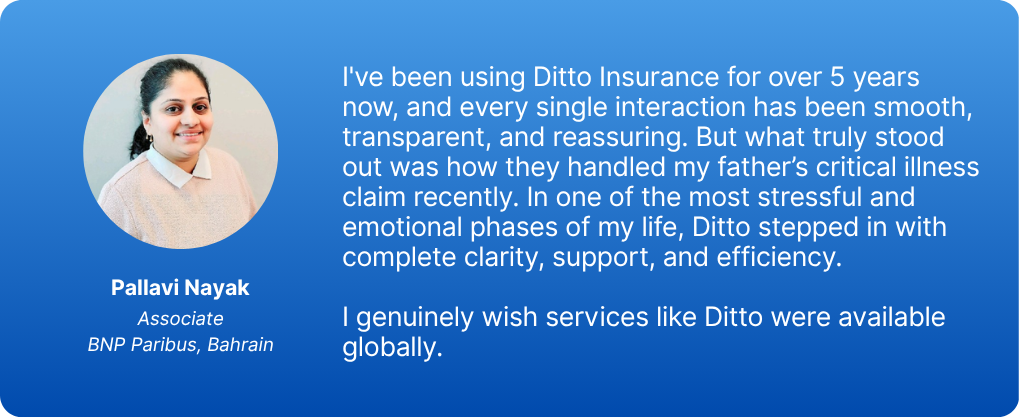
At Ditto, we’ve assisted over 8,00,000 customers with choosing the right insurance policy. Why customers like Pallavi below love us:
- No-Spam & No Salesmen
- Rated 4.9/5 on Google Reviews by 15,000+ happy customers
- Backed by Zerodha
- Dedicated Claim Support Team
- 100% Free Consultation
Confused about the right insurance? Speak to Ditto’s certified advisors for free, unbiased guidance. Book your call now or chat with us on WhatsApp, slots fill up fast!
Conclusion
Section 80D is one of the most effective tax-saving provisions for individuals and families looking to balance financial protection with long-term health security. It encourages proactive medical planning by offering the health insurance tax benefit on premiums paid for health insurance policies, preventive health check-ups, and even certain medical expenses incurred for uninsured senior citizens.
We hope this guide has helped you understand how the health insurance tax benefit under Section 80D works, including the applicable limits, the difference between senior and non-senior categories, how multi-year premiums are treated, and how deductions vary for self/family versus parents. With the right understanding of the income tax benefit on health insurance, you can maximize your tax savings while ensuring adequate healthcare coverage for yourself and your loved ones.
Quick Note
Frequently Asked Questions
Customer Reviews
Last updated on: