



Quick Overview
Be it healthcare, manufacturing, or information technology, Tamil Nadu has steadily emerged as one of India’s key growth hubs. With well-known hospitals and advanced medical infrastructure, cities like Chennai, Coimbatore, and Madurai are also home to some of the country’s most trusted hospitals. While this means better access to quality care, it also comes with higher treatment costs. Which is why choosing the right health insurance plan is essential for anyone living in Tamil Nadu.
In this article, we’ll break down the best health insurance plans in the state, why they’re needed, the types of options available, and how to choose the one that suits you best.
Why Do You Need Health Insurance in Tamil Nadu?
Major Health Problems and Health Statistics in Tamil Nadu
Tamil Nadu’s changing lifestyle has led to a steady rise in lifestyle- and environment-related health issues, especially in fast-paced cities like Chennai. According to the National Family Health Survey (NFHS-5), 30.2% of men aged 15 and above in Tamil Nadu have hypertension, compared to 24.8% of women in the same age group.
When it comes to elevated blood sugar levels, often used as an indicator for diabetes, the prevalence stands at 22.1% among men and 20.7% among women. These numbers rise sharply in higher age groups, highlighting how health risks tend to compound with age.
In addition, seasonal infections such as dengue, chikungunya, and viral fevers frequently spike during monsoons, while improved screening has led to a rise in reported cancer cases. Together, these trends increase both the frequency and cost of medical treatment in the state.
Best Health Insurance Plans in Tamil Nadu
Note: To know the methodology behind why these plans are recommended, refer to Ditto’s Cut and Framework.
How Much Health Insurance Coverage Do You Need in Tamil Nadu?
For major cities in Tamil Nadu, a health insurance cover of at least ₹15 lakh is generally recommended. Medical inflation in India is estimated at around 14% annually, which means treatment costs are rising sharply.
Families and individuals with lifestyle‑related risks, as well as those dependent on private hospitals should consider higher coverage in the ₹20–25 lakh range to stay adequately protected over the long term. For example, premiums for a 25-year-old male opting for a ₹15 lakh cover in Chennai can range from roughly ₹9,235 to ₹13,175 per year, depending on the plan. In comparison, premiums for a family floater covering spouses aged 62 and 63 can vary between approximately ₹58,019 and ₹72,880.
Note: Many insurers do not yet classify Chennai as a Tier-1 city, and instead price it at par with the rest of Tamil Nadu. This can vary from one insurer to another. As a result, premiums for Chennai residents are often lower than in cities like Delhi-NCR and Mumbai, making health insurance relatively more affordable in Tamil Nadu.
Are Government Health Insurance Plans Sufficient in Tamil Nadu?
Tamil Nadu residents may be eligible for several government-backed health schemes:
- Chief Minister’s Comprehensive Health Insurance Scheme (CMCHIS) (now converged with Ayushman Bharat PM-JAY): This is the state’s flagship public health insurance scheme for low and middle-income families. It offers cashless treatment at empanelled hospitals for a wide range of surgeries and therapies, with coverage typically up to ₹5 lakh per family per year for eligible beneficiaries.
- New Health Insurance Scheme (NHIS): A cashless health insurance scheme for Tamil Nadu government employees, pensioners, and their eligible dependents. Premiums are largely subsidised and deducted directly from salary or pension. The scheme covers hospitalisation for listed conditions up to ₹5 lakh, which can be extended to ₹10 lakh for specific procedures. This coverage is available over a pre-defined block period of four years.
- Central Government Health Scheme (CGHS): Applicable to Central Government employees and pensioners residing in CGHS-covered cities in Tamil Nadu, such as Chennai. It offers treatment through CGHS wellness centres and empanelled hospitals, either on a cashless or reimbursement basis, depending on the facility.
As we can see, government-sponsored health insurance plans often come with lower cover amounts and restrict you to a limited network of hospitals, which may not always be convenient. That’s why, at Ditto, we recommend having an adequate personal health insurance policy alongside to ensure broader coverage and greater flexibility when you need medical care.
Why Choose Ditto for Health Insurance?
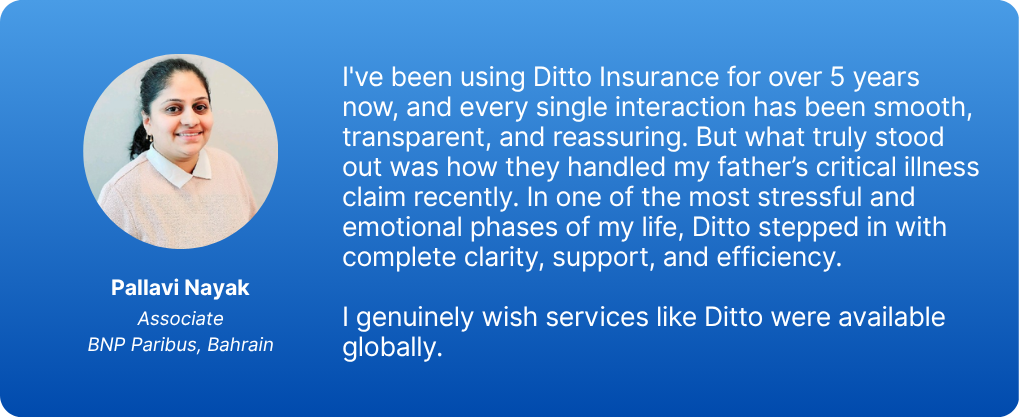
At Ditto, we’ve assisted over 8,00,000 customers with choosing the right insurance policy. Why customers like Pallavi below love us:
- No-Spam & No Salesmen
- Rated 4.9/5 on Google Reviews by 15,000+ happy customers
- Backed by Zerodha
- Dedicated Claim Support Team
- 100% Free Consultation
Confused about the right insurance? Speak to Ditto’s certified advisors for free, unbiased guidance. Book your call now, slots fill up fast!
Ditto’s Take on Best Health Insurance Plans in Tamil Nadu
- Comprehensiveness is Key: Choose a plan that offers the most comprehensive benefits with the shortest waiting periods, while still fitting your budget. Look for essentials like no co-payment and room rent restrictions, etc. Simply put, better benefits usually mean lower out-of-pocket expenses at the time of a claim.
- Adequate Cover: Opt for a sum insured that can realistically handle rising medical costs in Tamil Nadu. ₹15- 25 lakh cover is recommended. This can be adjusted if you already have an existing corporate or government health cover.
- Consider all Modes of Purchase: Explore all available purchase options, both online and offline. A good intermediary can help you compare plans objectively, guide you during purchase, and support you through claims later on.
- Read the Fine Print: Always go through the policy documents carefully. Understanding the terms upfront helps avoid unpleasant surprises when you actually need to make a claim.
While the above pointers can help you shortlist a comprehensive plan for yourself and your family, it’s just as important to look at the insurer’s own performance. Balancing both is key to finding a plan that truly works for you.
Frequently Asked Questions
Last updated on: