


What is Health Insurance for Parents?
Only 18% of Indians aged 60+ are covered by health insurance. When hospitalization happens, many families end up paying from savings, or worse, take loans. Several people search for health insurance for parents because they want to avoid that exact situation.
But buying a policy for parents is not the same as buying one for yourself. Age bands, pre-existing conditions, co-pay clauses, room rent limits, and waiting periods decide how much the insurer actually pays during the claims.
In this guide, we will explain why health insurance for parents is crucial, how it works in India and compare the top plans. We will also break down premiums, key inclusions and exclusions, and the important things you should know before buying.
Why Do Parents Need Health Insurance?
As your parents grow older, their health becomes more vulnerable, and medical expenses continue to rise sharply. In that light, health insurance for parents isn't just an expense but an investment that ensures your loved ones get the best possible care without financial burden. Here are a few reasons why having health insurance for parents is important -
1. The Soaring Cost of Healthcare in India
Healthcare costs in India are escalating rapidly, with medical inflation averaging 13% in 2025. Without insurance, even routine treatments can become a serious financial setback. Here are some real-world examples with approx. costs:
- Heart Bypass Surgery: ₹3 – 5 Lakhs
- Knee Replacement: ₹3 – 6 Lakhs
- Cancer Treatment (Chemotherapy): ₹5 – 15 Lakhs
- Dialysis (Annual Cost): ₹2 – 3 Lakhs
- ICU Charges (Per Day): ₹8,000 – 40,000
- Viral Fever Hospitalization: ₹50,000 – 1 Lakh
Without adequate health insurance for parents, medical bills can quickly drain years of savings and even push families into debt.
2. Early Enrollment = Better Coverage & Fewer Restrictions
The earlier you buy health insurance for parents, the more advantages they get:
- Insurers are more likely to approve applications if parents are relatively healthy.
- Pre-existing disease (PED) waiting periods (2–3 years) start ticking earlier, so coverage kicks in when it’s most needed.
- Many policies cap entry age at 65–70, so early enrolment ensures access to more options.
- Buying after a major diagnosis often leads to higher premiums (loading) or disease-specific exclusions.
In short: enrolling early doesn’t freeze premiums forever (they rise with age), but it helps your parents enter the pool healthier, with broader coverage and fewer restrictions.
3. Aging Equals Higher Risk of Health Issues
Chronic illnesses among older Indians are more widespread than many realize. According to a NITI Aayog report, 75% of the elderly live with at least one chronic disease, and about 32% suffer from multimorbidity (two or more conditions). Similarly, a BMC Geriatrics study shows multimorbidity is more common among women and urban residents. The Longitudinal Ageing Study in India (LASI) further highlights the burden: 26.8% of seniors report hypertension, 12.2% diabetes, and 9% arthritis. Worryingly, many cases go undiagnosed, as tests show far more people have diabetes and hypertension than those who report it.
With such high prevalence, your parents are likely to need frequent doctor visits, tests, and ongoing medications. Having health insurance for parents ensures these recurring costs don’t strain your finances while providing them uninterrupted care.
4. Significant Tax Benefits Under Section 80D
One often-overlooked benefit of buying health insurance for parents is the tax deduction under Section 80D of the Income Tax Act (under old tax regime):
- Self & Family (below 60 years): ₹25,000
- Parents (above 60 years): ₹50,000
- Total (if you and parents are insured): ₹75,000
5. Coverage Beyond Hospitalization
Hospital bills are only part of the story. Hidden costs like consultations, medicines, and tests often add up to a big amount. Good health insurance for parents covers:
- Pre-hospitalization expenses (diagnostics, doctor visits)
- Post-hospitalization expenses (medicines, follow-ups)
- OPD consultations and preventive check-ups
6. Special Senior Citizen Health Insurance Plans
Many insurers now offer dedicated senior citizen plans that provide:
- Coverage for pre-existing conditions (after waiting period/ reduced with add-ons)
- High sum insured (₹10 – ₹25 lakhs)
- Annual health check-ups and wellness benefits (tele-consults with doctors, discounts based on active lifestyle)
- OPD and home healthcare support
- Cashless treatment across leading hospital networks
These features make health insurance for parents a comprehensive shield against rising healthcare costs. With that out of the way, let us now look at how health insurance for parents actually work in India.
How Does Health Insurance for Parents Work in India?
Adding Parents To Your Family Floater
This is when you buy one family floater and include yourself, spouse, kids, and parents under the same sum insured.
When it can make sense:
- Your parents are relatively young and healthy (think late 40s or early 50s)
- You want the simplicity of one policy
The catch:
- Most insurers cap family floaters at 2 adults (2A+kids), so putting self, spouse, and both parents (4 adults) in one plan is possible but rare
- Your premium mostly becomes “your parents’ premium” because the premiums are decided based on the oldest member
- Your sum insured is shared; one person’s claim can eat into the family’s coverage
Separate Policy For Parents
This usually means one floater for both parents or individual policies for each parent.
Which is better:
- A single floater for both parents is usually cheaper, and bonuses plus restoration make the shared cover enough for everyone.
- Individual plans make sense if your parents have different health profiles or qualify for different plans, so both end up with enough coverage.
Why is the recommended setup:
- Your parents’ premium stays separate from your own plan
- Claims by parents do not affect your spouse or kids
- You can choose features that matter for older ages, think waiting period reduction or OPD coverage, without compromising your own plan.
Senior Citizen Specific Plan
Some insurers offer plans specifically designed for senior citizens.
When it can make sense:
- Your parents are older, and premiums feel too high for normal plans
- A comprehensive plan is not available due to underwriting restrictions
The catch:
- These plans often come with more restrictions, like co-pays, room rent limits, and disease-wise caps
- Premiums may look lower, but your out-of-pocket costs end up being higher during claims
Base Plan + Super Top-up
This is when you buy a base policy and add a super top-up as extra cover on top.
When it can make sense:
- You want higher overall coverage with affordable premiums
- Underwriting limits the base sum insured you can get, even if you want a higher cover
The catch:
- A super top-up only starts paying after you cross the aggregate deductible for the year
- Policy restrictions like co-pay, room rent limits, or disease-wise caps are common in super top-ups, which can raise your out-of-pocket costs.
- Super top-ups can have strict underwriting, too, so approval is not easy
- If your base plan and super top-up are from different insurers, it becomes difficult to get cashless for both plans
Did You Know?
How To Choose the Best Health Insurance Plans for Parents?
Imagine you’re shortlisting plans for your parents online. Every insurer says “comprehensive,” promises a huge cashless network, and claims to be perfect for parents. The real issue shows up when you read the fine print.
At Ditto, we compare plans using a simple framework based on three things:
- Policy Terms: Room rent rules, co-pay, consumables coverage, and waiting periods
- Insurer Metrics: Hospital network strength and claims service track record
- Premium Value: Whether the price is fair for what the plan actually offers
Using this approach, here are our top picks for health insurance for parents in India.
Best Health Insurance Plans for Parents in India (2026)
Talk to an expert
today and
find
the right
insurance for you.


Note: Sometimes, multiple plans from the same insurer rank in our top plans list. To keep the list balanced, we feature only one plan per insurer, even if more qualify.
Product-Wise Analysis of the Best Health Plans for Parents (2026)
Let’s see how the top plans actually stack up for parents. We’ll go one by one and highlight what each policy does well for older ages, where the fine print can hurt (co-pay, room rent limits, sub-limits, and pre-existing disease rules), and how the plan design plays out during real claims.
By the end, you will not just have a list of “best plans”. You will know which plan fits your parents’ situation and what to verify upfront, so there are no surprises at claim time.
HDFC ERGO Optima Secure
HDFC ERGO has a 96.71% claim settlement ratio (Avg FY 2022-25) and a network of 13,000+ hospitals.
Key Features
- Clean structure: no co-pay, no room rent limits, and no disease-wise sub-limits
- Secure Benefit: gives 2x cover from day 1, so ₹10L becomes ₹20L immediately
- Plus Benefit: boosts base cover by 50% after year 1 and 100% after year 2, even if you claim
- Restore Benefit: restores 100% of base SI for later claims in the same year, and can be made unlimited via an add-on
- Protect Benefit: covers listed non-medical items and consumables by default, which reduces out-of-pocket costs during claims
- Limitless (add-on): unlimited cover for 1 or 2 claims in the entire policy lifetime.
- ABCD Chronic Care (add-on): reduces waiting for asthma, BP, cholesterol, type 2 diabetes from 3 years to 30 days
- Optima Well Being (add-on): OPD add-on provides the benefit of unlimited general physical consultations on a cashless basis and some discounts on tests and medicines
Key Drawbacks
Premiums are usually on the higher side, and underwriting can be stricter, so some parents may face loadings that make it even more expensive.
Final Verdict
If your parents clear underwriting and the premium fits, Optima Secure is one of the best comprehensive plans for parents.
Care Supreme
Care Health has a 93.13% claim settlement ratio (Avg FY 2022–25) and an 11,400+ hospital network.
Key Features
- Clean structure: no co-pay, no room rent limits, and no disease-wise sub-limits
- Unlimited Automatic Recharge: refills the cover unlimited times in the same year, even for the same illness
- Cumulative Bonus (inbuilt): cover increases by 50% per year up to 100%, and does not drop after claims
- Cumulative Bonus Super (add-on): adds another 100% bonus per year up to 500%, on top of the inbuilt bonus
- Cumulative Bonus Booster (add-on): adds another 100% bonus per year with no upper cap, so the cover can keep growing with renewals
- Instant Cover (add-on): reduces waiting for asthma, diabetes, and hypertension from 3 years to 30 days
- Instant Cover Plus (add-on): cuts the waiting period to 30 days for select pre-existing diseases like Asthma, COPD, Coronary Artery Disease, Diabetes, Hypertension, and Obesity
- PED waiting reduction (add-on): reduces PED waiting from 3 years to 1 or 2 years
- Unlimited Care (add-on): unlimited coverage for a single hospitalization once in the policy lifetime
Key Drawbacks
- Consumables and health check-ups are optional and cost extra
- Complaint volume is higher than some peers, so service consistency can vary
Final Verdict
If you want a fairly priced plan for parents with strong inbuilt recharge and flexible add-ons to tighten waiting periods, and you prefer an insurer that does not apply loading charges, Care Supreme is a solid option.
Aditya Birla Activ One MAX
Aditya Birla has a 95.81% claim settlement ratio (Avg FY 2022–25) and a 12,000+ hospital network.
Key Features
- Super Reload: refills cover unlimited times if there are multiple claims in the same year
- Super Credit: increases cover by 100% of base SI every renewal, up to 500%, capped at ₹3 crore, regardless of claims
- Claim Protect: covers non-payable items by default, which reduces common claim-time out-of-pocket costs
- Chronic Care (add-on): reduces PED waiting to 0 days for listed chronic conditions like diabetes, asthma, and high blood pressure
- PED waiting reduction (add-on): reduces PED waiting from 3 years to 2 or 1 year
- Health Returns: can refund up to 100% of renewal premium, depending on activity and health metrics
Key Drawbacks
- Some parents may prefer an older, more established insurer; Aditya Birla is comparatively new in the market
- If you add PED reduction or chronic-care add-ons, you need to pay for them every year until the policy is active
Final Verdict
If your parents want comprehensive cover at a relatively lower price and with smoother underwriting, Activ One MAX is a strong fit.
Niva Bupa ReAssure 2.0 Platinum+
Niva Bupa has a 91.62% claim settlement ratio (Avg FY 2022–25) and a 10,000+ hospital network.
Key Features
- Clean structure: no co-pay, no room rent limits, and no disease-wise sub-limits
- ReAssure Forever: after the first claim is paid, it triggers an “unlimited” refill for life, where future claims can go up to your sum insured
- Booster+: unused base SI can carry forward and build up to 5x
- Lock the Clock: premium is locked to entry age until a claim is paid, though it can still change due to insurer-wide repricing and inflation
- Disease Management Rider (add-on): immediate cover for hospitalization or day care treatment for complications from diabetes or hypertension
- Safeguard / Safeguard+ (add-on): covers non-payable items, reducing out-of-pocket expenses during hospital bills
Key Drawbacks
Complaint volume is higher than peers', so service experience can vary.
Final Verdict
If you want an innovative policy and you are okay with doing a careful check of the policy wording, Niva Bupa can be a decent option for parents.
SBI Super Health Platinum Infinite
SBI General has a 96.14% claim settlement ratio (Avg FY 2022–25) and a 16,600+ hospital network.
Key Features
- Clean structure: no co-pay, no room rent limits, and no disease-wise sub-limits
- Reinsure Benefit: unlimited restoration in the same policy year, triggered from the first paid claim, up to 200% of base SI
- Health Multiplier: for listed serious illnesses, cover can increase up to 3x
- Claims Shield: covers consumables like gloves, masks, cotton, and bandages, reducing out-of-pocket costs.
- Short PED waiting: PEDs are covered after 2 years, which is lower than many peers
- OPD benefit: up to ₹10,000 for OPD expenses like check-ups and pharmacy bills
Key Drawbacks
- Servicing can feel more process-driven, so grievance resolution may be slower.
- It is also expensive, since this premium variant starts at a ₹50 lakh sum insured
Final Verdict
If you want strong restoration, a shorter PED waiting period, and a high-coverage design, this is a solid plan to shortlist, as long as you are okay with a more process-heavy service experience.
Premium Comparison of Health Insurance Plans for Senior Citizens
Note: Premiums for a ₹15L S.I., residing in Delhi - 110010, including necessary and mandatory add-ons. Exact premiums can vary depending on city, underwriting, discounts, and insurer repricing.
Inclusions and Exclusions of Parent Health Insurance Plans
It’s worth noting that coverage and exclusions may vary slightly across insurers and plans. It's recommended to check the policy wording of the specific plan you are interested in.

Things to Know Before Buying Health Insurance for Parents
Check Policy Restrictions
Before you look at “features,” check for co-pay, room rent limits, and disease-wise sub-limits. These are the most common reasons that claim payouts get reduced for parents. A high sum insured can still feel small if these restrictions are tight.
Understand Waiting Periods
Most parents have at least one pre-existing condition, and plans cover these only after a waiting period. Some insurers offer paid add-ons to shorten it, but you should confirm whether your parents’ condition is included. Also, check if the add-on needs to be paid every year to keep the benefit.
Be Ready For Underwriting
For parents, the premium you see online is often not the final premium after underwriting. The insurer may add a loading, impose a permanent exclusion for a condition, or, in some cases, decline the proposal. Always judge the plan after you see the final terms offered for your parents.
Choose Adequate Cover
A very high base sum insured can be expensive or hard to get approved at older ages. A common approach is to buy a base cover of ₹15-25L if you can get one. If only lower sum insured options are available, it's recommended to layer them with a super-top-up for additional coverage.
Check For Service Issues
Claim settlement ratios can look similar across insurers, but the experience can feel very different during a claim. Look at complaint trends, how smooth cashless is in your city, and how process-heavy the insurer is known to be. For parents’ claims, smoother service often matters as much as the policy wording.
Why Talk To Ditto For Health Insurance
At Ditto, we’ve assisted over 8,00,000 customers with choosing the right insurance policy. Why customers like Abhinav below love us:
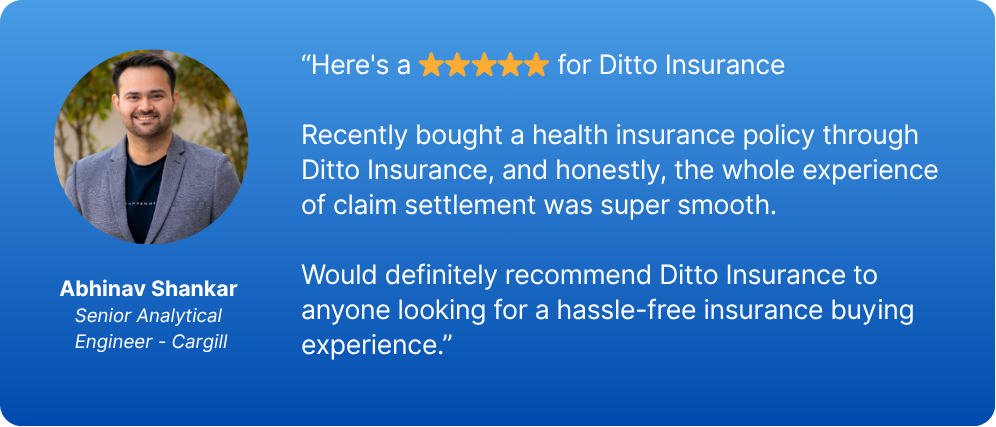
- No-Spam & No Salesmen
- Rated 4.9/5 on Google Reviews by 15,000+ happy customers
- Backed by Zerodha
- Dedicated Claim Support Team
- 100% Free Consultation
You can book a FREE consultation here. Slots are filling up quickly, so be sure to book a call or chat on WhatsApp with us.
Ditto’s Take on Health Insurance for Parents
If you’re buying health insurance for parents, start by choosing a comprehensive plan, not just the one that looks cheapest today. The biggest regret is not “I paid more.” It is buying a policy that cuts payouts during claims because of co-pay, room rent limits, or disease-wise caps.
A simple way to approach it
- Decide the structure first: in most cases, a separate parents policy is the cleanest option
- Shortlist 2 to 3 plans and scan the fine print before applying, especially PED waiting periods and any claim-reducing limits
- Apply with complete medical disclosures, then judge the plan based on the final underwriting terms you actually get, not just the brochure
If premiums are too high or underwriting limits your base cover, do not force a huge base plan. Buy the best base cover you can at a sustainable price, then add a super top-up to reach higher protection for big hospital bills.
Quick Note
Frequently Asked Questions
Customer Reviews
Last updated on: