The "best" term insurance company depends on your profile, but updated FY 2024-2026 data from the IRDAI and insurers' public disclosures consistently point to Axis Max Life, HDFC Life, ICICI Life, Bajaj Life, and SBI Life as top performers, all maintaining CSRs above 98%.
Axis Max Life: Strongest claim settlement record at 99.71%.
HDFC Life: Lowest complaint volume in the industry.
ICICI Life: Competitive pricing with a healthy 2.10x solvency ratio.
Bajaj Life: Highest solvency ratio in the industry at 3.52x.
SBI Life: Largest distribution network, backed by State Bank of India.
How to evaluate and choose:
Claim Settlement Ratio: Aim for above 97%; the industry average is 99.00%.
Solvency Ratio: IRDAI mandates a minimum of 1.5x; the industry median is 2.00x.
Riders: Add critical illness and waiver of premium riders selectively.
Premium: Compare premiums across insurers, but the differences are usually minor.
Compare insurers through unbiased experts like Ditto by consulting our IRDAI-certified advisors.
India is now the 10th largest insurance market globally by premium volume. Yet life insurance penetration in India is just 2.7%, accounting for only 1.8% of global premiums, highlighting a significant protection gap and widespread underinsurance.
With dozens of insurers and hundreds of policies in the market, comparing options can quickly become confusing, especially for first-time buyers. The reality is that not every insurer performs the same. Factors like claim settlement ratio, payout consistency, complaint volume, and financial strength can significantly impact your family’s experience during a claim.
So in this guide, we break down the best term life insurance in India using IRDAI data-backed insights, so you can confidently choose the right insurer.
Ditto’s Rating Framework: How We Chose the Best Term Insurers for You
Insurer Strength (60%) We prioritize insurers that have consistently demonstrated reliability over time by examining multi-year claim settlement performance, complaint data, financial scale, and the percentage of the claimed amount actually paid out.
Features That Actually Protect You (30%) Not all features are created equal, so we focus only on those that offer real-world protection. This includes benefits such as critical illness cover, a waiver of premium, disability support, and flexible payout options.
Premium Affordability (10%) While cost is important, it shouldn’t come at the expense of reliability or meaningful coverage. We compare premiums using a standard profile to ensure fairness but assign it a lower weight so that cheaper plans don’t automatically rank higher.
Performance Metrics of the Best Term Insurance Companies
CSR: The CSR of an insurer tells you the percentage of claims settled out of the total claims received. A higher CSR indicates a stronger track record of honoring claims. Axis Max Life ranks first among the top 10 term insurers by CSR. HDFC Life and Bajaj Life also outperform the industry’s average CSR of 99.00%.
ASR: While CSR shows how many claims are settled, ASR highlights the proportion of total claim value paid out. HDFC Life and Axis Max Life lead in this category, with SBI Life also exceeding the industry average of 94.83%. This suggests that these insurers maintain a balanced approach across both small and large claims.
Complaint Volume: This indicates how many complaints an insurer receives per 10,000 claims. HDFC Life has the lowest complaint volume in the industry at 1.00, which is remarkable for its scale. All five insurers have fewer complaints than the industry median of 13.10.
Solvency Ratio: IRDAI mandates insurers to maintain a solvency ratio of at least 1.5x. This shows an insurer's financial strength and its ability to pay future claims. Bajaj Life has the highest solvency ratio in the industry at 3.52x.
Annual Business Volume: This shows the size of the insurer’s business. Bigger insurers usually have more experience and stability. SBI Life and HDFC Life are the second and third-largest insurers in the industry after LIC (Life Insurance Corporation of India).
Note: These numbers are for the insurer’s overall life insurance business (including term plans, ULIPs, endowment plans, etc.). But they remain highly relevant for comparison based on term insurance, since they share the same claims-handling infrastructure and values. Also, we’ve used a 3-year average (FY 2024-26) rather than quarterly or annual data. This gives a more stable and reliable picture and avoids one-time changes.
If you're interested in the raw data that powers our research, visit the Term Insurance Data Lab, where we've compiled and curated key term insurance metrics from insurers and IRDAI reports over the years.
Detailed Comparison: Best Term Insurance Companies
01
Axis Max Life
Axis Max Life is our top-recommended insurer, and it consistently earns that position. Backed by Axis Bank, it combines the financial muscle of one of India's leading private banks with an operationally strong insurance business.
Axis Max Life
4.9
Overall Rating
CSR Score
5.0/5
ASR Score
4.0/5
Customer Service Rating
5.0/5
Gross Written Premium Score
5.0/5
Pros:
1. Strongest claim settlement track record among top term insurers.
2. Competitively priced plans with a wide range of features and riders.
Cons:
1. Slightly lower brand recall compared to HDFC or ICICI due to the change in brand name from 'Max Life' to 'Axis Max Life'.
02
HDFC Life
HDFC Life has an excellent reputation, and it backs it up with genuine performance across the metrics.
ICICI Life is one of the biggest names in life insurance, with strong claim metrics and a wide reach. It sits just below the top 2 due to slightly higher complaint volume.
ICICI Life
4.4
Overall Rating
CSR Score
3.0/5
ASR Score
4.0/5
Customer Service Rating
5.0/5
Gross Written Premium Score
5.0/5
Pros:
1. Decent brand recognition and market presence.
2. Competitive premium pricing.
3. Healthy solvency and claim metrics.
Cons:
1. Doesn't clearly lead in any particular performance area compared to peers.
04
Bajaj Life
Bajaj Life's solvency ratio speaks volumes about the company's financial strength and its ability to pay out claims even in adverse market conditions. Its plans are reasonably priced and offer decent customization options.
Bajaj Life
4.4
Overall Rating
CSR Score
4.5/5
ASR Score
2.0/5
Customer Service Rating
5.0/5
Gross Written Premium Score
5.0/5
Pros:
1. Competitive pricing, especially for non-smokers and women.
2. Decent plan customization.
3. Top recommendation for Non-Resident Indians (NRIs) due to simpler processes and easier medical underwriting.
Cons:
1. Smaller business scale than the top 3.
05
SBI Life
SBI Life brings something the others can't easily replicate: the trust and reach of the State Bank of India. If you value the security of a government-backed bank, SBI Life is a natural fit.
SBI Life
4.4
Overall Rating
CSR Score
3.0/5
ASR Score
4.0/5
Customer Service Rating
5.0/5
Gross Written Premium Score
5.0/5
Pros:
1. Largest distribution network among private insurers.
2. Strong claims and payout track record.
3. Massive customer base.
Cons:
1. Plans lack new-age features that competitors offer.
Best Term Insurance Plan Choices from Top Insurers
Offers a high sum assured starting from ₹50 lakh and extending into multi-crore coverage, depending on the policyholder’s needs and eligibility.
Individuals aged 18 and above are eligible to apply.
You can choose between multiple variants: Life, Life Plus, and Life Goal. The Life variant offers level and increasing cover, Life Plus offers level cover with an additional accidental death benefit, and Life Goal offers decreasing cover.
It also offers an in-built terminal illness benefit.
Riders available: Waiver of premium, critical illness, and accidental disability coverage, subject to the chosen option and rider eligibility.
Offers a sum assured starting from ₹25 lakh, with no limit (depending on underwriting).
Choice between level cover and increasing cover
Affordable premium structure
Customizable policy terms
Riders available: accidental death benefit and accidental partial/permanent disability.
You can also review our guide to the best term insurance plans in India to better understand your options and choose a plan that suits your needs.
Sample Premiums for Best Term Insurance Plans
Profile
Axis Max Life Smart Term Plan Plus
HDFC Life Click2Protect Supreme Plus
ICICI Life iProtect Smart Plus
Bajaj Life eTouch II
SBI Life Smart Shield Plus
25, Male
₹10,160
₹10,327
₹10,376
₹9,667
₹10,055
25, Female
₹8,636
₹8,778
₹8,821
₹9,180
₹8,866
30, Male
₹12,296
₹13,436
₹12,277
₹12,299
₹12,268
30, Female
₹10,452
₹11,421
₹10,435
₹10,063
₹10,357
35, Male
₹16,114
₹16,414
₹15,937
₹15,148
₹15,733
35, Female
₹13,697
₹13,952
₹13,546
₹13,146
₹12,781
For this example, we’ve considered profiles of healthy, salaried, non-smoking individuals living in a tier-1 city like Delhi (pin code: 110010) with a Sum Assured (SA) of ₹1 crore and coverage until age 65. The premiums are indicative and can vary depending on your age, SA, health conditions, lifestyle choices, and underwriting decisions.
Ditto's Verdict: The premium differences between plans aren't dramatic. We're often talking about a few hundred rupees a year. That's why your choice shouldn't depend solely on premium cost. An insurer that saves you ₹500 annually but drags its feet on claims isn't a good deal for your family.
Why Choose Ditto for Term Insurance?
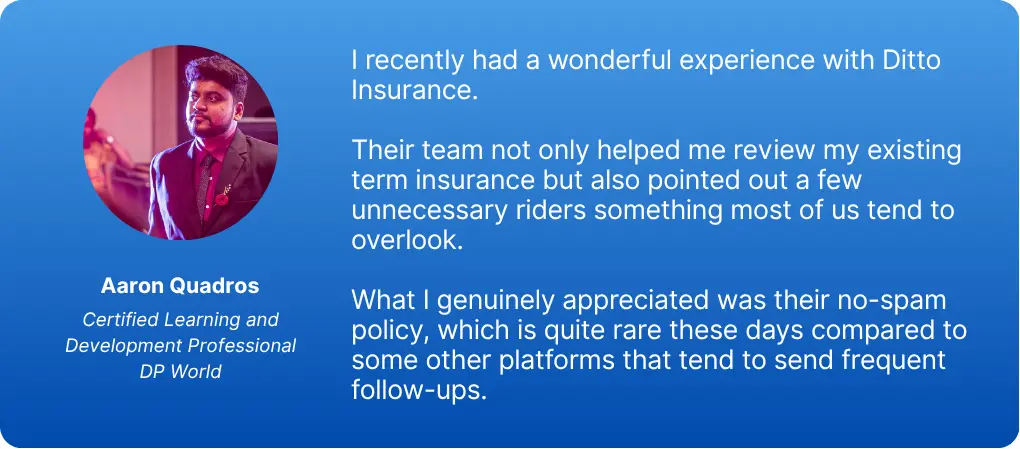
At Ditto, we’ve assisted over 8,00,000 customers with choosing the right insurance policy. Why customers like Aaron below love us:
No-Spam & No Salesmen
Rated 4.9/5 on Google Reviews by 15,000+ happy customers
Backed by Zerodha
Dedicated Claim Support Team
100% Free Consultation
You can book a FREE consultation. Slots are running out, so make sure you book a call or chat on WhatsApp now!
Ditto's Verdict on the Best Term Insurance Companies
When it comes to the best term insurance in India, Axis Max Life leads the pack, followed closely by HDFC Life, ICICI Life, Bajaj Life, and SBI Life. Each of these insurers stands out based on performance, reliability, and value. However, the final choice often depends on what matters most to you.
If a strong track record of claim settlements is your priority, Axis Max Life and HDFC Life are clear frontrunners. If you value financial strength and solvency, Bajaj Life makes a compelling case. And if brand trust and widespread accessibility are key, ICICI Life and SBI Life remain a solid option.
Whichever you choose, the best term insurance is ultimately the one you buy early, keep active, and never have to think about again, because if a claim arises, your family should not have to fight for the payout.
Disclaimer: At Ditto, we believe in full transparency. This review includes our partner insurers (Axis Max Life, HDFC Life, ICICI Life, Bajaj Life) and a non-partner insurer (SBI Life) because our ranking methodology is unbiased and applied consistently across all insurance companies. To know more about how we rate plans, read our detailed rating framework.
Share Your Feedback!
If you found our content helpful or have any suggestions, feel free to share your feedback with us on LinkedIn, Reddit, X, or via email at marketing@joinditto.in. We'd love to hear from you!
Frequently Asked Questions
Which is the best term life insurance company in India?
According to Ditto's data-backed framework, Axis Max Life is the best term insurance company in India as of 2026, earning a score of 4.9 out of 5. It leads with the 3-year average Claim Settlement Ratio (99.71%), holds a strong Amount Settlement Ratio of 96.37%, and is backed by Axis Bank. HDFC Life and Bajaj Life are strong alternatives. The best choice ultimately depends on whether you prioritize claims reliability, solvency strength, or brand trust.
Is HDFC Life better than LIC?
For term insurance, HDFC Life edges ahead on product quality. Its 3-year average (FY 2024-26) CSR is 99.66% versus LIC (Life Insurance Corporation of India)'s 98.16%, and its complaint volume is just 1.00 per 10,000 claims (FY 2024-26), the lowest in the industry. HDFC Life plans also offer more flexibility: critical illness riders, multiple payout options, and digital claim processes. LIC, with 68 years of history and government backing, is a strong choice if your family is in a smaller town and relies on agent or branch support. For urban buyers who want features and comfort, HDFC Life is the stronger pick.
Should I opt for a return-of-premium variant?
A return-of-premium (ROP) variant refunds the premiums you paid if you survive the policy term, but it comes at a significantly higher cost (50% to 80%) than a standard term plan. Financially, it’s usually not the most efficient choice because the extra premium could be invested elsewhere for better returns. If your priority is pure protection, a regular term plan plus disciplined investing is typically smarter.
What is the Amount Settlement Ratio, and how is it different from CSR?
The Claim Settlement Ratio (CSR) is the percentage of number of claims settled out of the total claims received. The Amount Settlement Ratio (ASR) shows the total amount paid in claims by an insurer out of the total claim value it received. A company can have a high CSR but a lower ASR if it pays smaller claims easily while delaying or disputing high-value ones. HDFC Life leads on ASR (FY 2023-25) at 96.72%, with Axis Max Life close behind at 96.37%. Both exceed the industry average of 94.83%, making them reliable for large-cover policies.
What is a good solvency ratio for a term insurance company in India?
IRDAI mandates that every insurance company in India maintain a minimum solvency ratio of 1.5x. This ratio measures an insurer's ability to pay future claims. A higher ratio signals stronger financial health. Among the top five insurers, Bajaj Life has the highest solvency ratio in the country at 3.52x, followed by ICICI Life at 2.10x and SBI Life at 1.94x. HDFC Life and Axis Max Life sit at 1.86x and 1.89x, respectively, well above the regulatory limit.
How much does a ₹1 crore term plan cost in India?
Premiums vary by age, health, and insurer. As a benchmark, a healthy 25-year-old non-smoking male in Delhi can get ₹1 crore in coverage until age 65 for roughly ₹9,667 to ₹10,376 per year, depending on the insurer. Bajaj Life eTouch II is at the lower end (around ₹9,667), while ICICI Life is slightly higher (around ₹10,376). The difference between the cheapest and the most expensive plan is often just a few hundred rupees annually, so claim reliability should matter more than tiny premium gaps.
How does Ditto score and rank term insurance companies?
Ditto uses a weighted framework: insurer strength accounts for 60% of the score, plan features for 30%, and premium affordability for just 10%. Insurer strength is evaluated using Claim Settlement Ratio, Amount Settlement Ratio, complaint volumes, and solvency over a 3-year average (FY 2024–26). Features are judged on real-world protection value. Affordability is included but kept low-weighted, so a cheap plan with poor claims history doesn't rank higher than a reliable insurer with competitive but slightly higher premiums.
What riders should I add to a term insurance plan in India?
The most useful riders are critical illness cover and waiver of premium. Critical illness cover provides a lump sum if you're diagnosed with a listed illness, which is useful because illness can disable you and your income long before death. A waiver of premium ensures the policy stays active if you can't pay the premiums due to disability or critical illness. Axis Max Life Smart Term Plan Plus and HDFC Life Click2Protect Supreme Plus offer these riders, often customizable at purchase.
Is SBI Life a good term insurance option in India?
SBI Life is a solid and trustworthy option, especially for buyers who value brand credibility and nationwide reach. As India's largest private insurer by premium volume (₹38,789 crore), it brings unmatched distribution and the backing of State Bank of India. Its FY 2024-26 CSR stands at 98.76%, with ₹2,409.93 crore paid in death claims. The main limitation is that its plans are considered less feature-rich than those of Axis Max Life or HDFC Life. Ditto rates SBI Life at 4.45/5.
How do I choose the right term insurance company in India?
Start with Claim Settlement Ratio: anything above 97% is excellent. A good Amount Settlement Ratio should ideally be above 90%, because it indicates that high-value claims are also being paid fairly. Next, examine the complaint volume per 10,000 claims to assess service quality. Verify the solvency ratio (minimum 1.5x as per IRDAI). Finally, compare plan features like critical illness cover, payout flexibility, and rider options. The premium difference between top plans is usually just a few hundred rupees per year, so reliability should outweigh cost. Ditto's recommended starting point: Axis Max Life for overall performance, HDFC Life for service quality.
Customer Reviews
4.9
20915 reviews
Ditto is doing really great. Absolutely spam free- that's the best part. They don't talk to you like they are forced to sell the product. It's more like, helping us buy better. Advisor Nuha was very patient and answered all my questions with clarity. Thanks for the service
I
INDHUMATHI M
Loved the service! Maheta Nidhi Hitesh was incredibly helpful and knowledgeable. She guided me through the whole process and made everything super easy to understand. I really appreciated how patient she was with all my questions—there was no pressure at all, just clear and honest advice. Honestly, I'm very happy with my experience at Ditto so far. Highly recommend!
RK
Ragul Kumar
I had a great experience with Ditto while exploring health insurance options. The process was smooth and everything was explained clearly.
A special thanks to Swaroop SK for patiently answering all my questions and guiding me through the policy details without any pressure. The transparency and support made it much easier to understand and choose the right plan.
Really appreciate the assistance!
PS
Pulkit Singh
Had a great experience with Ditto Insurance. Ishita Sudrania was extremely helpful in guiding me through choosing the right term plan. There was no spamming or sales pressure, and all my questions were patiently answered. She also assisted me thoroughly with the entire application process. Highly recommend!
SS
Samil Shah
I had a great experience with Ditto while filing my health insurance claim. Their team guided me clearly through the entire process, helped with the required documents, and promptly answered all my queries. Their support made the claim process much smoother and less stressful. Highly appreciate their assistance.