



Overview
Studies show India’s cancer incidence is projected to rise from 1.46 million cases in 2022 to 1.57 million cases in 2025. While term insurance protects your family after your death, a Critical Illness Rider helps protect your finances while you are alive. But is it worth it?
In the next few minutes, this guide breaks down everything you need to know about a critical illness rider in term insurance. Let’s dive in.
What is a Critical Illness Rider in Term Insurance?
A critical illness rider in term insurance is an optional add-on that pays a fixed lump sum if the policyholder is diagnosed with a covered critical illness. The payout is not based on hospital bills. Instead, it depends on the illness meeting the exact policy definition, waiting period, survival period, and rider terms.
Term Plans With Critical Illness Rider
To explore more about these plans, refer to our guide on the best term insurance plans in India.
Note: Unlike the accelerated CI option under ABSLI Super Term Plan (42 illnesses), the CI riders offered by the other plans discussed above provide a payout in addition to the base sum assured.
Sample Premiums Across Plans
Note: The listed premiums are for a non-smoker 25-year-old male, with a sum assured of ₹2 crore and opting for a critical illness rider of ₹25 lakh (coverage till age 65, without first-year discounts). As base plan premiums stay locked in for the entire policy term, so do rider premiums stay fixed for the entire coverage period.
Talk to an expert
today and
find
the right
insurance for you.


How Does the Critical Illness Rider Payout Work?
There are two kinds of critical illness riders, each working in a different way.
1) Standard Critical Illness Rider: This rider pays the critical illness benefit separately from your life insurance cover. For example, if you have a ₹25 lakh critical illness rider and a ₹1 crore term plan, a critical illness claim pays ₹25 lakh, while the full ₹1 crore life cover remains available for your nominee.
Example: Axis Max Life Smart Term Plan Plus and Bajaj Life eTouch II offer this option.
2) Accelerated Critical Illness Rider: This rider pays the critical illness benefit from your existing life cover. For example, if you have a ₹1 crore term plan and receive ₹20 lakh after a critical illness diagnosis, the remaining life cover reduces to ₹80 lakh. The payout helps during treatment, but lowers the final death benefit available to your family.
Example: Aditya Birla Super Term Plan pays a lump sum on the first diagnosis of any of the listed 42 critical illnesses, after which the benefit ends.
Once a critical illness claim is paid, the rider terminates, and no further rider premiums are payable. Your overall policy premium gets reduced since the critical illness coverage is no longer active.
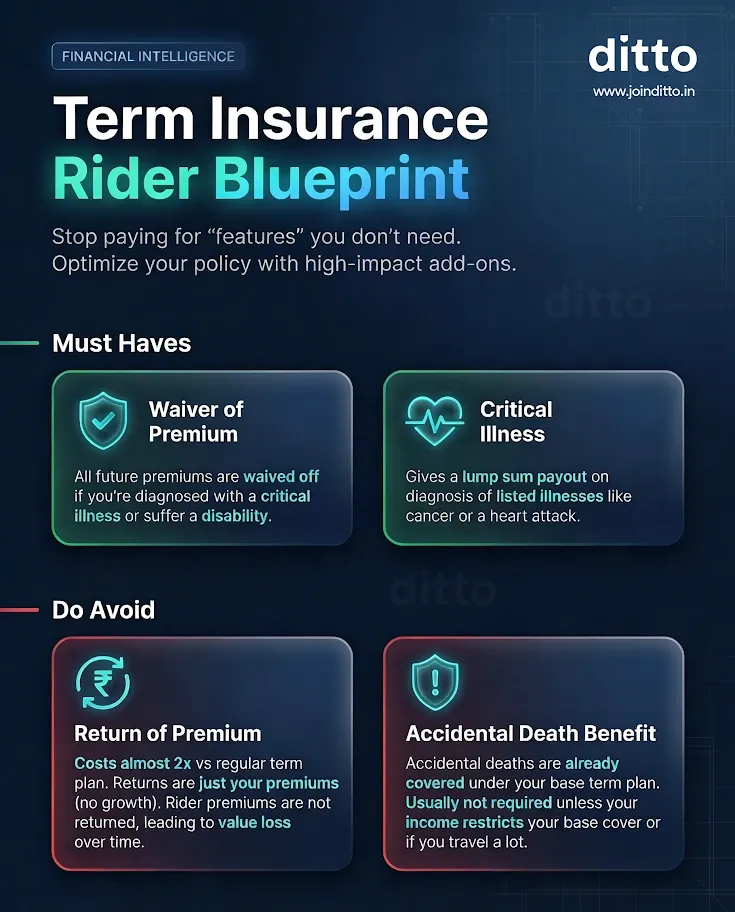
Note: At Ditto, in addition to the critical illness rider, we also recommend a waiver of premium for enhanced protection. Take a look at the infographic below to have an understanding of which riders you actually need and which to avoid.
Conditions Covered Under a Critical Illness Rider
The list of critical illnesses covered will vary from plan to plan, but here are some common ones covered in the top term plans.
- Cancer of Specified Severity: Coverage usually applies to major cancers confirmed through medical tests. Very early-stage cancers or non-invasive tumors may not qualify.
- Heart Attack of Specified Severity: The claim is typically paid for a medically confirmed heart attack with evidence of heart muscle damage. Chest pain or angina alone is usually not covered.
- Coronary Artery Bypass Surgery (CABG): Coverage applies when open-chest bypass surgery is performed to restore blood flow to the heart. Stents and angioplasty are generally excluded.
- Heart Valve Surgery: The rider usually covers surgical repair or replacement of heart valves. Some minimally invasive or catheter-based procedures may not qualify.
In addition to these, insurers often classify critical illness into major and minor. For example, Under Axis Max Life STPP’s Critical Illness and Disability Rider, a minor illness pays the lower of 25% of the rider’s sum assured or ₹5 lakh, while the rider continues with a reduced cover.
A major illness like Cancer of Specified Severity pays 100% of the rider's sum assured, after adjusting any previous minor illness payouts, following which the rider terminates. To explore more about the rider, refer to the policy prospectus.
Critical Illness Rider vs Standalone Critical Illness Plan: Which Is Better?
At Ditto, we prefer a CI rider attached to a term insurance plan over a standalone CI policy. A key reason is premium stability. Standalone CI plans can see premium revisions over time, much like health insurance policies.
In contrast, a CI rider added to a term plan locks in the premium at policy inception. This offers greater long-term cost predictability while combining life cover and critical illness protection into a single policy.
When Should You Add a Critical Illness Rider?
- In case you are the primary earner, it can provide a financial cushion if a serious illness disrupts income for months.
- Useful when you have large EMIs or financial responsibilities, such as home loans, education costs, or dependent parents.
- Helpful in covering expenses beyond health insurance, including recovery costs, caregiver support, travel, and income loss.
- Worth considering if major illnesses run in your family, especially conditions like cancer, heart disease, stroke, or kidney failure.
- Particularly valuable for self-employed individuals, whose earnings may stop immediately during treatment and recovery.
- Buying early can reduce costs, since rider premiums are lower when purchased at a younger age and in good health, and remain fixed for the whole term.
Who Should Not Buy a Critical Illness Rider?
- Individuals who already have strong health insurance and sufficient emergency savings to handle treatment costs and temporary income loss.
- People who prefer a simple, low-cost term plan without additional rider premiums.
- Applicants with certain pre-existing medical conditions, for whom adding riders may lead to stricter underwriting or affect policy issuance.
- Those who would rather invest the extra premium independently and build a flexible corpus that can be used for any financial need, rather than relying on a benefit payable only under specific policy conditions.
Why Choose Ditto for Term Insurance?
At Ditto, we’ve assisted over 8,00,000 customers with choosing the right insurance policy. Why customers like Aaron below love us:

- No-Spam & No Salesmen
- Rated 4.9/5 on Google Reviews by 24,000+ happy customers
- Backed by Zerodha
- Dedicated Claim Support Team
- 100% Free Consultation
You can book a FREE consultation. Slots are running out, so make sure you book a call or chat on WhatsApp now!
Ditto’s Verdict on Critical Illness Rider in Term Insurance
A critical illness rider is one of the term insurance add-ons we find meaningful, alongside options such as the WOP rider. It can provide valuable financial support during a major health crisis by helping manage treatment costs, income disruption, and other recovery-related expenses.
When deciding the CI cover amount, consider your income, financial obligations, dependents, and expected recovery period. As a practical starting point, a cover equal to at least 6–12 months of income may be appropriate, though the ideal amount will vary based on individual needs, affordability, and insurer eligibility criteria.
Frequently Asked Questions
Last updated on: