



Quick Overview
In a country where nearly 8 out of 10 working Indians earn their living outside the formal system, asking for salary slips and income tax returns can feel a bit out of touch. From freelancers and small shop owners to homemakers, gig workers, and first-time entrepreneurs, a huge part of India’s workforce runs on cash flows, seasonal income, or irregular payments, often without neat paperwork to prove it.
Yet, life doesn’t wait for Form 16s or perfectly filed income tax returns (ITRs). Families still depend on these earners. Loans still exist. And financial protection still matters. That’s exactly why the idea of term insurance without income proof exists, and why insurers and regulators had to rethink the traditional rules.

List of Term Insurance Plans Without Income Proof
Saral Jeevan Bima
Saral Jeevan Bima is the only regulator-designed term insurance product created specifically to ensure that individuals without formal income documentation are not excluded from life cover. Offered by all life insurers, it provides a fixed sum assured between ₹5 lakh and ₹25 lakh, with policy terms ranging from 5 to 40 years. It includes a mandatory 45-day waiting period, limited rider options, and lump-sum death benefits only. Insurers rely on basic financial checks, bank balance patterns, and KYC instead of income proof. For a detailed breakdown, refer to our Saral Jeevan Bima guide.
Bajaj Life iSecure II
Bajaj Life iSecure II is one of the most flexible private term plans for individuals who earn but lack formal income documentation, such as ITRs or salary slips. It offers coverage from ₹25 lakh up to ₹2 crore and uses surrogate indicators like average bank balance, CIBIL score, investments, asset ownership, and digital spending patterns for underwriting term insurance. The plan includes advanced features such as early exit options, instant claim intimation payouts, auto cover continuance, health management services, and multiple riders, though premiums are typically much higher than standard plans. For a deeper analysis, refer to our Bajaj iSecure II plan review.
ICICI Prudential iProtect Super
ICICI Prudential iProtect Super is a comprehensive term insurance plan that allows limited flexibility for applicants with income but incomplete documentation. It maintains a minimum income requirement of around ₹3 lakh per annum. Underwriting may accept surrogate indicators such as bank statements or asset records on a case-by-case basis. The plan offers coverage starting from 50L up to ₹2 crore, terminal illness benefits, premium break options during financial stress, and Smart Exit with premium refunds. For full features and underwriting details, refer to our ICICI Pru iProtect Super guide.
Joint Life Term Insurance Plans
Joint life term insurance plans allow one partner without income proof to be insured based on the earning partner’s verified income, depending on the insurer’s underwriting rules. These policies cover two lives under a single contract, and the claim payout depends on the chosen structure (first-death or second-death). Such plans are offered by insurers like HDFC Life, Aditya Birla Sun Life, and PNB MetLife. For plan mechanics and suitability, refer to our Joint Term Insurance guide.
Housewife Term Insurance Plans
Separately, some insurers also offer housewife-specific term insurance plans, where the working husband’s income and/or existing insurance cover is used as a surrogate for financial eligibility. This makes term insurance for housewife without income proof possible even when the policy is issued in her name alone. Coverage limits are usually conservative and depend on the spouse’s income profile. For details, refer to our Term Insurance for Housewife guide.
Talk to an expert
today and
find
the right
insurance for you.


When Can You Buy Term Insurance Without Income Proof?
You can consider term insurance without income proof in the following scenarios:
1) Buying Low Sum Assured Policies
Policies with ₹5 lakh–₹25 lakh cover (mainly Saral Jeevan Bima) are specifically designed for applicants without formal income documents.
2) Alternate Income Proofs Accepted for Term Plan Purchase
Some modern digital term plans allow underwriting using:
- Average bank balance
- CIBIL / credit score
- Mutual fund or FD holdings
- Car IDV
- Property ownership or loans
- Digital spending behaviour
This category includes Bajaj iSecure II and ICICI iProtect Super.
3) Employer‑Provided Group Term Insurance
Corporate group term insurance does not require individual income proof. Coverage is linked to designation or fixed multiples of salary. However, cover amounts are usually limited (₹10–50 lakh) and end when you leave the job.
Types of Income Proof Usually Accepted by Insurers
1) Salary Slips and Form 16
For salaried applicants:
- Last 3 months salary slips
- Form 16
- Employer salary certificate
- Appointment letter with CTC breakup
- 6–12 months bank statements
2) Income Tax Returns (ITR)
For self‑employed professionals and business owners:
- Last 2–3 years ITR
- CA‑certified computation of income
- Audited P&L and balance sheet
3) Alternative Documents
When formal proof is missing, insurers may accept:
- Investment portfolio statements
- FD / MF holdings
- Credit Score report
- Asset ownership documents, SIP details
- Average bank balances
Note
How Much Term Insurance Can You Get Without Income Proof?
High coverage is not allowed without income proof term insurance because insurers have no objective way to validate how much a person actually earns. This increases the probability of mispricing risk, higher claim incidence, and anti-selection, where only high-risk applicants seek large covers.
From a regulatory and actuarial standpoint, insurers also need to follow income-multiple formulas, typically 10 to 25 times annual income, to ensure coverage is proportionate and sustainable. Without documented income, these calculations break down, making large sum assured approvals financially and legally unsafe for insurers.
Who Can Buy Term Insurance Without Income Proof?
Term Insurance Without Income Proof vs Regular Term Insurance
1) Coverage Comparison
Term insurance bought without income proof is structurally capped to reduce insurer risk. Most applicants are limited to ₹25 lakh under Saral Jeevan Bima and 25L/₹50 lakh–₹2 crore under surrogate-income private plans. In contrast, regular term insurance with proper income proof can easily go up to ₹3 crore, ₹5 crore, or even ₹10 crore+, depending on income and age, and overall eligibility and underwriting. Regular plans also offer more variants, built-in features, and a wider set of riders.
2) Premium Differences
Plans issued without income proof usually cost more because insurers price in higher underwriting uncertainty and risk. Below is a real-world comparison for a non-smoking male, opting for ₹2 crore cover till age 70, with no riders and no first‑year discounts:
Premium Comparison
Key Insights: iSecure II premiums are usually about 60–90% higher, though the exact difference can vary from person to person. This extra cost exists because insurers cannot clearly verify the applicant’s income, which creates several risks: the possibility of over-insurance (buying more cover than one can financially justify), incorrect pricing due to limited financial data, anti-selection where higher-risk individuals are more likely to apply, and a higher chance of future premium defaults if income is unstable. To compensate for these uncertainties, insurers charge higher premiums than regular term insurance plans where income is properly documented.
Underwriting and Claim Risk
Regular term plans use strict financial underwriting based on income multiples (10–25× annual income), ITR trends, and bank statements. This results in predictable risk pricing and smoother claims processing.
Without income proof:
- Insurers rely on indirect indicators (bank balance, assets, credit score)
- Financial misrepresentation risk is higher
- Claim scrutiny is stricter
- Documentation checks during claim settlement are deeper
In short, regular term insurance offers higher cover, lower premiums, and cleaner underwriting, while no-income-proof plans trade these advantages for accessibility.
Why Choose Ditto for Term Insurance?
At Ditto, we’ve assisted over 8,00,000 customers with choosing the right insurance policy. Why customers like Aaron below love us:
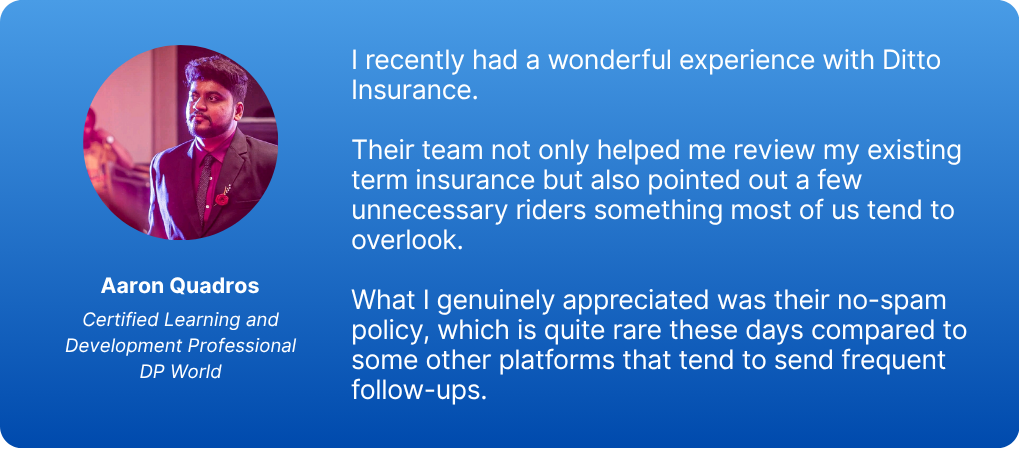
- No-Spam & No Salesmen
- Rated 4.9/5 on Google Reviews by 15,000+ happy customers
- Backed by Zerodha
- 100% Free Consultation
You can book a FREE consultation. Slots are running out, so make sure you book a call or WhatsApp us now!
Conclusion
Term insurance without income proof could be difficult, but it’s possible. It exists because a large part of India earns outside formal systems, and financial protection shouldn’t be limited to people with paperwork. If you currently lack salary slips or ITRs, options like Saral Jeevan Bima, surrogate-based private plans, employer cover if possible, or joint/ housewife covers can still provide basic security for your family.
Just remember that some of these plans come with coverage caps and slightly higher premiums. As your income becomes more formal, upgrading to or adding a regular high-coverage term plan is the smartest long-term move.
Frequently Asked Questions
Last updated on: