


Quick Overview
When buying life insurance, two companies that frequently come up in comparisons are SBI Life Insurance and HDFC Life. Both are well-established insurers with strong financial backing and diverse product portfolios. However, they differ slightly in areas such as claim performance, pricing, digital servicing, and distribution strength.
In this guide, we break down the differences, cover plan features, riders, premiums, and operational metrics to help you evaluate which insurer best aligns with your needs.
About SBI Life and HDFC Life Insurance
SBI Life vs HDFC Life: Plans & Features Comparison
Flagship Term Plan Comparison
Key Insight:
HDFC Life Click2Protect Supreme Plus focuses on flexibility, additional benefits, and rider customization. Meanwhile, SBI Life Smart Shield Premier often offers longer coverage options and competitive pricing, appealing to buyers seeking extended protection at lower premiums.
Rider Comparison: SBI Life vs HDFC Life
HDFC Life’s Rider Offerings:
- Critical Illness Cover
HDFC Life offers a Critical Illness rider, which covers around 60 critical illnesses and includes a 90-day waiting period and a 15-day survival period. The rider is available for a maximum tenure of 15 years. - Accidental Death Benefit
The insurer offers accidental protection through Accidental Death Cover, which provides an additional payout over and above the base sum assured in the event of accidental death. - Accidental Total and Permanent Disability
You can also opt for the Accidental Income Benefit rider, which provides monthly income equal to 1% of the rider's sum assured for 10 years if the insured suffers accidental total and permanent disability. - Waiver of Premium Benefit
HDFC Life provides an inbuilt Waiver of Premium rider linked to critical illness and disability events, which waives all future premiums if the insured suffers from a covered critical illness or disability. - Additional Riders
Beyond the four commonly compared riders, HDFC Life also offers LiveWell rider, Education Income Benefit, Cancer Cover, Spouse cover option, and Return of Premium option, available under specific plan variants.
SBI Life’s Rider Offerings:
- Accidental Death Benefit (ADB):
If the insured dies in an accident, the rider sum assured is paid as a lump-sum benefit in addition to the base policy amount. The death must usually occur within a specified period (typically around 180 days) from the date of the accident. - Accidental Partial Permanent Disability (APPD):
In case of partial permanent disability caused by an accident, the policyholder receives a predefined percentage of the rider sum assured, depending on the type and severity of injury (such as loss of a limb or eyesight).
Claim Settlement Ratio, Premium & Policy Benefits
Metric Comparison: SBI Life vs HDFC Life
Key Insights:
- HDFC Life records a higher CSR and ASR, suggesting slightly stronger consistency in honoring claims.
- Complaint volume is significantly lower for HDFC Life, indicating a better customer service experience.
- SBI Life has a higher solvency ratio, which reflects strong capital adequacy.
- SBI Life remains one of the largest life insurers in India by annual business premium and distribution reach, placing it above HDFC Life in both metrics.
Premium Comparison: SBI Life vs HDFC Life
We considered healthy, non-smoking salaried individuals living in a tier-1 city like Delhi, covered until age 70 with a sum assured of ₹2 Crore. The premiums are indicative only and may vary based on underwriting parameters such as occupation, location, lifestyle, and medical history.
Verdict: While SBI Life offers a lower premium, HDFC Life provides a more comprehensive protection structure with flexible coverage options. For clients looking beyond price to focus on long-term financial security, HDFC Life is the stronger choice.
Customer Experience & Policy Management
Policy Purchase & Renewal
Policies can be purchased online with simplified documentation and digital KYC. Premium payments and renewals can also be completed digitally.
Policy Tracking
Policyholders can easily track policy information online.
For example:
- Customers can check their HDFC Life policy status through the insurer’s website or mobile app.
- SBI Life customers can access SBI Life insurance policy details, update personal information, and download policy documents online on their portal.
Claim Support
Both insurers offer online claim intimation, a dedicated claim support team, and assistance with claim documentation and processing.
Which Is Better: SBI Life or HDFC Life?
SBI Life May Be Better If You Want
- Lower premiums
- Wider branch network and distribution reach
- Longer coverage options
- A simple, no-frills plan
HDFC Life May Be Better If You Want
- Higher claim settlement performance
- Lower complaint ratios
- Strong digital servicing experience
- More feature-rich and customizable plans
Both insurers remain reliable choices for long-term life insurance coverage.
Why Choose Ditto for Term Insurance?
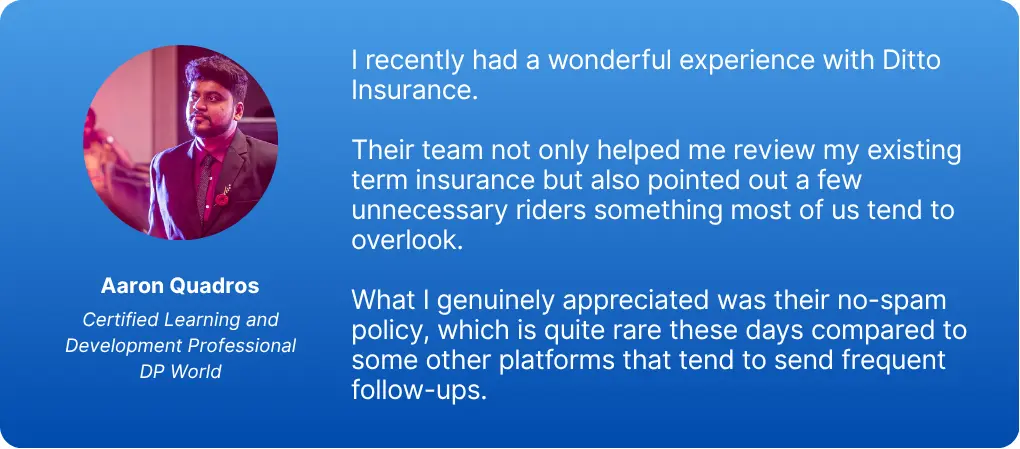
At Ditto, we’ve assisted over 8,00,000 customers with choosing the right insurance policy. Why customers like Aaron below love us:
- No-Spam & No Salesmen
- Rated 4.9/5 on Google Reviews by 15,000+ happy customers
- Backed by Zerodha
- 100% Free Consultation
You can book a FREE consultation. Slots are running out, so make sure you book a call or chat on WhatsApp now!
Ditto’s Take on SBI Life vs HDFC Life
Both SBI Life Insurance and HDFC Life are among the most reliable insurers in India. SBI Life stands out for its massive distribution network, brand strength, and scale. Meanwhile, HDFC Life excels in operational efficiency, product innovation, and customer service.
Ultimately, the right insurer depends on your priorities, whether you value lower premiums, simple plans, and reach (SBI Life) or strong claim metrics and product flexibility (HDFC Life).
If you are looking for a term plan that aligns with your future goals, we recommend exploring the best term insurance companies that offer comprehensive policies.
Full Disclosure: HDFC Life is a partner insurer of Ditto, while SBI Life isn’t. The above article has been written for informational purposes, and all the details have been sourced from IRDAI reports, insurer websites, and publicly available data.
Frequently Asked Questions
Last updated on: