




What is Home Loan Insurance?
Imagine you take a ₹1 crore loan to buy a home. Ten years down the line, only 60% of it is repaid. If something unfortunate were to happen to you, who would protect your family?
Most banks tend to suggest home loan insurance, and it does sound reassuring on paper, but is it the best option for you?
In this blog, we’ll explain how home loan insurance works, its pros and cons, and whether you should opt for it.
How Does Home Loan Insurance Work in India?
Here’s how it typically works:
- You take a home loan from a bank or NBFC.
- The lender offers you a home loan insurance plan (sometimes bundled with the loan).
- If you pass away during the tenure, the insurer pays the outstanding loan amount directly to the lender.
This ensures your family is not burdened with EMIs, and the property remains in their name.
Note: Many lenders present certain insurance products as “required,” but they are not regulator-mandated for loan approval in the way it is often implied.
To address this kind of “forced bundling” and mis-selling, the Reserve Bank of India (RBI) has invited public comments on draft amendments, aimed at issuing comprehensive guidelines on the advertising, marketing, and sale of financial products by banks.
Home Loan Insurance in the Eyes of RBI and NHB

Key Aspects of Home Loan Insurance
Alignment with Loan Tenure
The policy tenure usually matches your home loan tenure (15-30 years). Once the loan ends, the cover ends too.
Types of Coverage
Reducing cover, where the sum assured reduces every year as the loan principal reduces. Level cover, where the coverage remains constant throughout the policy term. Hybrid cover, where the coverage remains constant for an initial period and then reduces later.
Premium Payment Options
Single premium: paid upfront and often added to the loan amount, which means you’ll also pay interest on the premium with your EMIs. Regular premium: paid monthly or annually. While adding the premium to the loan may seem convenient, it increases your effective borrowing cost.
Add-ons and Riders
Many home loan insurance plans allow riders such as critical illness cover, permanent disability cover, and job loss protection. However, these riders increase the premium and vary in scope.
Joint Borrower Coverage
If the home loan has co-borrowers, the policy can cover both individuals. If one borrower passes away, the insurer clears the outstanding loan liability as per policy terms.
Tax Benefits
Premiums paid toward home loan insurance may qualify for tax deductions under Section 80C of the Income Tax Act (subject to prevailing tax laws). The payouts under these policies are also tax-free under Section 10 (10D).
Home Loan Insurance Plans
Several home loan protection plans and credit life insurance products are currently available in India. For example, ICICI Prudential offers ICICI Pru Loan Protect, which is an individual loan protection term plan.
In addition, many lenders offer group credit life insurance plans for home loans. These typically include:
- Axis Max Life Insurance’s Credit Life Secure
- HDFC Life Insurance’s HDFC Life Group Credit Protect Plus
- Tata AIA Life Insurance’s Tata AIA Group Loan Protect
- PNB MetLife India Insurance’s PNB MetLife Complete Loan Protection Plan
- SBI Life Insurance’s SBI Life Rinn Raksha
- Kotak Mahindra Life Insurance’s Kotak Loan Protect Cover
- Aditya Birla Sun Life Insurance’s Credit Life variants
- Bajaj Life Insurance’s Group Credit Protection Plus
In practice, most home loan insurance policies sold at the time of loan sanction are group credit life plans. In these arrangements, the lender acts as the master policyholder, and the borrower is added as a member. The insurance cover is often structured as a reducing sum assured that decreases in line with the outstanding home loan balance.
What Is Not Included in Home Loan Insurance?
Many people assume home loan insurance covers everything. It doesn’t.
Typically, it does not cover:
- Job loss (unless you’ve bought a specific rider)
- Critical illnesses (unless added)
- Property damage (that’s separate property insurance)
- Missed EMIs due to financial hardship
Advantages and Disadvantages of Home Loan Insurance
Common Mistakes to Avoid While Purchasing Home Loan Insurance
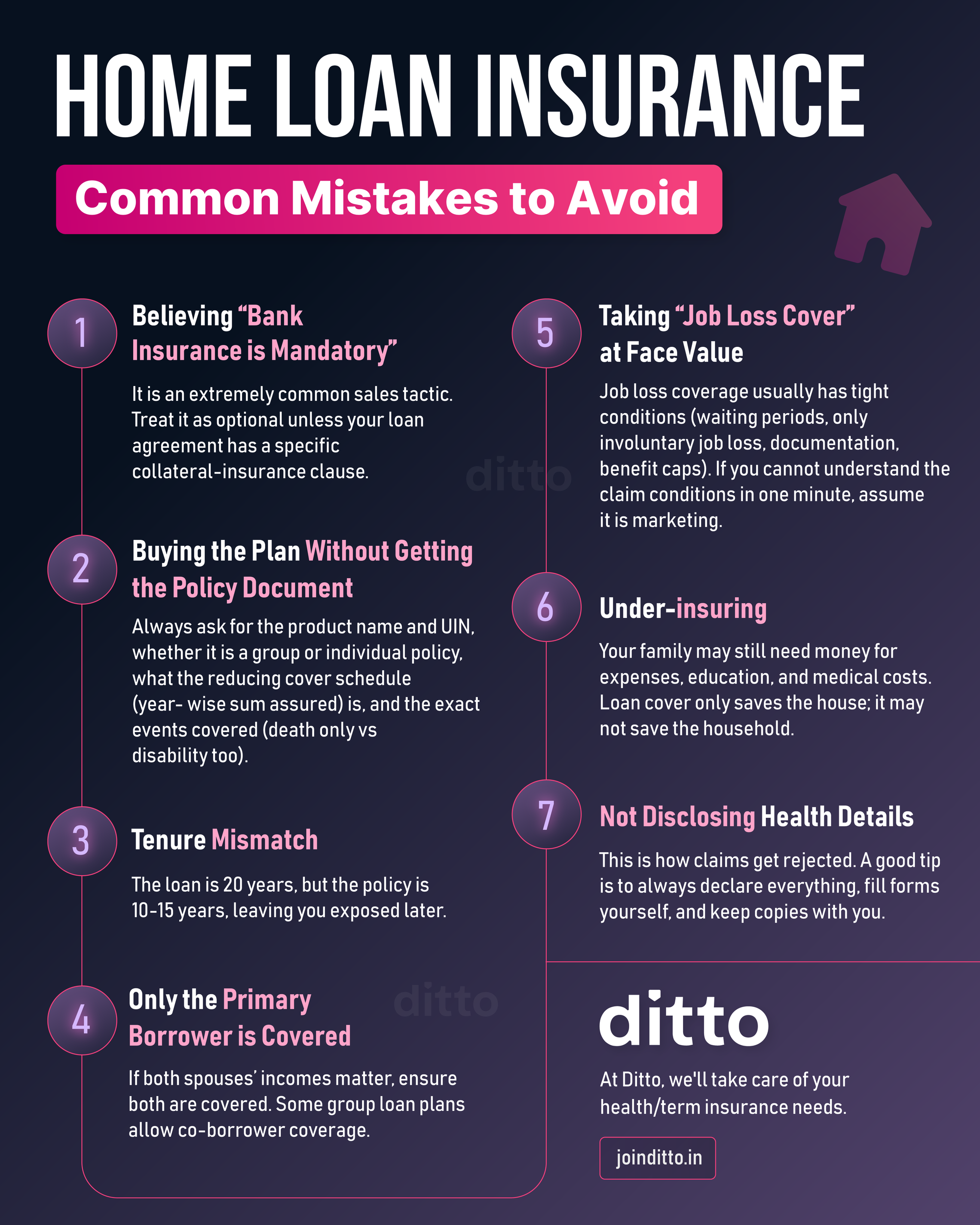
When Does Home Loan Insurance Make Sense?
- You want a clean “loan-only” solution and do not want to think about sizing term insurance
- You are getting a competitively priced plan (not inflated via distribution cost)
- You are paying the premium upfront (not financing it inside the loan), or the cost difference is still acceptable
- Your dependents would struggle to manage the loan paperwork/EMIs if something happens
- You are unable to get an adequately sized term plan (medical reasons), and the group cover is your only workable option
However, apart from these cases, home loan insurance is not a good product purely from a cost-efficiency standpoint. So, what should one opt for?
Home Loan Insurance vs Term Insurance: Which is Better to Protect Your Family?
Takeaway: Loan prepayment or foreclosure doesn’t automatically cancel the policy; refunds follow insurer formulas, and the cover can’t be transferred to a new loan or lender.
Cost Over Tenure: Why Structure Matters
Consider a ₹1 crore home loan for 20 years at 8.5% interest. After 10 years, the outstanding loan would be roughly ₹60 lakh. If the borrower passes away at this point, a reducing mortgage insurance plan would pay only the ₹60 lakh outstanding directly to the bank, closing the loan but leaving the family with no additional funds.
In contrast, a ₹1 crore term insurance plan would pay the full ₹1 crore to the nominee. The family could clear the ₹60 lakh loan and still retain ₹40 lakh for living expenses, children’s education, or long-term investments. They can also choose to transfer the loan in their name and continue to pay the EMIs with the sum assured.
There is also a cost-structure difference to consider. If a lender adds a ₹2,00,000 single-premium mortgage insurance policy into a 20-year loan at 9%, that premium itself gets financed. At 9% over 20 years, it increases the EMI by roughly ₹1,799 per month, and the borrower ends up repaying about ₹4.31 lakh in total (principal plus interest) for that ₹2 lakh premium. In effect, you pay interest on the insurance premium for the entire tenure.
Term Insurance Premiums
For this example, we’ve considered profiles of healthy, non-smoking, salaried individuals covered for a sum assured of ₹1 crore till the age of 65. The premiums are indicative in nature and vary based on your age, income, medical history, underwriting outcomes, etc.
Why Choose Ditto for Term Insurance?
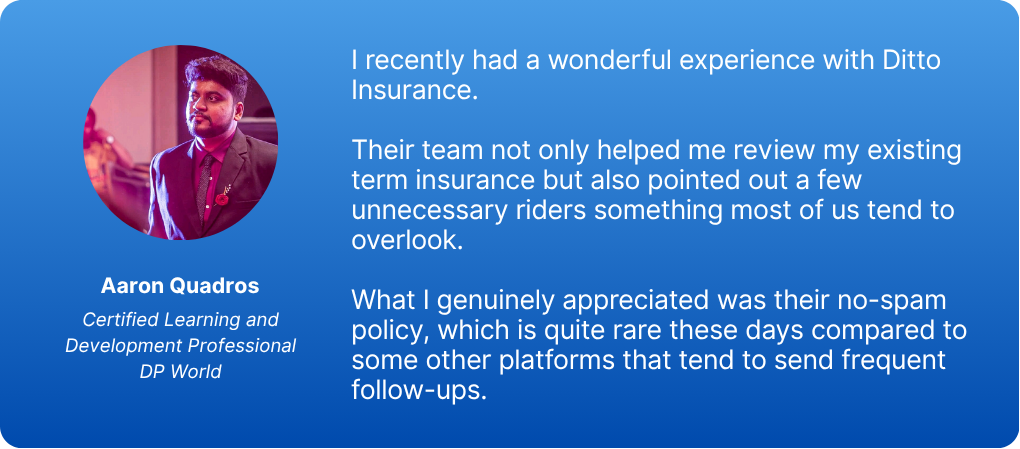
At Ditto, we’ve assisted over 8,00,000 customers with choosing the right insurance policy. Why customers like Aaron below love us:
- No-Spam & No Salesmen
- Rated 4.9/5 on Google Reviews by 15,000+ happy customers
- Backed by Zerodha
- 100% Free Consultation
You can book a FREE consultation. Slots are running out, so make sure you book a call or chat on WhatsApp now!
Ditto’s Take on Home Loan Insurance
If you want comprehensive protection for your family that’s cost-effective and flexible, a term plan, particularly one with life stage enhancement options, is typically the smarter choice over standalone home loan insurance.
If the bank insists on having some sort of life insurance coverage, you can also assign your existing term life insurance policy in the bank's favor for the outstanding portion of the loan. After the loan is cleared, the assignment is removed, and you can continue your term cover just for your family.
A term product like HDFC Life’s Click2Protect Supreme Plus adds even more value. It allows you to increase your sum assured at key life stages, such as when you take a home loan, get married, or welcome children, without undergoing fresh medical tests in many cases. This life stage benefit helps align your cover with evolving responsibilities and makes protecting your family financially easier while applying for a home loan.
If you are more worried about job loss or disability than death, consider strengthening your safety net with a personal accident policy that includes permanent disability cover, maintaining an emergency fund that can cover 6 to 12 months of EMIs, and ensuring you have adequate health insurance in place, since large hospital bills are one of the most common reasons borrowers struggle to keep up with their EMIs.
Our Takeaway: Consider term insurance as your core protection, with optional assignment to cover the loan. Unless there are underwriting concerns, such as medical or health issues, a home loan protection plan generally becomes the preferred or only viable option.
Disclosure
Frequently Asked Questions
Last updated on: