
Quick Review

Individual health insurance is a health policy bought for one person, where the full sum insured (SI) is reserved only for that individual’s medical expenses. Unlike family floater plans, the coverage is not shared with other members, and no other person can make claims using your sum insured.

Individual health insurance is ideal for people who want dedicated coverage, higher control over benefits, and specialized plans. It is especially suitable for those with pre-existing diseases (PED), senior citizens, or anyone needing tailored health coverage.

Choosing the right health insurance today is not just about the price you pay, it's also about the control and long-term protection it gives you. Individual health insurance gives you dedicated coverage that is not impacted by anyone else’s claims, making it a strong alternative to shared plans. 

In this guide, we break down individual health insurance plans and compare them with multi-individual and family floater options. We also explain how to convert corporate health insurance into individual coverage and help you decide which structure suits your life stage and health needs best.

Best Individual Health Insurance Plans in India

PlansBest ForKey StrengthsKey Watch-outs
HDFC ERGO Optima SecureIndividuals who prioritize claim reliability & long-term security2× cover from Day 1 + doubles again in 2 years (regardless of claims);  Consumables covered by default;   Strong riders for PED reduction, OPD & unlimited coverPremiums higher than peers;  Less “flashy” wellness features
Care SupremeCost-conscious buyers wanting maximum value & flexibilityUnlimited automatic recharge (related & unrelated);  Bonus up to 100% (extendable to 600% / unlimited);  Claim Shield for non-payables;  Strong pricing vs featuresHigher complaint ratio vs top insurers;   Service quality can be inconsistent
Aditya Birla Activ One MAXYoung, active individuals who value wellness-linked savingsUnlimited restoration from 2nd claim onwards;  Bonus up to 500% (up to ₹3 Cr cover);  HealthReturns can reduce premiums significantly;  Well-priced for feature depthWellness benefits need active engagement;  Insurer still building long-term service consistency
Niva Bupa ReAssure 2.0 Platinum+Buyers wanting feature-heavy, future-ready coverUnlimited restoration after first claim;  Age-lock on premiums until first claim;  Booster+ carries SI up to 10×;  Safeguard add-ons protect bonuses & consumablesAge-lock resets after a claim;  Claims experience not as consistent as top-ranked insurers
SBI General Super Health Platinum InfiniteHigh-income individuals seeking maximum benefits without compromisesUnlimited reinstatement (up to 200% SI per claim);  Health Multiplier boosts cover up to 3× for serious illnesses;  Global treatment + air ambulance;  Short PED waiting period (2 years)Very expensive premiums;  Global & multiplier benefits apply only to listed illnesses

Why Choose Individual Health Insurance?

1. Dedicated Coverage With No Sharing:

Individual health insurance gives one person exclusive access to the entire sum insured. This makes an individual health insurance policy easier to predict and manage over time.

2. Better for Pre-Existing Diseases and Seniors:

Individual health insurance plans are ideal for people with pre-existing diseases or senior citizens who face higher claim chances. Each person gets coverage priced to their own risk which makes individual health insurance more practical than shared covers for long-term needs.

3. Easier Transition from Corporate Health Cover:

When you leave a job, your company’s health cover ends, leaving a gap in protection. Switching to an individual policy lets you continue coverage and carry over waiting periods for pre-existing conditions.

4. Protection from premium Shocks Within the Family:

In family floater plans, premiums are calculated based on the eldest member’s age, not individual risk. This means one senior member or a large claim can increase premiums for the entire family. Individual health insurance isolates this risk. Your premium is linked only to your own age and health, which makes an individual health insurance policy more stable and predictable over time.

5. Clear Advantage over Multi-Individual Plans:

Multi-individual plans give separate sums insured but link premiums and renewals. Individual plans keep claims, bonuses, and underwriting fully independent. Some features in multi-individual plans apply per person (like waiting periods), others per policy (like add-ons), so check the wording carefully. This makes individual plans ideal for families with uneven health risks.

Difference Between Individual, Multi-Individual, and Family Floater Health Insurance Plans

FeatureIndividual Health InsuranceMulti-Individual Health InsuranceFamily Floater Health Insurance
Type & Policies1 policy per person1 policy for multiple family members1 policy for the whole family
Sum InsuredDedicated to one person onlyEach member has a separate dedicated sum insured (individual buckets)Shared pool for all family members
Claim ImpactNo impact on others; claims affect only the insured personClaims of one member do not reduce others’ coverageAny claim reduces the sum insured available for all members
Premium CalculationBased on individual’s age, health, and risk profilePremiums are total of each member’s age-based premium, often with a family discountBased on the eldest member’s age; can increase if senior members or high-risk members are included
No Claim Bonus (NCB)Earned individuallyCalculated separately for each memberA single claim by any member can reset the bonus for the entire family
Policy ManagementSeparate renewals for each personSingle renewal for the family; easier adminSingle renewal for the family; less flexibility per individual
Biggest Practical EffectMaximum independence; full control over benefits, claims, and add-onsIndependence per member with convenience of single policyCost-effective for young families, but a large claim can exhaust the coverage pool
Best ForIndividuals or families with uneven health risks, chronic conditions, or diverse needsFamilies with parents included or big age gaps; want per-member cover but single policy convenienceYoung couples or nuclear families with small kids; want maximum cover per rupee and are okay with shared coverage risk
Key Nuances / InsightsIdeal if each member needs custom add-ons, riders, or tailored coverage; premium shocks are isolatedCombines the benefits of individual coverage with simpler admin; protects each person’s cover while keeping documentation unifiedEconomical, but one large claim can reduce the sum insured for everyone; less flexible for older members or high-risk individuals
CTA

How to Convert Corporate Health Insurance to Individual Policy?

Moving from a corporate/group health plan to an individual policy in India involves a simple two-step process under IRDAI guidelines:

    • Step 1: Migrate within the same insurer
      • Done when leaving the organization, if the group policy changes, or if it’s withdrawn.
      • Continuity benefits apply; waiting period credits and cumulative bonus are carried forward.
      • Migration is subject to underwriting; insurers may assess health, ask for tests, adjust premiums, or apply exclusions.

        Note: IRDAI requires insurers to communicate their underwriting decision within 15 days. Also make sure there is no break in coverage. Your individual policy should start immediately after the corporate plan ends to retain waiting period benefits.
    • Optional Step 2: Port to another insurer
      • Once you are on an individual indemnity policy, you may choose to port to another insurer. Portability is typically initiated 60–30 days before renewal (and sometimes within 15 days after), with regulated timelines for data sharing and insurer decisions.

Important Practical Notes

    • Direct porting from a group policy to another insurer is usually not allowed—you must migrate first.
    • Credits are generally limited to your earlier sum insured; higher coverage often comes with fresh waiting periods.
    • Corporate premiums are subsidized—individual policy premiums will reflect your age and health profile.

Individual Health Insurance Plans: Premium Comparison

Plan NamesAge 25Age 35Age 45Age 55Age 65
HDFC ERGO Optima Secure₹14,060₹15,865₹18,430₹37,620₹64,932
Care Supreme₹12,896₹12,896₹17,593₹27,569₹43,442
Aditya Birla Activ One MAX₹10,148₹11,253₹16,914₹28,829₹50,164
Niva Bupa ReAssure 2.0 Platinum+₹11,616₹13,625₹16,892₹30,220₹53,053

Note: The annual premiums shown above are indicative and calculated for individuals opting for a ₹15 lakh sum insured under individual health insurance plans in New Delhi, with no pre-existing diseases. Premiums may vary based on city of residence, medical history, insurer underwriting, and selected riders or add-ons.

Why Approach Ditto for Health Insurance?

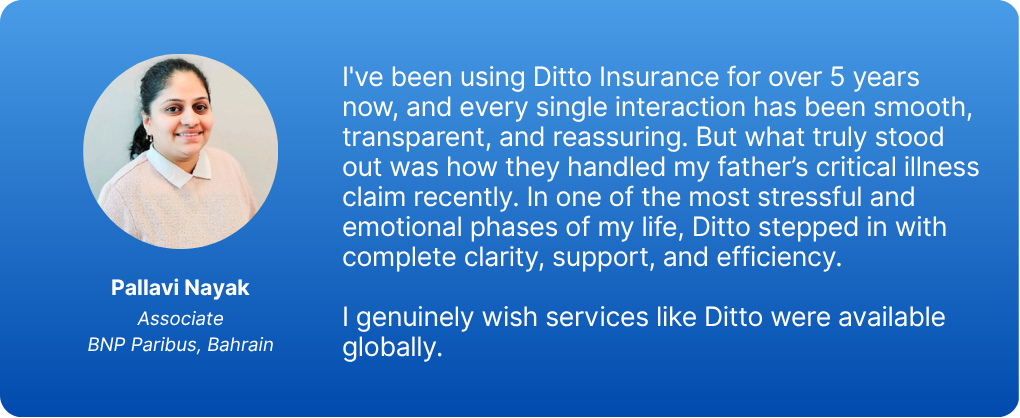
At Ditto, we’ve assisted over 8,00,000 customers with choosing the right insurance policy. Why customers like Pallavi below love us:
Individual Health Insurance
    • No-Spam & No Salesmen
    • Rated 4.9/5 on Google Reviews by 15,000+ happy customers
    • Backed by Zerodha
    • Dedicated Claim Support Team
    • 100% Free Consultation

Confused about the right insurance? Speak to Ditto’s certified advisors for free, unbiased guidance. Book your call now or WhatsApp us slots fill up fast!

Who Should Buy Individual Health Insurance & How Much Cover to Choose

Individual health insurance is best suited for people who want full control over their coverage. It is better for individuals with pre-existing conditions, senior citizens, or families where members have very different health needs and risk profiles. Separate individual policies offer maximum independence, ensuring one person’s claims or age do not affect others’ premiums or benefits. 

As for coverage, a sum insured of ₹15–25 lakh is a practical starting point in metro cities. Higher coverage is recommended for those with medical conditions, high hospitalization costs, or long-term planning needs, to stay protected against rising healthcare inflation.

Disclaimer: This article is for informational purposes. Some insurers featured are partner insurers of Ditto. The information presented is based on insurers’ websites, policy wordings, official disclosures, IRDAI-published data, and Ditto’s claims-handling experience across thousands of customers. You can read more about how we evaluate insurers on Ditto’s Cut.

Frequently Asked Questions

What to check before buying individual health insurance?

Check for room rent limits, co-payments, sub-limits, and waiting periods, not just the premium. Choose plans with unlimited restoration, a strong cashless hospital network. You may also choose useful riders like PED reduction or consumables cover, based on specific needs. Always disclose medical history honestly to avoid claim rejection.

What happens to my individual health insurance if I move to a new city?

Your individual health insurance policy remains valid across India. However, if your insurer uses "Zone-based pricing," moving from a Tier-2 city to a Metro (Zone 1) might result in a slightly higher premium at the time of renewal to match the increased cost of healthcare in that region.

How do I make a claim for my individual health insurance?

You can make a claim under either a cashless or reimbursement process. For cashless claims, inform the insurer or Third-Party Administrators (TPAs) at the time of planned admission (usually 48 hours in advance) or within 24 hours in case of an emergency. For reimbursement claims, submit all required documents: hospital bills, discharge summary, and medical reports, typically within 7–15 days of discharge, depending on the insurer’s policy terms.

Last updated on: