



Quick Overview
While India is the birthplace of yoga, treatments involving it weren’t always covered under health insurance. That meant people who preferred traditional healing systems often had to pay out of pocket. Even today, many Indians rely on Ayurveda, Yoga, Unani, Siddha, or Homeopathy as their first line of treatment. That’s why the IRDAI’s move to mandate AYUSH coverage has been a welcome shift. Before this, not many insurers offered AYUSH coverage. And even if they did, it was usually capped by an amount or a certain percentage. In most cases, you need to be admitted to a government-approved AYUSH hospital or center for at least 24 hours, based on a registered practitioner’s recommendation.
In this article, we’ll break down what AYUSH treatment is, what it covers and excludes, and whether it makes sense for you.
Benefits of AYUSH Treatment Cover in Health Insurance
Access to Holistic Treatments
Lower Side Effects
Wider Acceptance Among Insurers
Cost-Effectiveness
What Does AYUSH Treatment Cover and Doesn’t Cover in Health Insurance?
Note: At Ditto we have noticed that it is generally harder to claim for AYUSH treatment. That’s because it’s usually hard for an AYUSH practitioner to justify a hospitalization of more than 24 hours for such procedures. Hence, such claims are routinely dismissed because they don’t meet the burden of proof.
Reasons to Select a Health Insurance Policy with AYUSH Cover
Choosing a health insurance policy with AYUSH cover makes sense if you value flexibility in how you approach treatment. It ensures you’re not limited to only allopathic care and can opt for Ayurveda, Homeopathy, or other traditional therapies without worrying about costs. This can be especially useful if you already prefer holistic treatments or want gentle recovery options with potentially fewer side effects. Since modern insurers include AYUSH benefits by default, it gives you broader coverage without drastically increasing your premium.
Why Choose Ditto for Health Insurance?
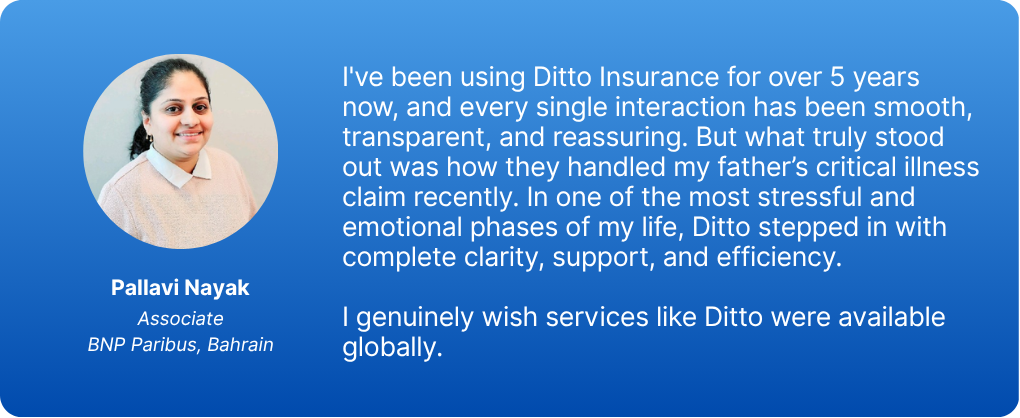
At Ditto, we’ve assisted over 8,00,000 customers with choosing the right insurance policy. Why customers like Pallavi below love us:
- No-Spam & No Salesmen
- Rated 4.9/5 on Google Reviews by 15,000+ happy customers
- Backed by Zerodha
- Dedicated Claim Support Team
- 100% Free Consultation
Confused about the right insurance? Speak to Ditto’s certified advisors for free, unbiased guidance. Book your call now or chat over WhatsApp, slots fill up fast!
Ditto’s Take On AYUSH Cover in Health Insurance
While AYUSH coverage is now widely included even in the best health insurance plans, your ability to claim it still depends heavily on policy terms. That said, it’s a positive step that encourages people to explore more holistic and non-invasive treatments. If adoption grows, it could benefit insurers too, since AYUSH treatments are often more affordable than modern medical procedures. For now, we’d consider AYUSH coverage a good-to-have feature (rather than a must-have). Considering the above discussed conditions, this feature solely should not be the deciding factor in purchasing a plan.
If you’re choosing a policy primarily for AYUSH benefits, make sure to compare your options, and read the fine print carefully. Check whether the specific treatments you’re interested in are covered, so you don’t run into surprises during claims.
Frequently Asked Questions
Last updated on: