
Quick Overview

A mediclaim policy is a health insurance plan that helps cover hospitalization expenses when you are admitted to a hospital. It pays admissible costs up to your sum insured through cashless treatment or reimbursement. What decides how much you actually get is the policy wording, not the label. Plans with room rent caps, co-pay, and treatment sub-limits can reduce claim payouts even with a high sum insured. Look for comprehensive coverage with fewer caps, clear exclusions, reasonable waiting periods, and optional coverage for consumables.

A mediclaim policy is supposed to protect you in a medical emergency. But for many people, the first time they truly read their policy is when a claim gets stuck or denied.

According to IRDAI's annual report (FY 2024-25), insurers settled only 87% of health insurance claims in India. This means 13% were rejected. On paper, 13% may not seem like a large number, but it feels very different if your claim happens to be the one that doesn't make it through.

That is why you should understand what a mediclaim policy actually is before you buy one. In this article, we explain how a mediclaim insurance policy works, the best mediclaim plans, and group coverage in India.

What Is a Mediclaim Policy and How Does It Work?

IRDAI does not define “mediclaim” as a separate product category. Under IRDAI’s product rules, health insurance is broadly classified into two buckets: indemnity-based and benefit-based.

    • Indemnity-based health insurance pays your actual loss (your eligible hospital bill), as per policy terms.
    • Benefit-based health insurance pays a fixed amount when a defined event happens, no matter what your bill looks like.

When someone says mediclaim insurance policy, they usually mean an indemnity-based hospitalization plan.

How Does Mediclaim Policy Work in Real Life?

Let’s understand this with a simple numerical example. 

Imagine you have a mediclaim policy with a sum insured: ₹15,00,000. Your hospital bill comes out to be ₹8,50,000. If the full amount is admissible, then you pay nothing, and the insurer pays the entire bill.

Now compare that to a benefit-based plan, like a hospital cash policy that pays ₹15,000 per day. If you were hospitalized for 3 days, the payout is ₹45,000, even if your bill is ₹8,50,000. 

In simple terms, a mediclaim policy (indemnity plan) is designed to pay the hospital bill, while benefit-based plans are usually additional plans that give you extra cash support.

Mediclaim Policy vs Health Insurance: Which is Better?

In modern India, health insurance vs mediclaim policy is not the right question to ask because there is basically no difference. “Mediclaim” is a legacy word that became popular decades ago because older hospitalization products were commonly marketed like that (especially by public sector insurers). Over time, people started using “mediclaim policy” incorrectly as a shortcut for any health insurance that pays hospital bills.

Today, insurers sell “health insurance” products, and plans that people call a mediclaim insurance policy are simply indemnity-based health insurance plans.

How to Choose the Right Mediclaim Insurance Policy in 2026

At Ditto, we use a simple, structured evaluation framework to rate plans on three practical factors:

    • Coverage and Features

We look at what changes your real payout, like room rent rules, co-pay, waiting periods (and reduction options), restoration, bonus, consumables, and key exclusions.

    • Insurer Reliability 

We check claims and service track record using IRDAI disclosures, complaint volumes, business scale, and hospital network strength.

    • Cost for a Benchmark Profile

We test whether the premium is meaningfully priced for what the plan offers.

These are combined into a single Policy Rating, which we standardize into a Ditto Policy Score so you can compare options quickly.

Best Mediclaim Policy in India: Types and Top Features

PolicyDitto Policy ScoreClaim Settlement Ratio (Average FY 22-25)Key Features
HDFC ERGO Optima Secure4.6/5 96.71%2x cover from day 1, doubles again in 2 years, irrespective of claims, no room rent limit, consumables covered by default
Care Supreme4.5/5 93.13% Unlimited recharge, bonus up to 100% irrespective of claims (higher via add-ons), no disease-wise sub-limits
Aditya Birla Activ One MAX4.4/5 95.81% Unlimited restoration, bonus up to 500% irrespective of claims, HealthReturns fitness discounts up to 100% 
Niva Bupa ReAssure 2.0 Platinum+4.3/5 91.62%Unlimited restoration, age-lock premium till first claim; unused SI carry-forward up to 10x 
SBI Super Health Platinum Infinite4.1/5 96.14% Unlimited reinstatement (up to 200% SI per claim), 3x cover for listed illnesses, OPD (outpatient department) + consumables built in 

For a detailed explanation, read more about the best health insurance plans in India.

CTA

Types of Mediclaim Policy Available in India

1) Based on Coverage

Individual vs Family Floater vs Group Mediclaim Policy

FeatureIndividual MediclaimFamily Floater MediclaimGroup Mediclaim
Who it CoversOne personFamily, including spouse and kids share one sum insuredEmployee group, often family too
Who Owns the PlanYouYouEmployer or organization
UnderwritingFull underwritingFull underwritingOften no medical underwriting
Waiting PeriodsStandard waiting rules applyStandard waiting rules applyOften, immediate coverage for many benefits (depending on the employer plan)
PortabilityYou can port across insurersYou can port across insurersDifficult to port
Best forParents, high-risk member, or solo coverYoung families and kidsBackup coverage while employed, or if you are unable to get comprehensive retail plans
Biggest CatchManaging multiple policies for many membersOne big claim can exhaust the shared poolEnds with employment and has limited customization

For more details, check out our guide on the best mediclaim policy for family.

2) Other Common Types 

These are variations built for specific needs.

Senior Citizen Plans

Often comes with more restrictions, like mandatory co-pay, so fine print matters more.

Maternity Coverage

Usually comes with waiting periods and sub-limits, so it works best when bought early.

Super Top-up

An add-on layer that can increase total cover at a lower cost, but only after an aggregate deductible is crossed.

Critical Illness, Personal Accident, Hospital Cash

Typically benefit-based, useful as add-ons, not replacements for a strong base plan.

Group Mediclaim Policy: Coverage, Benefits and Eligibility

Group mediclaim policy and group health insurance are the same thing. Since we already compared it with the individual and family floater in the table above, here’s the only extra context you need:

Rule-Based Eligibility: Coverage depends on the employer or organization’s master policy, including who counts as a dependent (spouse/kids/parents).

Layer Up: It’s great as backup while you’re covered, but don’t build your entire long-term health cover around it.

For the full breakdown (inclusions, common clauses, and how to plan your personal cover around it), read our dedicated guide on Group Health Insurance.

Why Choose Ditto for Health Insurance?

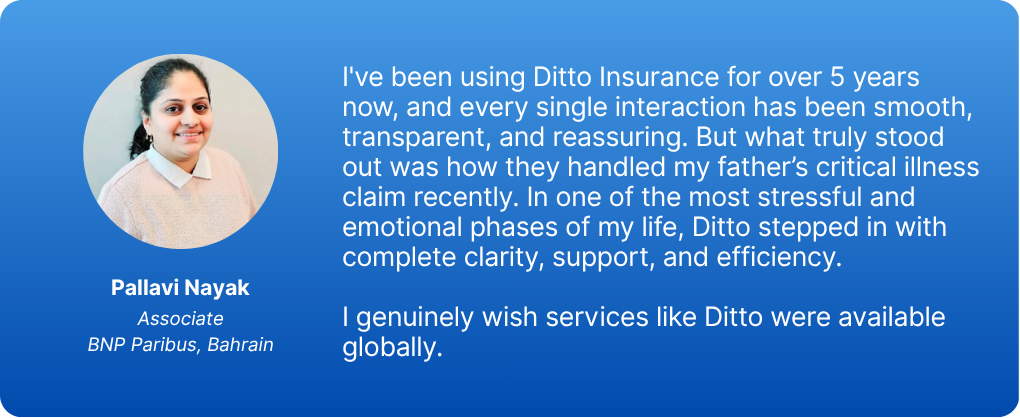
At Ditto, we’ve assisted over 8,00,000 customers with choosing the right insurance policy. Why customers like Pallavi below love us:
Mediclaim Policy
    • No-Spam & No Salesmen
    • Rated 4.9/5 on Google Reviews by 15,000+ happy customers
    • Backed by Zerodha
    • Dedicated Claim Support Team
    • 100% Free Consultation

Confused about the right insurance? Speak to Ditto’s certified advisors for free, unbiased guidance. Book your call or chat on WhatsApp with us now!

Ditto’s Take 

When most people say “mediclaim policy,” what they are really looking for is a good health insurance plan that pays hospitalization bills without any surprises. However, they should  not get stuck on the word “mediclaim.”

Here’s what we recommend:

    • Do not buy mediclaim policies based on marketing words. Check the policy wording and the insurer’s operational metrics and network hospitals to understand the real coverage being offered. 
    • Prioritize claim-friendly rules. The strongest plans are the ones that pay your full hospital bill. Look for fewer restrictions and caps so that your out-of-pocket expenses remain low.

In the end, a good mediclaim policy is just a comprehensive health plan with fewer restrictions on claims.

Quick Note

Ditto currently partners with HDFC ERGO, Care Health, Aditya Birla Health, and Niva Bupa. Some insurers on this list are non-partners, and we’ve still included them here because the article is unbiased and based entirely on published data, not on commercial relationships.

For a detailed explanation of our process, partnership policy, and disclaimers, please see our [Editorial Policy & Disclaimers] document.

Finally, this analysis is based on publicly available information and should not be treated as personalized advice. Always read the policy brochure carefully and consult a licensed advisor before purchase.


Frequently Asked Questions

What are non-payables or consumables in a mediclaim policy?

Non-payables are small hospital line-items that insurers usually do not cover (gloves, syringes, masks, admission charges, food, attendant items), so they get deducted from your claim. Some health insurance plans cover them via an inbuilt feature or add-on, so always check your policy wording.

Why do cashless claims get rejected in a mediclaim insurance policy?

The most common reasons are non-network hospitals, incomplete or delayed pre-authorization documentation, or policy conditions like waiting periods and exclusions. If cashless is declined, you can often still proceed via reimbursement if the treatment is covered and the documents are in order.

How much cover should my mediclaim policy have?

Choose your sum insured based on your city, preferred hospital type, and who you are covering. We recommend anywhere between ₹15-25 lakh of a base cover for most people because the bonus and restoration push your usable cover much higher. 

Can I port my mediclaim policy?

Yes, you can port your mediclaim insurance policy, but only at renewal, subject to underwriting. You typically apply 30 to 60 days before renewal, and the waiting period credit you already served carries forward; any extra sum insured you add may face fresh waiting periods for the incremental amount.

Can I have two mediclaim policies? How do claims work?

Yes, IRDAI allows using multiple health policies for the same hospitalization. In practice, you usually settle with one insurer first (often cashless), then claim the remaining eligible amount from the second insurer as reimbursement using the first insurer’s settlement summary.

Last updated on: