The SBI Life Claim Settlement Ratio (CSR) for FY 2024–25 stands at 98.83%. The insurer has maintained this strong performance, with a 3-year average of 98.24% for FY 2022–25, well above Ditto’s benchmark of 97%. This indicates that SBI Life Insurance settles a large number of claims, making it one of India's more reliable life insurers.
This guide is for anyone looking to assess how reliable SBI Life is in settling claims, understand its long-term claims performance, and evaluate whether it is the right insurer for their term insurance needs.
SBI Life Insurance Company Limited is one of India’s leading private life insurers. Registered with IRDAI in March 2001, it is a publicly listed life insurer promoted by State Bank of India (SBI), which held a 55.38% promoter stake as of March 31, 2025, alongside BNP Paribas Cardif. Its scale and strong institutional backing have helped it establish a credible position within India’s private life insurance sector.
However, brand value and business size alone are not enough when evaluating a term insurer. One of the most important metrics to assess is the claim settlement ratio, as it indicates how consistently an insurer honors eligible claims. This is where the SBI Life term insurance claim settlement ratio becomes relevant, particularly when evaluated alongside other operational metrics, including the Amount Settlement Ratio (ASR), complaint volume, solvency ratio, pending claims, and long-term settlement trends.
What is the SBI Life Claim Settlement Ratio, and How is it Calculated?
The SBI Life claim settlement ratio tells you what percentage of claims the insurer settled of the total claims received during a financial year. For example, if the company receives 100 claims and settles 98 of them, its CSR for that year stands at 98%.
Here’s how to interpret it:
98% and Above: Reflects a highly dependable insurer with strong, consistent claim settlement.
95% to 98%: Indicates that most claims are paid, but it is worth reviewing other metrics before making a decision.
Below 95%: May indicate a higher risk of claim delays or rejections and warrant closer scrutiny.
Formula: Claim Settlement Ratio = (Total Claims Settled ÷ Total Claims Eligible for Settlement) × 100
Note: The CSR reported by SBI Life is not specific to term insurance alone. It is calculated across the entire life insurance segment, including term insurance, Unit Linked Insurance Plans (ULIPs), whole life plans, endowment plans, and other offerings. Keep this in mind when comparing figures across insurers.
At Ditto, we focus on the 3-year average CSR rather than a single year's number, as it gives a more stable picture of an insurer's actual claim performance. Alongside the SBI Life claim settlement ratio, it is also important to review metrics like the Amount Settlement Ratio (ASR), complaint volume, business volume, and solvency ratio to make a well-rounded decision.
SBI Life Claim Settlement Ratio: Year-Wise Trend (Last 5 Years)
Year
Claim Settlement Ratio (%)
FY 2020–21
93.09%
FY 2021–22
97.05%
FY 2022–23
97.26%
FY 2023–24
97.62%
FY 2024–25
98.83%
3-Year Average (2022–25)
98.24%
Note: All this data is sourced from IRDAI annual reports and the insurer’s public disclosures. SBI Life Insurance has demonstrated a consistent improvement in its claim settlement performance over the past few years. More importantly, the insurer has maintained a strong 3-year average CSR of 98.24% between FY 2022–25, while also recording its highest CSR ratio of 98.83% in FY 2024–25.
Talk to an expert today and find the right insurance for you.
SBI Life Insurance maintains a strong claim settlement ratio, although it remains marginally below the industry average. Even so, its consistent improvement over recent years reflects strengthening claims performance and operational reliability.
The insurer’s Amount Settlement Ratio (ASR) is above the industry mean, indicating fair payouts across both high-value and low-value claims.
Its complaint volume is significantly lower than the industry median, suggesting a relatively smoother customer and claims experience compared to many peers.
SBI Life’s solvency ratio remains comfortably above the IRDAI requirement of 1.5x, reflecting strong financial stability and the ability to meet future claim obligations.
The insurer’s business volume is substantially higher than the industry median, highlighting its large operational scale and established market presence.
Note: At Ditto, we rely on 3-year averages for key operational metrics to smooth out short-term volatility and avoid overreacting to one-off events or seasonal variations.
Looking for the numbers behind the analysis? Ditto Data Lab brings together term insurance data from official reports, carefully organized by our team.
SBI Life CSR vs. Competitors: How Does it Stack Up?
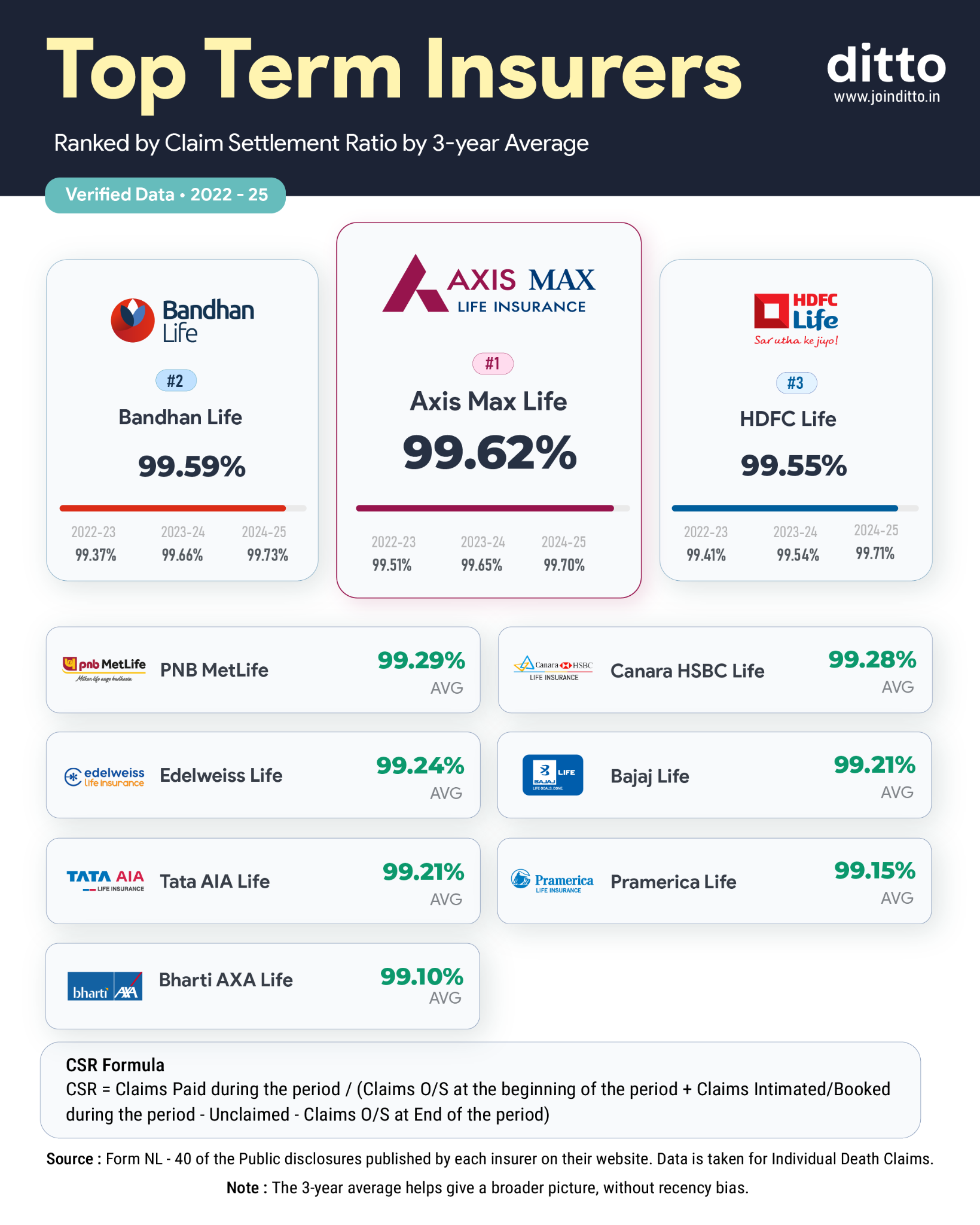
Note: SBI Life does not feature in Ditto’s top 10 term insurers by 3-year average claim settlement ratio because several private insurers currently maintain averages above the 99% mark. While the SBI Life term insurance claim settlement ratio remains strong, some competitors currently maintain slightly better long-term averages.
If you’d like to learn more about SBI Life in detail, we’ve covered it in our blog on SBI Life Insurance Review.
Why Choose Ditto for Term Insurance?
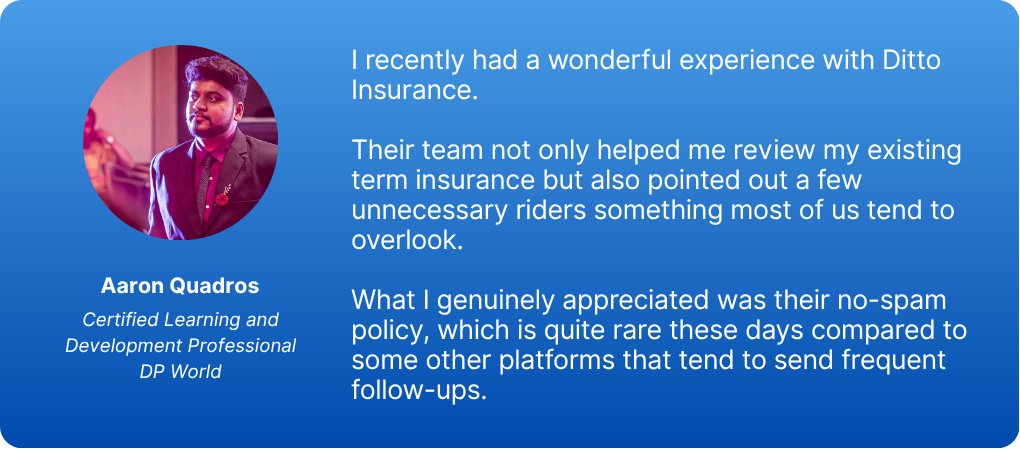
At Ditto, we’ve assisted over 8,00,000 customers with choosing the right insurance policy. Why customers like Aaron below love us:
No-Spam & No Salesmen
Rated 4.9/5 on Google Reviews by 15,000+ happy customers
Ditto’s Take: Should You Buy SBI Life Term Insurance Based on Its CSR?
SBI Life benefits from strong institutional backing, large-scale operations, and a consistent claims track record, all of which strengthen its credibility as a term insurer.
However, some leading private insurers currently perform better on metrics such as long-term claim settlement consistency, product flexibility, and overall plan competitiveness. Depending on your age, coverage needs, and premium budget, some competing insurers may offer more competitive pricing or flexible features than certain SBI Life insurance plans.
Overall, SBI Life remains a dependable option for buyers who prioritize brand trust and operational stability. That said, comparing it with other leading insurers before making a final decision is still the better approach.
What is SBI Life's term insurance claim settlement ratio over the last 5 years?
SBI Life’s claim settlement ratio, including term insurance, has improved significantly over the past five years. It increased from 93.09% in FY 2020–21 to 98.83% in FY 2024–25. The yearly figures are 93.09%, 97.05%, 97.26%, 98.62%, and 98.83%, respectively. Over FY 2022–25, the 3-year average stands at 98.24%. This consistent upward movement indicates steady improvements in claims-processing efficiency and operational systems, rather than a one-time increase in performance in a specific year.
Is SBI Life's claim settlement ratio good for term insurance?
SBI Life’s 3-year average claim settlement ratio of 98.24% for FY 2022–25 is considered strong for term insurance. It is higher than the broader life insurance industry average, which typically ranges between 96% and 97%. A ratio above 98% indicates that most eligible claims are settled successfully. However, some insurers report ratios above 99%, which sets a higher benchmark. While SBI Life performs well, it is still advisable to compare multiple insurers on additional parameters before making a final decision.
How does SBI Life compare to other insurers on the claim settlement ratio?
SBI Life’s 3-year average claim settlement ratio of 98.24% is strong, but does not place it among the top-ranking insurers. Some companies, such as Axis Max Life and HDFC Life, report averages above 99%, giving them a slight edge in comparison tables. However, SBI Life has shown significant improvement over time, rising from 93.09% in FY 2020–21 to 98.83% in FY 2024–25. While it may not lead the rankings, its steady upward trend indicates a dependable and improving claims performance.
Is SBI Life a good insurer for term plans based on CSR?
SBI Life can be a good choice for term insurance buyers who value institutional credibility, financial stability, and a consistent claims track record. Its strong distribution network and improving operational metrics also support its reputation as a dependable private insurer. However, the right insurer ultimately depends on your priorities. Some insurers may offer lower premiums, better rider flexibility, or stronger claim metrics for specific age groups and coverage requirements. Instead of relying only on CSR, compare overall policy value, underwriting experience, and long-term servicing quality before making a decision.
What is the SBI Life 3-year claim settlement ratio average?
SBI Life’s 3-year average claim settlement ratio for FY 2022–25 is 98.24%. This is calculated using the yearly figures of 97.26%, 98.62%, and 98.83% for FY 2022–23, FY 2023–24, and FY 2024–25, respectively. A multi-year average provides a more stable and reliable view of an insurer’s performance compared to a single year. It helps smooth out temporary fluctuations and provides a clearer picture of long-term consistency in claims, which is important when evaluating an insurer’s reliability.
Why is SBI Life not in the top 10 on the claim settlement ratio?
SBI Life’s 3-year average claim settlement ratio of 98.24% is strong, but it does not place the company in the top 10 rankings. This is because several private insurers consistently report averages above 99%. These higher ratios push SBI Life Insurance slightly below the top-performing group when comparisons are based purely on CSR. However, SBI Life’s steady improvement from 93.09% to 98.83% over five years shows meaningful progress and strengthens its position as a reliable insurer.
What does the SBI Life claim settlement ratio tell us about reliability?
A high claim settlement ratio generally indicates that an insurer settles most eligible claims successfully. In SBI Life’s case, the FY 2024–25 CSR of 98.83% and the 3-year average of 98.24% suggest a strong track record in honouring claims. However, CSR should not be viewed in isolation. Metrics such as claim processing timelines, complaint volumes, Amount Settlement Ratio (ASR), and solvency ratio also play an important role in evaluating overall reliability. Looking at these factors together provides a more complete assessment of an insurer’s claims performance and service quality.
What is the difference between the claim settlement ratio and the amount settlement ratio for SBI Life?
The claim settlement ratio shows the percentage of claims that are approved and paid. In contrast, the amount settlement ratio indicates the proportion of the total claim value that is actually paid out. A high CSR means most claims are accepted, but it does not guarantee full payouts in every case. ASR provides additional insight into whether policyholders receive the complete sum assured or a reduced amount. Reviewing both metrics together gives a more comprehensive understanding of an insurer’s claims performance.
Will SBI Life pay claims if there is a medical issue at the time of policy issuance?
If a medical condition is fully disclosed at the time of policy purchase and accepted by the insurer, claims are generally honored in accordance with the policy terms. The insurer may apply conditions such as higher premiums or exclusions based on the disclosed risk. Most claim rejections result from non-disclosure or incorrect information provided in the application. SBI Life’s strong claim settlement ratio suggests that properly disclosed and valid claims are typically paid without issues.
Does SBI Life's claim settlement ratio include all types of policies?
Yes, SBI Life’s claim settlement ratio includes individual death claims across all types of life insurance products. This covers term plans, endowment plans, ULIPs, and whole life policies. IRDAI calculates CSR as a combined metric rather than separating it by product category. As a result, the reported ratio reflects the insurer’s overall claims performance across its entire life insurance portfolio. This is important to keep in mind when evaluating CSR specifically for term insurance.