



Quick Overview
If you are looking up the claim settlement ratio of Star Health Insurance, you are likely trying to understand how dependable the insurer is when it comes to settling claims.
That is the right question to ask. While factors like a wide hospital network and strong brand presence are important, they do not always reflect the actual claims experience. What matters more is how consistently an insurer settles claims over time.
Based on current data, Star Health shows signs of improvement in recent performance. However, its 3-year average CSR still remains below the industry benchmark, which suggests that long-term consistency is still catching up.
How to Calculate the Star Health Insurance Claim Settlement Ratio?
The Claim Settlement Ratio (CSR) is calculated using the following formula:
CSR = (Total Number of Claims Settled / Total Number of Claims Available to Settle) × 100
Here, total claims settled include both fully and partially settled claims. Total claims available to settle include claims carried forward from the previous year and new claims reported during the year. From this, claims closed without payment and claims still pending at the end of the year are subtracted.
Note: The Insurance Regulatory and Development Authority of India (IRDAI) does not prescribe a standard formula for CSR. As a result, the claim settlement ratio may vary depending on the methodology used by different insurers and platforms.
At Ditto, we use the above formula, as it better reflects delays and unresolved claims. We recommend focusing on the 3-year average CSR rather than a single-year figure, as it reflects consistency over time.
It is also important to review other metrics, such as complaints per 10,000 claims, Incurred Claims Ratio (ICR), and Gross Written Premium (GWP), for a more complete picture.
Talk to an expert
today and
find
the right
insurance for you.


Star Health Insurance: 3-Year Claim Settlement Ratio and Other Metrics
Note: All this data is sourced from IRDAI Annual reports and Insurers’ public disclosure.
Key Insights
- CSR: While there is a visible improvement in the latest year, the 3-year average remains below the industry benchmark, indicating only moderate consistency in settling claims over time.
- Complaints: The complaint levels are higher than the industry average, suggesting gaps in claims experience and post-sale service.
- ICR: The ratio is in the ideal 50% to 70% range, showing that the insurer maintains a strong balance between honoring claims and preserving financial stability.
- Annual Business: The insurer has shown steady growth over the years, highlighting its expanding market presence.
Note: If you'd like to explore the detailed figures reported by insurers and the IRDAI in their annual disclosures and public reports, visit Ditto Data Labs, our proprietary repository of health insurance data, meticulously compiled, verified, and maintained by the Ditto team over the years.

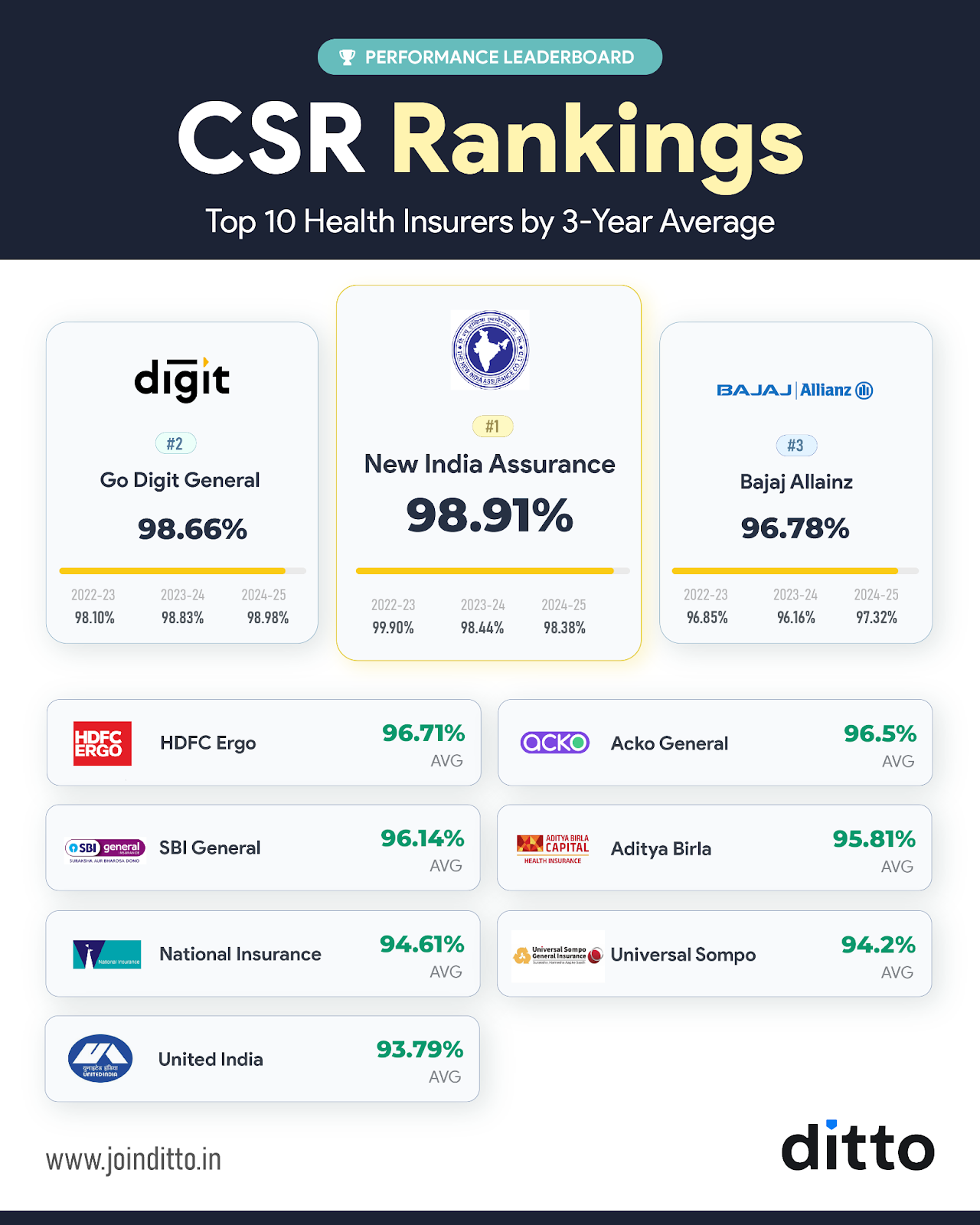
Top 10 Health Insurance Providers by Claim Settlement Ratio
Why Choose Ditto for Health Insurance?
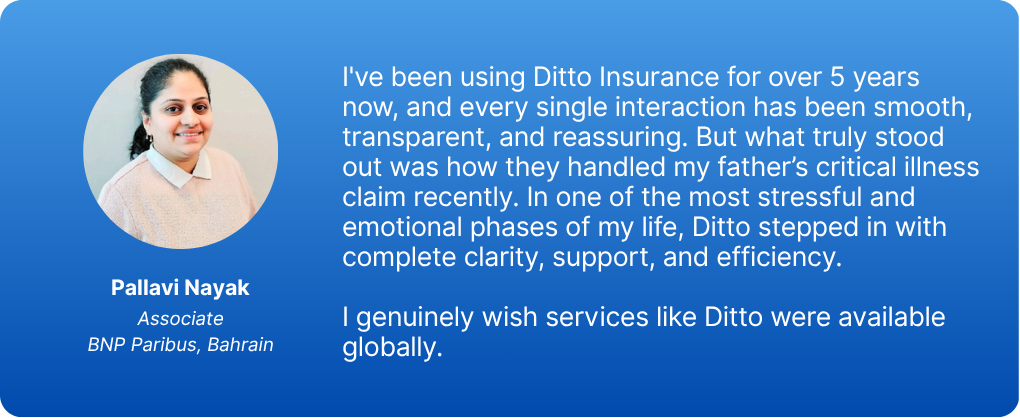
At Ditto, we’ve assisted over 8,00,000 customers with choosing the right insurance policy. Why customers like Pallavi below love us:
- No-Spam & No Salesmen
- Rated 4.9/5 on Google Reviews by 15,000+ happy customers
- Backed by Zerodha
- Dedicated Claim Support Team
- 100% Free Consultation
Confused about the right term insurance? Speak to Ditto’s certified advisors for free, unbiased guidance. Book your call or WhatsApp us now; slots fill up fast!
Ditto’s Take on Star Health Insurance
If you look only at the claim settlement ratio, Star Health does not emerge as the strongest option in the market. However, the overall picture is more nuanced.
While the insurer has improved its recent claims performance, its long-term track record in consistently settling claims still falls short of the industry benchmark. At the same time, Star Health brings meaningful strengths, including a wide hospital network, an in-house claims team, strong scale, and relatively fast processing for a large share of claims.
Our view is simple: If a Star Health plan aligns well with your needs, it can still be worth considering, especially if you have an advisor experienced in handling its processes and claims. But if claim consistency is your top priority, you should compare it carefully with stronger peers such as HDFC ERGO and ICICI Lombard.
You can also explore our detailed breakdown of top health insurance plans to see how different insurers compare across key parameters.
Ultimately, the decision should not be based on CSR alone. Evaluate plan benefits, waiting periods, exclusions, and overall claims experience before finalizing your choice.
Frequently Asked Questions
Star Health Customer Reviews
Last updated on: