

Quick Overview

The claim settlement ratio for SBI General Insurance in 2025 stood at 96.13%. Its 3-year average (FY 2022–25) is 96.14%, showing steady and consistent performance over time.

To put this in perspective, this is well above the industry average of 91.22% and broadly in line with other strong performers such as HDFC Ergo and Bajaj General Insurance.

In simple terms, SBI General has been reliably settling a high proportion of claims, which is a reassuring sign.

With deposits of ₹53.8 trillion, the State Bank of India is the largest in the country by a margin. That scale is often seen as a proxy for public trust, and by extension, brand credibility.

This same legacy carries into SBI General Insurance (IRDAI Reg. No. 144). Incorporated in 2009 as a joint venture between SBI and Insurance Australia Group (which later exited), the insurer has since grown into a sizable player, underwriting over ₹3,300 crore in gross health premiums annually.

In this article, we’ll break down SBI General’s claim settlement ratio - what it means, how it has moved over the years, how it compares with competitors, and whether it could be a suitable choice for you.

How to Calculate the SBI General Health Insurance Claim Settlement Ratio?

Claim Settlement Ratio (CSR), while not the only metric, is one of the most important ways to assess an insurer’s performance. It is the percentage of the insurer's total claims settled in a year relative to the total number of claims available to pay.

CSR = (Number of claims settled / Number of claims available to settle with the insurer) X 100The total claims available to settle include claims carried forward from the previous year, new claims reported, claims closed without payment, and claims still pending at year-end. 

Note: The IRDAI doesn’t have any specific formula for calculating the Claim settlement ratio. Hence, these numbers can differ depending on the formula used by different platforms and insurers. We, at Ditto: 

    • Use the formula mentioned above, as it better captures long delays in claim settlement by insurers.
    • Recommend looking at the 3-year average CSR, since a single year’s data isn’t enough to judge an insurer’s long-term stability.
    • Suggest reviewing the 3-year averages of other key metrics as well—such as Average complaints received per 10,000 claims, the Incurred Claims Ratio (ICR) and Gross Written Premium. This is important because CSR alone doesn’t differentiate between partially and fully settled claims, and therefore cannot give the full picture of an insurer’s performance.
CTA

SBI General Health Insurance: Last 3-year Claim Settlement Ratio and Other Metric

MetricsFY 2022-23FY 2023-24FY 2024-253-year Average (FY 22–25)Industry Average
Claim Settlement Ratio (in %)94.20%98.08%96.13%96.14%91.22%
Average Complaints per 10,000 Claims23.5923.2814.6620.5127.06
Incurred Claim Ratio (ICR) (%)74%88%NA81.23% (3-year average for 2021–24 used)83.93%(3-year average for 2021–24 used)
Annual Business / Gross Written Premium (crore)₹1,255₹3,999₹4,731₹3,329₹3969
Network HospitalsN/AN/A N/A16,600+ (as of today)10,000+ recommended

Note: The complaint numbers shown above reflect all of SBI General’s products (health, motor, and others), as the insurer does not publish product-wise complaint data separately.

Key Insights

CSR

SBI General’s 3-year average Claim Settlement Ratio stands at 96.14%, placing it among the better performers in the industry. This is especially notable since the insurer has managed to maintain similar levels over the last five years.

Complaints

SBI General received an average of 20.51 complaints per 10,000 claims over the last three years. This is slightly lower than the industry average of 27.06, though it is still higher than a few competitors that report single-digit complaint figures.

ICR

Its Incurred Claims Ratio (ICR) averages 81.23%, which puts it marginally outside our preferred range of 50–80%, and also around the industry average of 83.93%. That said, the ICR has fluctuated widely between 61% and 88%, pointing to some inconsistency.

Annual Business

SBI General’s Gross Written Premium (GWP) stands at ₹3,165 crore, which may feel modest for an insurer backed by the SBI brand. For context, Care Health Insurance, a standalone health insurer that started later in 2012, has a 3-year average GWP of ₹6,775 crore - more than twice that of SBI General.

Top 10 Health Insurance Providers by Claim Settlement Ratio

RankHealth Insurance CompanyCSR 2022–23CSR 2023–24CSR 2024–25Average CSR (2022–25)
1New India Assurance Co. Ltd.99.80%98.44%98.83%98.91%
2Digit Health Insurance98.18%98.83%98.98%98.66%
3Bajaj General Insurance96.85%96.16%97.32%96.78%
4HDFC ERGO Health Insurance95.49%97.19%97.45%96.71%
5Acko General Insurance97.45%96.31%95.75%96.50%
6SBI General Insurance94.20%98.08%96.13%96.14%
7Aditya Birla Health Insurance95.95%95.61%95.88%95.81%
8National Insurance Co. Ltd.95.60%94.68%93.56%94.61%
9Universal Sompo General Insurance100%93.39%89.21%94.20%
10Oriental Insurance Co. Ltd.93.05%94.21%93.38%93.55%

Why Choose Ditto for Health Insurance?

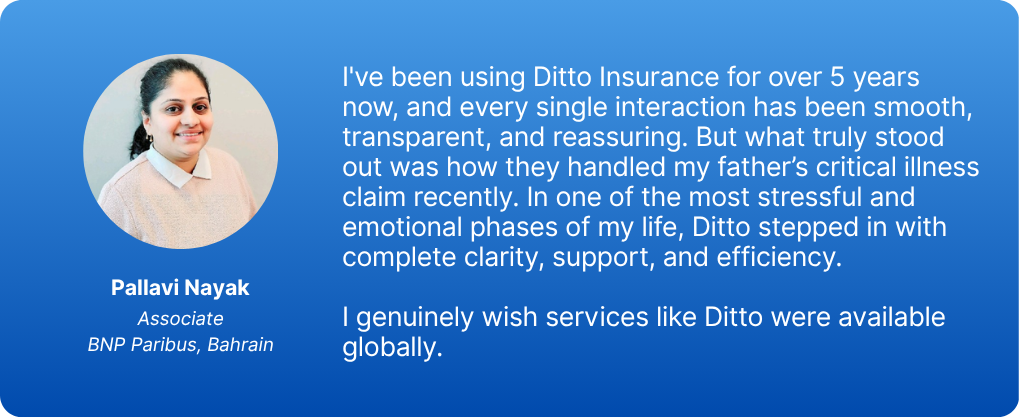
At Ditto, we’ve assisted over 8,00,000 customers with choosing the right insurance policy. Why customers like Pallavi below love us:
SBI General Health Insurance Claim Settlement Ratio
    • No-Spam & No Salesmen
    • Rated 4.9/5 on Google Reviews by 15,000+ happy customers
    • Backed by Zerodha
    • Dedicated Claim Support Team
    • 100% Free Consultation

Confused about the right insurance? Speak to Ditto’s certified advisors for free, unbiased guidance. Book your call now, slots fill up fast!

Ditto’s Take on SBI General

    • High Claim Settlement: SBI General has consistently reported one of the highest claim settlement ratios in the industry, making it a strong contender on this metric.
    • TPA Usage: While SBI General has an in-house claims team, it still relies heavily on TPAs. This can sometimes lead to delays or inefficiencies in the claims process.
    • Higher Premiums: Their plans tend to be slightly more expensive than those of peers, especially when you compare benefits. That said, this gap is gradually narrowing with newer offerings like SBI Super Health Platinum Infinite.
    • Read the Fine Print: Always go through the policy wording carefully so you’re clear about what’s covered, what’s excluded, and any limits that may apply.

Conclusion

SBI General has a strong brand pedigree, and its performance has consistently kept pace with that of some of the better-performing insurers in the market. That said, specific competitors may offer more well-rounded coverage at a similar premium. So, if you’re looking for the best fit, it’s always worth comparing the top health insurance options based on your individual needs.

Note

  • To know the methodology behind why the above plans are recommended, refer to Ditto’s Cut and Framework
  • Our assessment here is completely independent and based solely on publicly available data and the evaluation framework we use for all insurers. If you want to understand how Ditto reviews insurers across claims, complaints, business strength, and product suitability, you can read our methodology here. The information provided is for general awareness and should not be used for financial or legal decisions. Please refer to the official website for the latest details. 

Frequently Asked Questions

What are the types of claim process of SBI General health insurance?

In cashless, you get admitted to a network hospital, share your insurance details, notify the insurer (48 hours for planned admissions, 24 hours for emergencies), and complete the pre-authorisation process. The insurer then settles the bills directly. In reimbursement, you first pay the hospital bills yourself, then submit the claim form, discharge summary, and original bills to the insurer for review.

Where can I find the claim settlement ratio for SBI General Health Insurance?

You can calculate the claim settlement ratio for SBI General by navigating to the NL-37 form on the ‘Public disclosure’ page of their official website.

What are the documents required for SBI General Health Insurance Claims?

Make sure you have the soft/hard copies of the documents handy. For cashless claims, just the policy number (health insurance card) and a copy of ID proof are required. For reimbursement claims, you need a copy of a duly filled claim form, ID proof of the patient and proposer, discharge summary, medical documents, payment receipts, and the proposer’s bank details. Based on the underwriter’s decision, you may have to submit some additional documents.

Does SBI General’s CSR only include fully settled claims?

While there’s no fixed definition, CSR usually counts both fully and partially paid out claims as “settled.”

Does a higher sum insured reduce the chances of claim settlement?

No, a higher sum insured does not automatically reduce the chances of claim settlement. However, it can attract greater scrutiny at the application stage due to the higher risk involved. It also depends on many factors, such as the admissibility of the claim, truthful disclosure of pre-existing conditions, and more. 

Last updated on: