



Quick Review
Is Star Health Insurance good? It’s a common question among buyers, especially since Star Health is one of India’s most well-known standalone health insurers. In this guide, we break down how the insurer performs in claim approvals and settlements, examine its key benefits and drawbacks, and share our view on plan usability, real-world claim experience, and important tips to keep in mind before buying.
Overview of Star Health Insurance
Who They Are
Diverse Offerings
Claims Handling
Performance & Reliability
Some of Star Health’s Most Popular Plans: Super Star, Assure and Star Comprehensive.
Star Health Insurance Performance Metrics (2022–2025)
If you're asking "is Star Health Insurance good?", the best way to find out is to look at their track record over the last few years. At Ditto, we look at the average of the last three years to get a fair view of how they operate. Think of these numbers as the company's "report card." They show us how reliable the company is, how easily they pay out claims, and how often customers face issues.
The figures above are sourced from the insurer’s public disclosures (Form NL 37) and IRDAI Annual Reports.

Insights
Claim Settlement Ratio (CSR)
Star Health’s CSR improved from 80.07% in FY22–23 to 88.34% in FY24–25, with a three-year average of 84.97%. While the trend shows steady improvement, the CSR remains below the 90% industry average which is considered ideal. Buyers should note that claim settlement performance is moderate, and there may be delays or challenges in some cases.
Average Complaints
With an average of 52.31 complaints per 10,000 claims, Star Health sits on the higher side of the spectrum. Many of these complaints are about claims being rejected or delayed due to paperwork. As the largest standalone health insurer, Star Health has a very large number of customers, which adds to these complaints and shows the need for better complaint handling.
Incurred Claim Ratio (ICR)
An average ICR of 67.26% puts Star Health in a good “sweet spot” (the ideal range is 50–80%). This suggests that the company is effectively balancing its financial sustainability with its commitment to paying out policyholder claims.
Annual Business / Gross Written Premium (GWP)
Star Health maintains its position as a market leader, with its GWP growing from ₹12,952 crores to ₹16,716 crores. This consistent growth reflects a high level of brand trust and a dominant presence in the retail health insurance segment, where they currently hold approximately 32% of the market share.
Network Hospitals
Star Health boasts one of the largest hospital networks in India, with over 14,000+ hospitals. Its especially strong presence across South Indian states makes it a popular choice in the region. This wide reach helps policyholders access cashless treatment not just in metro cities, but also in many Tier-2 and Tier-3 locations.
Is Star Health Insurance Good: Benefits and Drawbacks
Determining whether Star Health Insurance is good or bad requires analyzing both its benefits and drawbacks.
Key Benefits of Star Health Insurance
- Specialised Plans for Diverse Needs: Star Health stands out for offering dedicated plans for individuals who are often declined or restricted by other insurers. This includes policies for cancer patients, cardiac conditions, diabetes, and children with autism. While these plans improve access to coverage, they usually come with condition-specific limits, waiting periods, or treatment caps, making it important to review the fine print.
- In-House Claims Processing: Unlike many insurers that rely on Third-Party Administrators (TPAs), Star Health handles claims through its own in-house team. This can improve coordination and speed up cashless approvals in many cases. However, claim turnaround times can still vary depending on hospital processes, documentation quality, and case complexity.
- Senior-Friendly Entry Options: Through its Senior Citizens Red Carpet plan, Star Health allows individuals aged 60 to 75 to purchase health insurance without mandatory pre-policy medical tests. This lowers entry barriers for older adults, though such plans typically include co-payments, longer waiting periods, or sub-limits that affect claim payouts.
- Modern Features in Newer Plans: Star Health’s newer offerings, such as the Super Star plan, include features designed to improve long-term value. These include premium stability through an age lock-in feature (“Freeze Your Age”) and unlimited restoration of the sum insured within the same policy year. These benefits add flexibility but often apply only after certain conditions are met.
- Wide Range of Add-On Covers: Star Health offers one of the most extensive add-on menus in the market, allowing customers to tailor their policy to specific needs. Options include reduced waiting periods for pre-existing diseases, maternity cover, hospital cash benefits, personal accident cover, high-end diagnostics, international second opinions, durable medical equipment cover etc. While this flexibility is a strength, selecting multiple add-ons can increase premiums and policy complexity.
Drawbacks of Star Health Insurance
- Claim Delays & Service Limitations: Many policyholders report slow and documentation-heavy claim processes. Claims can involve multiple follow-ups, repeated document requests, and delays in reimbursements. Given Star Health’s large retail customer base, personalised support is not always consistent, making it important for customers to maintain clear and complete medical records.
- Strict Claim Investigation & PED Scrutiny: Star Health, like all insurers, evaluates claims closely against disclosed medical history. However, many customers claim that even minor discrepancies or perceived omissions in documentation lead to rejections or repeated follow-ups, especially around pre-existing conditions (PEDs). In one reported case, a claim was denied repeatedly despite submitting documentation, with the insurer citing non-disclosure of medical history as a reason.
- Frequent Deductions & Partial Settlements: A common grievance relates to partial claim settlements. Deductions often arise due to non-medical expenses, room rent limits, procedure-wise caps, or interpretation of exclusions. Consumer disputes have highlighted cases where policyholders received significantly lower payouts than expected due to fine-print exclusions.
- Disputes with Hospitals and Cashless Issues: The Association of Healthcare Providers – India (AHPI) has raised concerns about Star Health Insurance, citing disputes over tariffs, treatment costs, unexplained bill deductions, and occasional suspension of cashless services at certain hospitals. These disputes can sometimes lead to cashless services being temporarily unavailable at certain hospitals, forcing patients to pay upfront and claim reimbursement later.
- Major Cybersecurity Failure & IRDAI Fine: In 2025, Star Health faced a regulatory penalty after a data breach exposed sensitive records of 31 million customers, including PAN details, medical reports, and mobile numbers. Hence, policyholders should be aware of potential data security considerations.
- Conflict with “Moratorium Period” Rules: Star Health has also faced legal action for wrongly denying claims even after 5 years of continuous renewals. According to IRDAI rules, insurers cannot reject claims for non-disclosure after 60 months unless there is proven fraud. Buyers should be aware of policy terms and the protection provided under IRDAI’s moratorium period rules.
5 Things to Check Before Buying Star Health Insurance
Go Through the Policy Wording Carefully
Make sure you understand how each benefit works, any sub-limits, and the permanent exclusions. Don’t rely just on marketing; knowing what the policy won’t cover helps avoid surprises when you file a claim.
Check Waiting Periods and Co-payments
Most plans have a 30-day initial wait, 24 months for specific diseases, and 1–3 years for pre-existing conditions. Senior citizen plans often have 10–20% co-pay, so you’ll pay a portion out of pocket.
Understand Maternity Coverage
Maternity benefits usually have a 24-month waiting period and capped payouts, either a fixed amount or a percentage of the sum insured (eg: 10% of base cover in Star Assure). Private hospital deliveries often cost more, so expect some out-of-pocket expenses even with coverage.
Keep Disclosures and Documents Accurate
Star Health reviews claims strictly, especially around pre-existing conditions. Make sure all health info is correctly disclosed at purchase, and keep your medical records complete to avoid delays or disputes.
Confirm Cashless Hospital Availability
Star Health has a big hospital network, but cashless facilities can vary by hospital and city. Some may offer reimbursement only, so always check before planned treatment to avoid last-minute hassles.
Why Talk To Ditto for Health Insurance
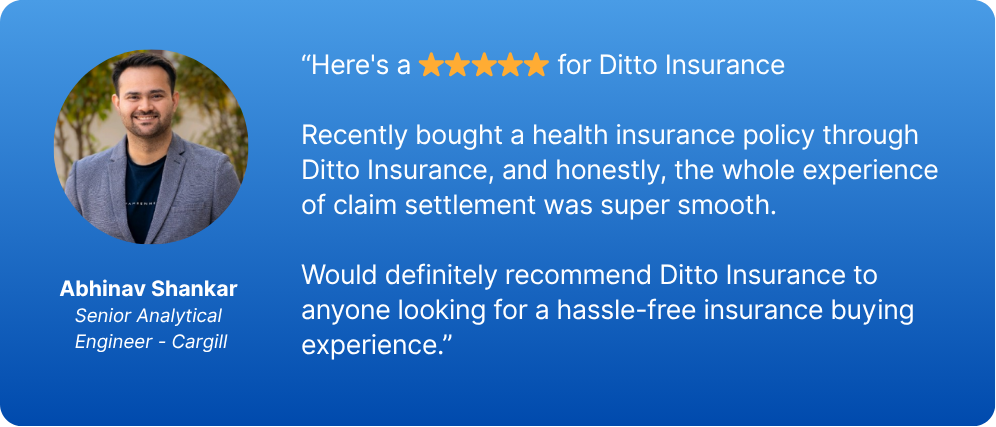
At Ditto, we’ve assisted over 8,00,000 customers with choosing the right insurance policy. Why customers like Abhinav below love us:
- No-Spam & No Salesmen
- Rated 4.9/5 on Google Reviews by 15,000+ happy customers
- Backed by Zerodha
- Dedicated Claim Support Team
- 100% Free Consultation
You can book a FREE consultation here. Slots are filling up quickly, so be sure to book a call or chat on WhatsApp with us.
Is Star Health Insurance Good: Ditto’s Take
Star Health Insurance stands out for its scale, wide hospital network, and ability to cover customers who are often declined by other insurers such as seniors, people with complex pre-existing conditions, and those looking for disease-specific plans. Its in-house claims team, extensive add-ons, innovative features, and broad range of offerings strengthen its overall appeal. Its plans also offer balanced and competitive pricing across age groups.
That said, operational metrics and customer feedback suggest that claim settlement quality is inconsistent. This means Star Health works best for buyers who are careful with disclosures, maintain thorough documentation, and clearly understand policy terms.
In short, Star Health can be a reasonable choice if you value wide hospital reach, and specialised plans. But buyers who prioritise smoother claims and service consistency may want to compare alternatives before deciding. For a smoother experience, it’s best to buy a Star Health plan through a knowledgeable agent or intermediary who can guide you through the claim process and help keep all your documentation in order.
Disclaimer: Star Health is a partner insurer of Ditto. We’ve sourced the information in this article from the insurer’s website, public disclosures, and our own experience with them. This content is purely for informational purposes. To understand how we evaluate insurers, check out Ditto’s Cut. We recommend speaking with an expert before choosing a health insurance plan based on your specific needs and situation.
Frequently Asked Questions
Last updated on: