







Quick Overview
Imagine a new born is admitted to the NICU (Neonatal Intensive Care Unit - a specialized ward for critically ill or premature babies) two days after birth. Parents rush to get the claim approved by the insurer, but they say the baby will be covered only after the child is formally added, as per policy terms. Most parents don’t know that newborn babies aren't automatically covered under their health plan the moment they're born.
Add to that the rising cost of private hospital NICU care, which can run into lakhs depending on the city and length of stay. It's clear that having solid health insurance for new born baby matters.
In this article, we’ll break down the coverage, when and how to add your child, how maternity plans differ from standard plans, how to pick the best option, and what to do next based on your situation.
What Is Health Insurance for a New Born Baby?
Health insurance for new born baby is coverage that takes care of hospitalization, medical emergencies, and treatment costs for your child from birth. But this can happen only if the policy includes an explicit newborn benefit.
For example, HDFC ERGO Optima Secure + Parenthood add-on does not cover newborn expenses, so confirm newborn wording separately instead of assuming maternity equals baby cover.
Let’s take a look at the different ways to get coverage for a new born baby.
Standard Retail Plans
Many retail plans have a minimum entry age of 91 days for dependent children. This means your baby can be added only after they are about 3 months old. Any medical expense before that window is out-of-pocket.
For example, Tata AIG MediCare Premier allows adding a child only from 91 days onwards.
Plans with Maternity Cover
Some maternity plans include a newborn benefit alongside maternity cover, but it is usually limited to the maternity limit. In such plans, newborn hospitalization expenses can be covered from day 1, often with clear sub-limits and a time window (up to 90 days). Always check the policy wording, as maternity cover does not always cover newborn expenses.
For example, Niva Bupa Aspire Titanium+ offers newborn cover from day 1 as part of its maternity setup. The best part about this plan is that it provides new born coverage up to the full base sum insured, as compared to other insurers that provide new born coverage within the maternity limit. So parents don’t have to choose between getting coverage for delivery expenses or their baby’s complications.
Family Floater vs. Individual Policy
Most parents add their newborn as a dependent to their existing family floater plans. Many plans allow entry for a dependent child after 91 days, and some require at least one parent to be insured for very young children. It is difficult to obtain an individual plan for a new born baby, as the minimum entry age is 18 years.
Some plans, like Care Advantage, also allow a minimum entry age of 5 years, with the parent as the proposer.
Coverage and Benefits Under a Health Insurance Policy for New Born Baby
Ditto Claim Story: New Born Edition
What's Usually not Covered
- Routine vaccinations and OPD visits, unless your plan has a specific newborn vaccination benefit or an OPD and wellness add-on. For example, ICICI Lombard Elevate includes vaccination coverage under the maternity add-on, capped at 1% of the cover amount (up to ₹10,000).
- Newborn expenses in some maternity add-ons, where the policy wording excludes expenses incurred on the newborn baby.
- Any expenses during the first 90 days if you don't have a newborn benefit and the baby is not yet eligible to be added.
How to Get Health Insurance for a New Born Baby
Step 1: Check for Explicit New Born Baby Benefit
If yes, your newborn may be covered from day 1 as per the policy terms. Inform your insurer immediately after delivery and, if required, ask them to formally add the baby to the policy.
Step 2: Add Baby Within the Allowed Timeframe
Many insurers allow mid-term addition of a newborn, but the exact window and process vary by product. Every day you delay is a day your child is unprotected.
Step 3: Documents Required
- Birth certificate of the baby
- Hospital discharge summary
- Your existing policy number
- ID proof of the parent (proposer)
Step 4: Understand When Coverage Starts
If your plan has a newborn benefit, claims are evaluated as per the new born benefit terms and timelines. If you're adding the baby under a standard plan after 91 days, the baby is covered from that date forward, subject to underwriting with fresh waiting periods.
Did You Know?

Factors to Consider When Choosing the Best Health Insurance for New Born Baby
When Does Coverage Start?
If you're buying a family floater plan or maternity cover, check if the policy explicitly includes newborn hospitalization. Look for any sub-limits or any extra terms and conditions that can cause problems during claims.
NICU Coverage
NICU stays can be one of the biggest expenses in the first few weeks. Confirm whether the plan covers NICU under a newborn benefit, or only after the baby is added as an insured member.
Operational Metrics
You want an insurer that pays claims reliably and provides good service. For example, insurers like HDFC ERGO, with a claim settlement ratio (CSR) of 96.71% for FY 2022-25 and 9.28 complaints per 10,000 claims, can make the claims process easier.
Network Hospitals Near You
Cashless claims save you the hassle of arranging money upfront during emergencies. Check if the insurer has good cashless hospital coverage in your city, especially for children or maternity-specific hospitals.
Waiting Periods
Check which waiting periods apply to the baby so you can plan your expenses accordingly.
Family Floater Shared Coverage
When adding a baby to your existing floater policy, make sure the sum insured is high enough to cover the entire family. A ₹5-10 lakh floater split across 3 people is thin coverage.
Best Time to Get Health Insurance for Your Baby
Why Choose Ditto for Health Insurance?
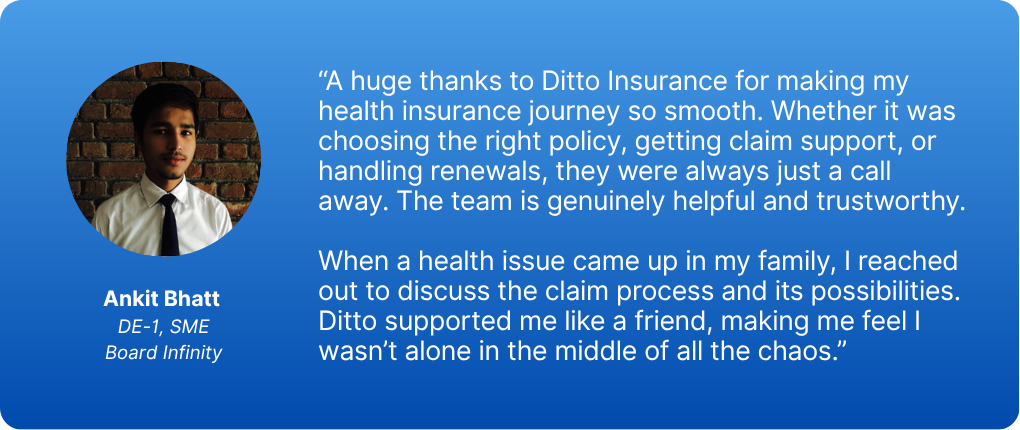
At Ditto, we’ve assisted over 8,00,000 customers with choosing the right insurance policy. Why customers like Ankit below love us:
- No-Spam & No Salesmen
- Rated 4.9/5 on Google Reviews by 15,000+ happy customers
- Backed by Zerodha
- Dedicated Claim Support Team
- 100% Free Consultation
Confused about the right insurance? Speak to Ditto’s certified advisors for free, unbiased guidance. Book your call or chat on WhatsApp with us now!
Ditto's Take
Health insurance for a new born baby is about making sure that a hospital bill isn’t adding to the stress in the most vulnerable weeks of your child's life.
You just need to do one thing: pick up the phone and confirm with your insurer exactly when your baby is covered and what you need to do to activate that coverage.
The right coverage guarantees that a hospital bill isn't what troubles you when you're already running on no sleep.
Disclaimer
Frequently Asked Questions
Last updated on: