



Quick Overview
In 2024 alone, 30.89 million people traveled abroad for jobs, family visits, and higher studies. Yet, many still struggle with a basic question: whether they need an international health insurance, rely on travel insurance, or just their existing policy.
That’s why it helps to understand international health insurance. In this article, we’ll get to know what international insurance is, when you need it, and which option fits your situation.
What Is International Health Insurance?
International health insurance (also called global medical insurance) is a policy that provides healthcare coverage across multiple countries. These plans help cover a long-term stay abroad, a medical emergency in a foreign country, or planned treatment overseas. However, not all plans offer uniform coverage. Before discussing global health insurance, let’s understand the differences between domestic and international insurance.
Talk to an expert
today and
find
the right
insurance for you.


Types of International Health Insurance
- Expat Health Insurance
These plans are suitable if you’re planning a long-term stay abroad. A good expat health insurance plan covers hospitalization, surgeries, and emergencies overseas, so you don’t have to pay everything out of pocket. One comprehensive example is Allianz Worldwide Care.
- Global Health Insurance (Domestic + Overseas Coverage)
Some companies offer global plans that work well if you live in India and want the flexibility of coverage abroad as well. However, these plans are significantly expensive and can have multiple restrictions on overseas coverage.
Here are some of the notable health insurance plans offering global coverage.
Note: The figures for claim settlement ratios (CSR) and complaints per 10,000 claims are based on a three-year average (FY 2022–25).
To put the cost in perspective, here's what the premiums for some of these plans look like:
Note: Premiums are indicative and may vary based on age, add-ons, and medical underwriting. The premiums are calculated for healthy individuals residing in Delhi (110010). A = Adult and C = Child.
- Group Overseas Insurance
These are employer-sponsored plans for employees working abroad. These plans are related to the work and sometimes cover family members, too. It covers emergency medical expenses, medical evacuation, trip cancellation, and lost luggage, often at a lower cost than individual policies.
Who Needs International Health Insurance?
You need international health insurance if:
- You are a frequent international traveler, especially if you visit multiple countries regularly.
- You are an expat (a person living abroad, often temporarily for work, education, or lifestyle reasons) or a long-term resident living abroad.
- You visit your family abroad more than once a year.
That said, international health insurance isn't always the most practical choice, even for people living abroad. In many countries, a local health insurance plan, an employer, or a university-sponsored plan may actually be the better option. This is because:
- It may be mandatory for your visa or residency permit.
- It's often better aligned with local hospital networks and billing systems.
- It can be significantly cheaper than an India-linked international plan.
So before buying, check whether your destination country, employer, or institution already has a coverage requirement or a plan in place. For a detailed understanding, refer to our guide on “What to Choose: Travel Insurance or Medical Insurance Offering International Coverage?”
Key Benefits of International Health Insurance Plans
Protection Against Global Healthcare Costs
Access to Hospitals Worldwide
Emergency Support Beyond Treatment
Customizable
International Health Insurance for Travel and Students
Short-Term Travel
International travel health insurance is suitable for trips lasting a few days to a few months, usually up to 6-12 months. It primarily covers emergencies like accidents, sudden illness, or hospitalization, but does not include routine check-ups or ongoing treatments.
Student Health Insurance
Many foreign universities require health insurance for international students as part of the admission or visa process. These plans cover hospitalization, mental health support, and limited outpatient care. It is always advisable to check your university’s minimum coverage requirements before choosing a policy.
Common examples include HDFC Ergo Student Suraksha plan and Tata AIG Student Travel Insurance.
How to Choose the Right International Health Insurance Plan?
- Check the Sum Insured in The Right Currency
Coverage should match the cost of treatments in your destination. For example, a ₹50 lakh (around $53,000) coverage may not be enough in countries like the U.S.. If you’re considering an international health insurance, opt for at least ₹2 crore cover.
- Read the Exclusions
Most plans exclude cosmetic treatments and self-inflicted injuries. Pre-existing conditions are covered only after you complete a waiting period. Also, check pandemic or COVID-19 coverage explicitly, as it varies across insurers.
- Don't Rely on Your Indian Insurer
An insurer that works well in India may not offer strong coverage abroad. For long-term stays, compare global insurers like HDFC, Niva Bupa, Allianz SE, and Cigna Global based on your destination and needs. - Check the Claims Process
A smooth claims process is critical when you're abroad. Look for plans with cashless coverage in your preferred location, 24/7 support, and clear reimbursement timelines.
Why Talk to Ditto for Health Insurance?
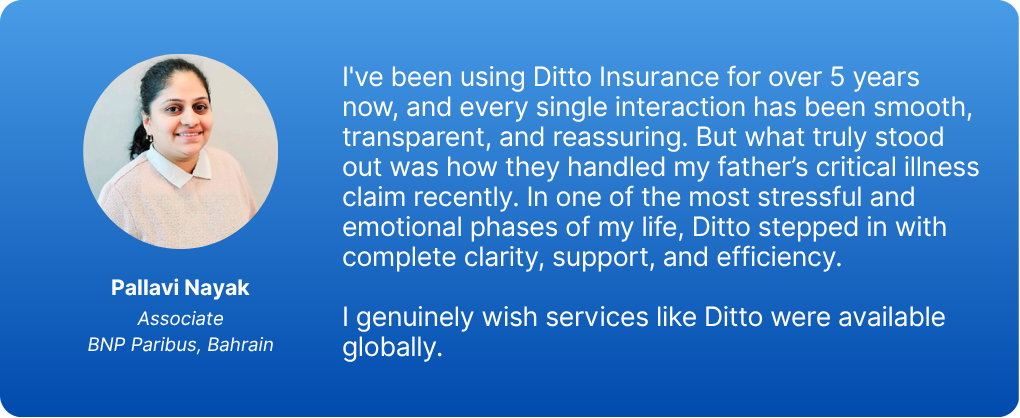
At Ditto, we’ve assisted over 8,00,000 customers with choosing the right insurance policy. Why customers like Pallavi below love us:
- No-Spam & No Salesmen
- Rated 4.9/5 on Google Reviews by 5,000+ happy customers
- Backed by Zerodha
- Dedicated Claim Support Team
- 100% Free Consultation
You can book a FREE consultation here. Slots are filling up quickly, so be sure to book a call now or WhatsApp us.
Conclusion
International health insurance can seem like a comprehensive solution with global coverage and high sum insured options. In reality, it comes with high premiums, coverage restrictions, and may not always be the most practical choice. It makes sense only for a specific group, such as expats or frequent travelers. For most others, a simpler approach works better:
- For short trips, consider travel insurance.
- For long-term stays, consider local or country-specific health insurance.
- For coverage in India, choose a comprehensive domestic health insurance plan.
Start by identifying your travel duration and destination, then choose the type of coverage accordingly. If you’re unsure about which policies to start with, check our detailed guide on the best health insurance plans in India.
Disclaimer
Frequently Asked Questions
Last updated on: