


Quick Overview
At Ditto, after helping more than 8,00,000 people with their insurance, we’ve noticed a common issue - many rely only on their employee health insurance for medical cover. This can feel safe at first because employer-provided group health insurance looks very attractive, with features like no waiting periods, Day 1 cover for pre-existing diseases (PEDs), and sometimes even perks such as wellness programs or gym memberships. However, understanding how this coverage really works and where it may fall short is important before depending on it entirely.
In this article, we’ll break down what employee health insurance is, its types, inclusions and exclusions, and whether relying on it alone is actually enough for you.
List of Employee Health Insurance Companies and Their Popular Plans
Key Benefits of Employee Health Insurance for Employers and Employees
For Employers
- Employee Retention: Added health insurance benefit helps employers retain employees more effectively.
- Signals Care: Demonstrates the employer’s commitment to their employees’ wellbeing.
- Improves Productivity: Helps keep the workforce healthy, which improves productivity.
- Compliance Support: In some cases, it helps keep employers comply with laws like Employees’ State Insurance Act 1948, mandating social security or health insurance coverage.
For Employees
- More Economical: Employee health insurance plans are generally cheaper because the risk is spread across a large group, when compared to individual health insurance.
- Waiting Periods: Insurers often waive waiting periods under group policies, which is helpful when immediate medical care is required.
- Maternity Coverage: Most corporate plans include maternity cover by default, sometimes up to a certain degree. This benefit is usually absent in retail health plans.
- Coverage For People with PEDs: For many people (or their parents), getting retail health insurance is not possible due to severe PEDs. In such a case, taking a super top-up from your employer plan or maximizing their employee health insurance might be the best option.
- Usually Free of Cost: Usually employers provide this cover free of cost, up to a certain amount. Post this amount, the differential needs to be paid by the employee. The amount depends on the cover opted, and age of members added in the policy.
A Real-life Claim Story
Your corporate or employer health plan can cover your parents from Day 1. But it’s best to treat this as a bonus, not your main plan, because the coverage can change if you switch jobs, retire, or if your employer revises the policy. For example, one of our clients uses his corporate cover mainly for his dad, since a personal policy isn’t possible due to medical history. For long-term stability, he has separate personal health plans for himself, his brother’s family, and his mom.
Notes
- Not all employee health insurance covers are the same. Coverage can vary from company to company and also depends on the benefits your employer chooses for the plan.
- Always keep your employee health insurance ID card handy.
What Does Employee Health Insurance Cover? Inclusions and Exclusions
Should You Buy a Separate Health Insurance Plan if You Already Have an Employee Health Insurance?
Yes, while employee health insurance has clear benefits, relying on it alone is not ideal. These policies cover you only while you are employed. When you switch jobs or retire, you lose that cover. At that stage, age or PEDs can make individual policies costlier or limit your options.

Why Salaried Professionals Should Buy Their Own Policy
Portability and continuity
Your individual policy stays with you through job changes, breaks, and retirement, and can be renewed lifelong.
Avoid Heavy Premiums
Should you wish to extend your cover beyond a certain amount or add more members in your employee health insurance, you might need to pay a steep premium for it.
Flexibility to choose coverage
Corporate plans usually have lower cover amounts of ₹5 -15 lakh. However, in retail health insurance you can pick the sum insured and add-ons that suit your life stage and needs.
The Younger, The Better
In case of retail plans, it’s always better to get them when you’re young. This minimises the chances of rejection due to severe PEDs.
Tax Benefits
Premiums qualify for deduction under Section 80D (old regime), offering both health protection and tax savings. While an 18% GST is still applicable on any premium paid for group health insurance policies.
Why Choose Ditto for Health Insurance?
At Ditto, we’ve assisted over 8,00,000 customers with choosing the right insurance policy. Why customers like Pallavi below love us:
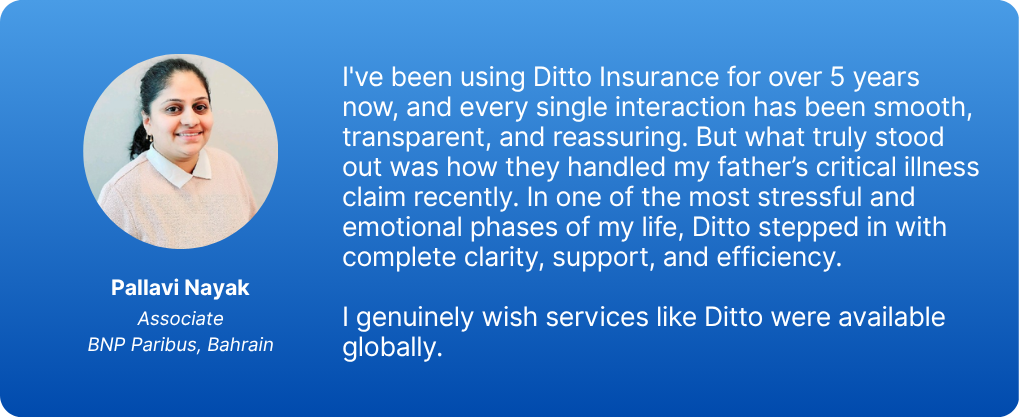
- No-Spam & No Salesmen
- Rated 4.9/5 on Google Reviews by 15,000+ happy customers
- Backed by Zerodha
- Dedicated Claim Support Team
- 100% Free Consultation
Confused about the right insurance? Speak to Ditto’s certified advisors for free, unbiased guidance. Book your call now or chat over WhatsApp, slots fill up fast!
Conclusion
While always a good backup option, relying only on corporate health insurance can leave gaps during job changes, breaks, or retirement, since the cover ends with employment. An individual health insurance policy offers stable, flexible, and lifelong protection, giving you control over coverage and providing tax benefits under Section 80D. Buying early helps keep premiums lower, avoids extra loadings, and allows you to serve waiting periods while you are still healthy, making it a smarter long-term financial safeguard.
Always read the terms of your employee health insurance policy carefully to avoid any surprises later, and compare all retail health insurance options for better coverage.
Note: Our assessment here is completely independent and based solely on publicly available data and the evaluation framework we use for all insurers. If you want to understand how Ditto reviews insurers across claims, complaints, business strength, and product suitability, you can read our methodology here. Please refer to the official website for the latest details.
Frequently Asked Questions
Last updated on: