



What is Claim Shield Add-on in Care Health Insurance?
Hospital bills include “consumables” like gloves, syringes, and PPE kits. These make up to 5-15% of your total bill as per Ditto’s claim team’s experience. The catch is that in most standard health insurance policies, these consumables are not covered by default. Claim shield in care health insurance is designed to reduce these non-payable deductions by covering a defined list of items.
While comparing health insurance plans, consumables coverage can decide whether you pay extra at discharge or not. In this article, we cover how claim shield works, key features and benefits, eligibility, what it covers and does not cover, and who should buy it.
How Does Claim Shield in Care Health Insurance Work?
Hospitals often add small line items called “consumables” (gloves, syringes, sutures, masks, PPE kits, etc.). Most standard health insurance plans do not cover these, so they get deducted as “non-payable” and can leave you with surprise out-of-pocket costs at discharge. A few plans cover consumables by default as an in-built feature, while others offer it as an add-on.
Here’s how a Ditto customer paid ₹697 extra for Care Supreme’s Claim Shield add-on and avoided the consumables deduction during an ACL reconstruction.
He had a ₹10 lakh cover and spent 3 days in the hospital.
Claim Shield is meant to pick up certain “non-payable” line items that get deducted from claims, as long as they appear in Care’s defined list.
Which Consumables Options Does Care Offer?
- Claim Shield
Covers 68 consumables and other typically excluded items like masks, gloves, syringes, and miscellaneous hospital costs listed by Care. Offered in plans like Care Ultimate.
- Claim Shield Plus
This is the latest and expanded version that covers 140+ non-payable items. Offered in plans like Care Supreme and Care Advantage.
- Care Shield (Bundle)
Care Shield combines three things into one add-on: 68-item non-payables cover, no claim bonus protection (for claims below 25% of sum insured) and inflation-linked sum insured increase. Offered in plans like Care Heart.
Points to Remember
- List-Based Coverage: The add-on pays only for items that are part of Care’s defined list for the specific plan.
- Uses Base Sum Insured: The payout for consumables comes out of your available sum insured for the year, so it is not “free money,” it is fewer deductions.
- Policy Wording: As always, please read the policy wording and consumables annexure for your exact plan for the final list and conditions.
Key Features and Benefits of Claim Shield Rider Plan
Consumables Protection
Cleaner Cashless Claims
Clear Item List
Low-Cost Upgrade
Premiums for Care Shield in Care Health Insurance Plan
Note: These are indicative premiums for a Delhi resident with a ₹15 lakh sum insured, including mandatory and recommended add-ons. Your premium can change based on age, city, medical history, plan variant, and chosen add-ons.
Value Check
Claim Shield Plus costs about 8% extra each year, which is easier to justify than paying unpredictable non-payable deductions during a claim.
Eligibility Criteria for Claim Shield Health Insurance Plan
Claim Shield is an optional add-on, so there is no separate “special eligibility” beyond being eligible for the underlying Care plan you are buying. If Care is willing to issue you the base policy, you can opt for Claim Shield on the same policy, subject to the plan variant offering it.
Two quick practical notes:
- You can only select add-ons at purchase or at renewal, not mid-policy.
- Availability can differ by plan and version, so always check the brochure or policy wording.
What is Covered and Not Covered in Claim Shield in Care Health Insurance?
What is Included?
In this PDF below, we decode the annexures, so you can see the exact list of consumables and other “non-payable” items covered.
What is Excluded?
Even with Claim Shield, a few expenses can become out-of-pocket, mainly because it covers list-based items and the base policy rules still apply:
- Anything not in the Annexure item list remains your cost.
- Base policy exclusions and conditions still apply to the overall claim.
- Costs above your available sum insured stay out of pocket.
- Plan mechanics that create shortfalls like co-pay, deductibles, room-category related deductions, and disease wise sub-limits.
Important Note: Exact inclusions, exclusions, and the final item list can vary by plan. Always verify against the latest policy wording and annexure for your specific plan.
Why Choose Ditto for Health Insurance?
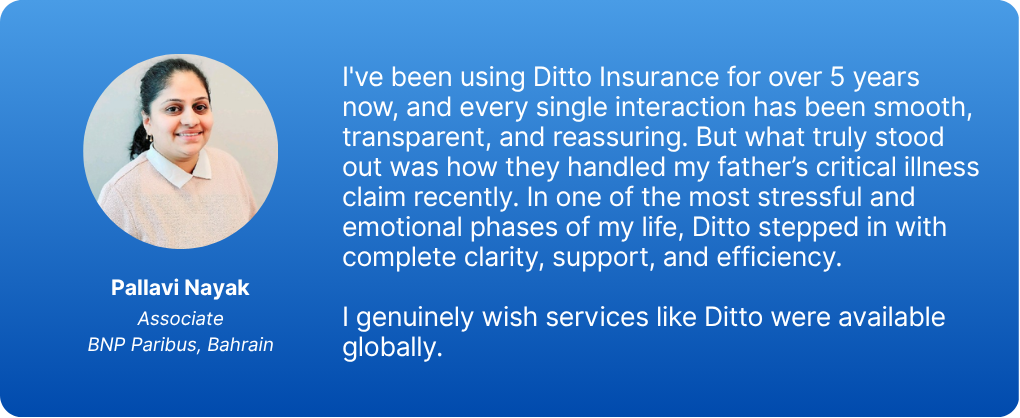
At Ditto, we’ve assisted over 8,00,000 customers with choosing the right insurance policy. Why customers like Pallavi below love us:
- No-Spam & No Salesmen
- Rated 4.9/5 on Google Reviews by 15,000+ happy customers
- Backed by Zerodha
- Dedicated Claim Support Team
- 100% Free Consultation
Confused about the right insurance? Speak to Ditto’s certified advisors for free, unbiased guidance. Book your call or chat on WhatsApp with us now!
Who Should Buy Claim Shield in Care Health Insurance?
We would recommend choosing it if:
- You want fewer out-of-pocket charges at discharge
- You want your coverage to feel comprehensive and complete during a real claim
- You prefer small predictable costs over big random bill deductions.
Bottom Line: For a small premium bump, this add-on has a huge impact on your peace of mind.
Full Disclosure
Frequently Asked Questions
Last updated on: