Senior citizen health insurance (for ages 60+) covers hospitalization costs for pre-existing diseases, accidents, critical illnesses, and age-related treatments. Many plans come with shorter waiting periods, but premiums are usually higher and may include co-pays or other limits.
Ditto rates plans using policy features, insurer metrics, and premium value. Our top pick is Optima Secure by HDFC ERGO, backed by a 96.71% average claim settlement ratio for FY 2022-25. For example, a 65-year-old in Delhi pays ₹69,433 per year for a ₹15 lakh cover under this plan.
This guide is for senior citizens and families buying coverage for parents.
Senior citizen health insurance is not just regular health insurance with a higher premium. It is hospitalization cover built for higher age, higher medical risk, and more frequent claims. In fact, nearly one in three hospitalizations in India involved someone aged 60 or older, according to Household Health data collected by the Ministry of Statistics, India. That is why the fine print matters as much as the sum insured, especially clauses that decide how much the insurer pays and how much you pay out of pocket.
In this guide, we’ll explain how senior citizens can buy health insurance in India and which policies are worth shortlisting. We’ll also compare premiums, inclusions, exclusions, government schemes, rejection back-up options, and the key checks to make before buying.
Want help shortlisting a senior citizen health insurance policy? Book a free call or chat on WhatsApp with Ditto, and we will guide you.
How Can Senior Citizens Get Health Insurance in India?
1) Buy a Comprehensive Plan
If the senior medically qualifies, this is usually the best place to start. Many comprehensive plans today allow entry at older ages, but approval still depends on health and underwriting.
Why This Is Better:
Comes with fewer built-in restrictions, so out-of-pocket expenses are usually low
Offers strong coverage growth features like bonuses and restorations, which matter more as medical costs rise with age
Works better as a long-term policy, you can renew year after year without changing your policy frequently
2) Buy a Senior Citizen Specific Plan
These are plans marketed specifically for seniors. They can make sense when comprehensive plans are hard to get because of medical history or seem unaffordable.
Why It’s Not Recommended as a First Choice:
Often comes with built-in limits like co-pay, room rent caps, and sub-limits, which can reduce payouts even with a high sum insured
Offers fewer coverage-growth features compared to comprehensive plans, so your usable coverage can feel inadequate over time
For example, Star Health offers a senior citizen Red Carpet health insurance plan that comes with a mandatory 30% co-pay.
Did You Know?
Many insurers now offer senior citizen-specific support, such as dedicated helplines and priority email queues. For example, HDFC ERGO lists a separate 24x7 customer care number for senior citizens and persons with disabilities (022 6158 2026). Niva Bupa also offers grievance redressal via seniorcitizensupport@nivabupa.com.
Best Senior Citizen Health Insurance in India: Comparison
01
HDFC Ergo
Optima Secure
The plan has a clean structure with no co-payment, no room rent limit, and no disease-wise sub-limits. Its biggest pull is the coverage design: Secure Benefit gives 2x cover from day 1; Plus Benefit increases the base cover over time; Restore refills the sum insured for future claims; and Protect covers many non-medical expenses by default. Add-ons like Limitless and ABCD Chronic Care make it even stronger, especially for high-cost claims or chronic conditions. The only real concern is price and stricter underwriting, so this works best for seniors who want premium-quality coverage and do not mind paying for it.
HDFC Ergo
Optima Secure
4.6
Overall Rating
Insurer Rating
5.0/5
Customer Service Rating
5.0/5
Premium Rating
3.0/5
Feature Rating
4.6/5
02
Care
Care Supreme
It has no co-payment, no room rent cap, and no disease-wise sub-limits, while its Unlimited Automatic Recharge refills the cover unlimited times in the same year, even for the same illness. The inbuilt cumulative bonus increases the cover by 50% each year, up to 100%, and optional boosters can take this growth much higher. Add-ons like Instant Cover and PED waiting period reduction can make the plan more practical for seniors with diabetes, asthma, hypertension, or other pre-existing conditions. The catch is that some benefits, like consumables and health check-ups, are not built in, and complaint volume is higher than at some peers, but overall, it is a sensible plan if you want balanced pricing and flexibility.
Care
Care Supreme
4.5
Overall Rating
Insurer Rating
4.2/5
Customer Service Rating
3.0/5
Premium Rating
5.0/5
Feature Rating
4.5/5
03
Aditya Birla
Activ One MAX
It offers Super Reload for unlimited refills during the year, Super Credit to grow the cover by 100% of the base sum insured every year up to 500%, and Claim Protect to cover non-payable items by default. Seniors with chronic conditions may find the Chronic Care add-on useful because it can reduce the waiting period to 0 days for listed conditions like diabetes, asthma, and high blood pressure. The plan also has Health Returns, where policyholders can earn back part of the renewal premium based on fitness and health activity. The main limitation is that Aditya Birla is relatively new in health insurance, and waiting-period reduction add-ons must be paid for every year. But for seniors who want strong features without very high premiums, it is a good contender.
Aditya Birla
Activ One MAX
4.4
Overall Rating
Insurer Rating
4.5/5
Customer Service Rating
5.0/5
Premium Rating
5.0/5
Feature Rating
4.3/5
04
Niva Bupa
ReAssure 2.0 Platinum+
There is no co-payment, no room rent limit, and no disease-wise sub-limit, which is great for hospital flexibility. ReAssure Forever is the standout feature because after the first paid claim, it provides a lifetime refill-style benefit, allowing future claims to reach the sum insured. Booster+ lets unused base cover accumulate up to 5x, while Lock the Clock keeps the premium linked to entry age until the first claim, though insurer-wide hikes and medical inflation can still apply. Add-ons like Disease Management Rider and Safeguard or Safeguard+ are useful for diabetes, hypertension, and non-payable hospital items. The downside is that the plan can feel slightly complicated, and complaint volume is higher than peers', so it is better suited for seniors who like feature-heavy plans and are okay with possible service inconsistencies.
Niva Bupa
ReAssure 2.0 Platinum+
4.3
Overall Rating
Insurer Rating
4.2/5
Customer Service Rating
3.0/5
Premium Rating
5.0/5
Feature Rating
4.2/5
05
SBI General
Super Health Platinum Infinite
It has a clean structure with no co-payment, no room-rent limits, and no disease-wise sub-limits. The Reinsure Benefit offers unlimited restoration in the same policy year, triggered from the first paid claim, up to 200% of the base sum insured. The Health Multiplier Benefit can increase coverage up to 3x for listed serious illnesses, and Claims Shield covers consumables such as gloves, masks, cotton, and bandages, helping reduce out-of-pocket costs. It also has a shorter 2-year PED waiting period, and OPD benefits up to ₹10,000 for check-ups and pharmacy bills. The main issue is affordability, since this variant starts at ₹50 lakh sum insured, and service can feel process-heavy. But it is a good option for seniors who want extensive coverage and are okay with a premium product.
SBI General
Super Health Platinum Infinite
4.1
Overall Rating
Insurer Rating
3.8/5
Customer Service Rating
3.0/5
Premium Rating
5.0/5
Feature Rating
4.2/5
Note: If you'd like to explore the detailed figures reported by insurers and the IRDAI in their annual disclosures and public reports, visit Ditto Data Labs, our proprietary repository of health insurance data, meticulously compiled, verified, and maintained by the Ditto team over the years.
Premium Comparison of Health Insurance Plans for Senior Citizens
Profiles
HDFC ERGO Optima Secure
Care Supreme
Aditya Birla Activ One MAX2
Niva Bupa Reassure 2.0 Platinum +
(Individual Plan): Age 65
₹69,433
₹57,345
₹50,164
₹56,699
(Family Floater, 2A): Ages (66,65)
₹1,04,539
₹1,17,720
₹87,805
₹98,897
(Family Floater, 2A): Ages (72,71)
₹1,38,695
₹1,57,861
₹1,10,516
₹1,22,885
Note: Premiums for a ₹15 lakh sum insured for a residence in Delhi - 110010, including necessary and mandatory add-ons. Exact premiums can vary depending on city, underwriting, discounts, and insurer repricing.
Talk to an expert today and find the right insurance for you.
Inclusions and Exclusions of Senior Citizen Health Insurance Plans
What’s Covered
What’s Not Covered
In-patient hospitalization
Investigation and evaluation only
Pre-hospitalization expenses
Rest cure, rehabilitation, and respite care
Post-hospitalization expenses
Obesity or weight control treatments
Day care treatments
Gender change or related treatments
Organ donor expenses
Cosmetic or plastic surgery
Modern treatments (robotic surgery, stem cell therapy, etc.)
Hazardous or adventure sports injuries
AYUSH treatments (Ayurveda, Homeopathy, etc.)
Treatment breaching the law
Road ambulance charges
Unproven treatments or experimental procedures
Domiciliary treatments
Sterility and infertility treatments
-
Maternity (unless specifically covered)
-
Wellness or rejuvenation therapies
-
Dietary supplements or alternative substances
-
Substance abuse or alcohol-related treatments
It’s worth noting that coverage and exclusions may vary slightly across insurers and plans. It's recommended to check the policy wording of the specific plan you are interested in.
Why Should You Buy Senior Citizen Health Insurance?
01
Rising Medical Inflation and Treatment Costs
Medical inflation continues to rise, and treatment costs increase with age due to complications and chronic conditions. Seniors typically require more frequent medical attention, making health insurance an essential financial safeguard.
02
Enhanced Coverage for Age-Related and Lifestyle Diseases
Senior citizen health insurance plans offer more comprehensive coverage for lifestyle diseases and age-related conditions. They also provide support for common procedures, such as joint replacements, including hip replacements, which are more prevalent among older adults.
03
Higher Likelihood of Hospitalization
With advancing age, the frequency of hospitalization increases. As medical needs grow, the importance of having dedicated health insurance becomes even greater for managing recurring or unexpected medical expenses.
04
More Affordable Than Paying Out of Pocket
Even though premiums may be higher for seniors, health insurance remains far more affordable than bearing hospital and treatment expenses out of pocket, which can run into several lakhs for a single hospitalization.
05
Better Tax Benefits Under Section 80D
For individuals aged 60 and above, Section 80D of the Income Tax Act offers higher deduction limits for health insurance premiums, making senior citizen health insurance more tax-efficient under the old regime.
06
Additional Benefits and Better Access to Healthcare
Senior health insurance plans often include annual health check-ups, access to quality hospitals, better room options, experienced doctors, OPD coverage, and wellness discounts offered by insurers. These benefits help seniors maintain their health proactively while enjoying better care and comfort.
What to Do if Your Application Gets Rejected?
1) Group Plan for Immediate Cover
If you can get on a group health insurance policy (through your bank, social clubs, or alumni groups), it is often the fastest way to get insured because group plans have little to no medical underwriting. Group plans still come with waiting periods, but usually less than retail plans.
Just remember: group cover is tied to the group, so it can end when the membership changes.
2) Use Your Children’s Employer Cover
Many employee health insurance policies let you add your parents as dependents, which can be a practical backup while you keep trying to get an individual plan. Corporate plans come with a 0 waiting period and no scrutiny for pre-existing disease
Do not treat it as permanent, though. Corporate cover is not “owned” by you, and it can stop when you switch jobs or retire.
3) Back-up Plans to Consider
If comprehensive plans are getting declined or heavily loaded, you can explore plans built for specific health profiles. For example, Care Freedom is for people with chronic conditions and has a 24-month pre-existing disease waiting period, but it comes with restrictions that you should read carefully.
Similarly, Aditya Birla Activ One VYTL is made for people with chronic health conditions and offers in-built day 1 hospitalization cover for listed chronic conditions.
Senior Citizen Health Insurance Scheme by Government of India
Senior citizen health insurance government schemes can be a real lifesaver for those who qualify, especially if affordability is a concern. But most of these plans are designed for specific groups (low-income households, government staff, ex-servicemen, organized-sector workers), and they come with tighter rules than a typical retail health insurance plan.
“Poor and vulnerable” families identified using SECC deprivation and occupation criteria
Up to ₹5 lakh per family per year for secondary and tertiary hospitalization; cashless and paperless treatment at empanelled public and private hospitals. PM-JAY replaced older schemes like RSBY and SCHIS.
Retired insured persons (and spouse) who retire on superannuation/VRS/premature retirement after being in insurable employment for at least 5 years, with the required contribution
Retired insured person + spouse can continue medical benefits by paying ₹10 per month (paid in advance, yearly)
RELHS (Railway Employees Liberalized Health Scheme)
Retired railway employees who join RELHS (rules depend on retirement timing and membership status)
Designed for retired railway employees; joining requires a prescribed contribution and is meant to align with CGHS-style contribution concepts
Poor and vulnerable families (bottom segment as defined by the state’s implementation)
₹5 lakh per family per year for secondary and tertiary hospitalization; cashless at empanelled public and private hospitals; no restriction on age; pre-existing conditions covered from day 1
Expanded to all families in the state, eligibility and category rules apply
Cashless secondary and tertiary procedures in network hospitals; ₹5 lakh per family per year (family floater); pre-existing diseases covered from day 1
Karnataka residents, with rules for “eligible households” vs general households
Aims for universal health coverage; includes primary plus specified secondary and tertiary benefits; merges multiple existing state health schemes under one umbrella
Below Poverty Line families, as defined by the state’s Civil Supplies department
Cashless treatment up to a stated annual limit per family; covers a defined list of diseases and procedures via empanelled government and private hospitals
Tamil Nadu
CMCHIS (Chief Minister’s Comprehensive Health Insurance Scheme)
State scheme aimed at “needy” households
Designed for universal health coverage goals; cashless treatment for approved procedures in empanelled government and private hospitals using the scheme card/e-card
Ditto’s Take on Government Health Insurance Schemes for Senior Citizens
If you are eligible for a government scheme and you have affordability issues, these schemes are worth using as a safety net.
But government schemes are not the primary recommendation for senior citizens due to restrictive features such as strict eligibility criteria, limited hospital networks, package-based coverage, and paperwork.
For most senior citizens, it is better to opt for a comprehensive retail health insurance plan, because you get higher flexibility, broader usable coverage, and fewer constraints.
Things to Keep in Mind Before You Buy Health Insurance for Senior Citizens
Check Policy Restrictions
Before you compare “features,” check for co-pays, room rent limits, and sub-limits, as these are the most common reasons payouts are reduced on claims. Even a high sum insured can feel useless if these restrictions are tight, so review them upfront before shortlisting any plan.
Waiting Period Reduction
Most plans have waiting periods, especially for pre-existing diseases, but some insurers offer paid add-ons to shorten them. Check if these add-ons apply to your PEDs and how long you have to keep paying for them.
Review Old Policy Before Switching
Do not switch just because you found a lower premium, because you might restart waiting periods if there is any new diagnosis. If you do want to move, portability is meant to help you switch at renewal without breaking continuity, so follow the correct portability process and disclose your medical history.
Expect High Premiums Due to Loading Charges
Final premiums may increase if the insurer applies a loading for pre-existing diseases or overall risk, and that extra cost continues for future renewals. This is why the premium you see online is often not the final premium after underwriting.
Why Choose Ditto for Health Insurance?
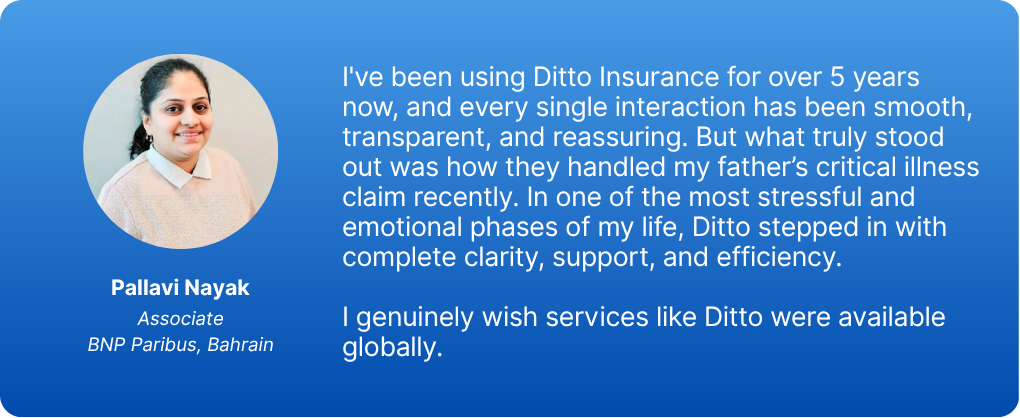
At Ditto, we’ve assisted over 8,00,000 customers with choosing the right insurance policy. Why customers like Pallavi below love us:
No-Spam & No Salesmen
Rated 4.9/5 on Google Reviews by 15,000+ happy customers
Backed by Zerodha
Dedicated Claim Support Team
100% Free Consultation
Confused about the right insurance? Speak to Ditto’s certified advisors for free, unbiased guidance. Book your call or chat on WhatsApp with us now!
Ditto’s Take
For most senior citizens, start by getting a comprehensive plan and treat it as a long-term policy you renew every year. It is usually better to pay a bit more for reliable claims than save on premiums and get surprised later.
Shortlist 2 to 3 plans, then quickly check key limits like co-pay, room rent caps, disease caps, and waiting periods
Apply with clean, complete medical disclosures
If underwriting comes back with a rejection or heavy conditions, switch to a fallback plan, such as group cover, as a temporary bridge or a senior-focused plan with fewer restrictions
Keep it sustainable: choose a premium you can pay every year, and if budget is tight, use a two-layer setup with a solid base plan plus a super top-up for large bills.
Disclaimer
We believe in full transparency around our partnerships. Our current insurer partners are HDFC Ergo, Care, Aditya Birla, and Niva Bupa. But as you can see in this list, the rankings include both partners and non-partners because the methodology is unbiased and applied uniformly across all insurers.
Frequently Asked Questions
What is senior citizen health insurance, and who is it for?
Senior citizen health insurance is hospitalization cover designed for people aged 60 and above. It covers pre-existing diseases, accidents, critical illnesses, and age-related treatments like joint replacements. Unlike a standard health plan, it is built around higher medical risk and more frequent claims. Nearly one in three hospitalization cases in India involves someone aged 60 or above, according to Household Health data from the Ministry of Statistics. At Ditto, we recommend treating these policies as long-term financial tools, not just annual coverage, because the fine print matters as much as the sum insured.
What is the best health insurance for senior citizens in India in 2026?
At Ditto, we recommend HDFC ERGO Optima Secure as the top pick for senior citizens in 2026. It has no co-payment, no room rent limit, and no disease-wise sub-limits. The plan also comes with a strong average claim settlement ratio of 96.71% for FY 2022 to 2025. Other solid options include Aditya Birla Activ One MAX, Care Supreme, Niva Bupa ReAssure 2.0 Platinum+, and SBI Super Health Platinum Infinite. The best plan depends on your budget, existing medical conditions, and how much out-of-pocket expense you are comfortable with.
Is a comprehensive plan better than a senior citizen specific plan?
Yes, in most cases. Comprehensive plans tend to have fewer built-in restrictions, such as co-pays, room-rent caps, and sub-limits. They also offer stronger coverage growth features, such as cumulative bonuses and restoration benefits, which matter more as medical costs rise with age. Senior citizen specific plans are a practical fallback when comprehensive plans are declined because of medical history or seem unaffordable. For example, Star Health Senior Citizen Red Carpet comes with a mandatory 30% co-pay, which can reduce your payout even on a large claim. A comprehensive plan with clean terms is usually the smarter long-term choice.
What is the waiting period for pre-existing diseases in senior citizen health plans?
Most health insurance plans in India have a waiting period of 2 to 3 years for pre-existing diseases like diabetes, hypertension, and heart conditions. IRDAI has capped the maximum pre-existing disease waiting period at 36 months. Some insurers offer paid add-ons that can significantly reduce this waiting period. For example, Care Supreme offers an Instant Cover add-on and a PED waiting period reduction option that can make the plan more practical for seniors with common chronic conditions. Always check whether the add-on applies specifically to your pre-existing conditions before buying it.
How much does health insurance cost for a 65-year-old in India?
Premiums vary by insurer, city, and medical history, but here is a realistic benchmark. A 65-year-old in Delhi pays around ₹69,433 per year for a ₹15 lakh cover under HDFC ERGO Optima Secure. Aditya Birla Activ One MAX comes in lower at around ₹50,164 for the same profile. For a senior citizen couple aged 66 and 65, family floater premiums can range from ₹87,805 to over ₹1,17,720, depending on the insurer. These are pre-underwriting figures, so the final premium may be higher if the insurer applies a medical risk loading.
What tax benefits do I get for buying health insurance for my senior citizen parents?
Under Section 80D of the Income Tax Act, you can claim a deduction of up to ₹50,000 per year for health insurance premiums paid for senior citizen parents. This is in addition to the ₹25,000 deduction allowed for your own health insurance. If both you and your parents are senior citizens, you can claim up to ₹1 lakh in total deductions. These benefits apply only under the old tax regime. Even if your parents cannot get insured, Section 80D allows a deduction on actual medical expenses up to ₹50,000, provided you have the bills and receipts.
What is the Ayushman Bharat scheme for senior citizens above 70?
The government expanded Ayushman Bharat PM-JAY in September 2024 to cover all senior citizens aged 70 and above, regardless of income. Eligible seniors receive up to ₹5 lakh per year for secondary and tertiary hospitalization at empanelled public and private hospitals. This is expected to benefit around 6 crore senior citizens across approximately 4.5 crore families in India. Seniors already covered under CGHS or ECHS can choose to either continue their existing scheme or switch to PM-JAY. At Ditto, we see government schemes as a useful safety net but not a replacement for a comprehensive retail health insurance plan.
What are the main exclusions in senior citizen health insurance plans?
Most senior citizen health insurance plans do not cover cosmetic or plastic surgery, weight loss treatments, gender reassignment, sterility and infertility, substance abuse-related treatments, or unproven experimental procedures. Injuries from hazardous or adventure sports are also typically excluded. Wellness therapies, dietary supplements, and rest or rehabilitation cures are not covered either. Maternity is excluded unless specifically included as an add-on, which is rare in senior plans. Coverage for pre-existing diseases is included, but only after the waiting period. Always read the policy wording of the specific plan you are considering, since exclusions can vary slightly across insurers.
How do I choose the right sum insured for senior citizen health insurance?
For senior citizens in India, a sum insured of at least ₹15-25 lakh is a reasonable starting point, given rising medical inflation. However, for high-cost treatments like cardiac surgeries or cancer, the costs can run out quickly. A practical approach is to buy a solid base plan and pair it with a super top-up policy for large bills, which keeps premiums more manageable. At Ditto, we also recommend considering coverage growth features such as cumulative bonuses and restoration benefits, which can effectively increase your usable cover over time without raising the base premium each year.
Customer Reviews
4.9
20915 reviews
Ditto is doing really great. Absolutely spam free- that's the best part. They don't talk to you like they are forced to sell the product. It's more like, helping us buy better. Advisor Nuha was very patient and answered all my questions with clarity. Thanks for the service
I
INDHUMATHI M
Loved the service! Maheta Nidhi Hitesh was incredibly helpful and knowledgeable. She guided me through the whole process and made everything super easy to understand. I really appreciated how patient she was with all my questions—there was no pressure at all, just clear and honest advice. Honestly, I'm very happy with my experience at Ditto so far. Highly recommend!
RK
Ragul Kumar
I had a great experience with Ditto while exploring health insurance options. The process was smooth and everything was explained clearly.
A special thanks to Swaroop SK for patiently answering all my questions and guiding me through the policy details without any pressure. The transparency and support made it much easier to understand and choose the right plan.
Really appreciate the assistance!
PS
Pulkit Singh
Had a great experience with Ditto Insurance. Ishita Sudrania was extremely helpful in guiding me through choosing the right term plan. There was no spamming or sales pressure, and all my questions were patiently answered. She also assisted me thoroughly with the entire application process. Highly recommend!
SS
Samil Shah
I had a great experience with Ditto while filing my health insurance claim. Their team guided me clearly through the entire process, helped with the required documents, and promptly answered all my queries. Their support made the claim process much smoother and less stressful. Highly appreciate their assistance.