

Quick Review
For most Indians today, getting quality healthcare while keeping expenses under control has become a top priority. To address this, the Insurance Regulatory and Development Authority of India (IRDAI) introduced the Arogya Sanjeevani Health Insurance policy to standardize basic health cover across insurers. While IRDAI defines the core structure, insurers offer sum insured options from ₹50,000 to ₹10 lakh, with many now extending this to higher amounts.
This guide delves into everything you need to know about Arogya Sanjeevani Health Insurance, from its key features, eligibility, coverage details, and who can consider this policy.
List of Arogya Sanjeevani Policies in India
Currently, the policy is available through 30 insurers in India. Here are some of the leading insurance providers offering Arogya Sanjeevani health insurance policies:
Note: While the IRDAI standard is up to ₹5 Lakh, many insurers now offer higher limits under the same product name.
Eligibility Criteria for Arogya Sanjeevani Policy
Key Points to Remember
- Family Floater Limit: A family floater policy usually covers a maximum of 2 adults and 3 dependent children.
- Children turning 25: Once a child turns 25, they must migrate to their own individual policy.
- Independent Children: Dependent children above 18 years who are financially independent are ineligible for coverage under the family floater option.
Key Benefits of Arogya Sanjeevani Health Insurance
- Access to Health Insurance When Options Are Limited: For customers with multiple pre-existing diseases (PEDs), comorbidities, higher age, or repeated rejections, Arogya Sanjeevani health insurance often becomes the only viable option. Many insurers offer it as a counter-offer (Plan of last resort) when comprehensive plans are declined.
- Lower Premiums Make Entry Easier: Because the plan comes with copays, sub-limits, and caps, premiums are usually meaningfully lower than regular retail plans. This reduces the entry barrier for first-time buyers and budget-constrained families. The benefit is affordability and access and not complete financial protection during large hospital bills.
- Standardization Reduces Product Confusion and Mis-selling: Since IRDAI defines the product structure, customers don’t face wildly different wordings or coverage tricks across insurers. This makes it easier to understand what they’re buying and reduces the risk of mis-selling.
- Easier Insurer Comparison on Service, Not Terms: Because the product design is the same, customers can compare insurers on claims experience, premiums, hospital networks, support quality and reliability instead of getting lost in product feature differences.
- Higher Chances of Approval by Insurers: Because Arogya Sanjeevani health insurance limits insurer liability through copays and sub-limits, insurers are more willing to approve risky profiles. This increases acceptance rates for customers who would otherwise face repeated rejections.
- Portability: You can transfer your Arogya Sanjeevani policy to another insurer at renewal while carrying forward continuity benefits like waiting periods already served and moratorium. Learn how health insurance portability works and the steps involved here.
What Is Covered And Not Covered Under Arogya Sanjeevani Health Insurance?
Note:
- Arogya Sanjeevani health insurance follows IRDAI’s list of 199 non-payable items, so many consumables and incidental charges aren’t covered. Because the policy has strict limits on room rent, if the hospital includes consumables as part of a high room package, the insurer may apply a proportionate deduction. This deduction can affect the entire bill, not just the room rent. Also, unlike comprehensive plans, there are no riders to cover these consumables, so these costs are borne out-of-pocket.
- Always refer to the actual policy wording of your insurer to understand the full scope of permanent exclusions, definitions, and conditions under which certain treatments may be included or excluded.
Premium Comparison: HDFC Arogya Sanjeevani vs HDFC Optima Secure
To help you compare costs, here’s a quick look at the premiums for HDFC Ergo Optima Secure (a comprehensive retail health plan) versus HDFC Arogya Sanjeevani. The figures below show annual premiums for a ₹10 lakh sum insured, based on different family profiles in pin code: 110001, New Delhi.
Important Checklist Before Buying Arogya Sanjeevani
- Honest Disclosure: Disclose all pre-existing diseases upfront. Even though PEDs are covered after the waiting period, non-disclosure can lead to claim rejection later.
- Check Network Hospitals: Ensure the insurer has good cashless hospital coverage near your home and preferred hospitals.
- Compare Premium for Your Age: Premiums vary by age slab. Compare the actual yearly cost for your age and family structure.
- Understand Copays & Sub-limits: Be clear that you will have to pay a mandatory co-pay on all claims out of your own pocket. Furthermore, strict sub-limits on room rent and specific procedures mean you will face significant out-of-pocket expenses if your hospital bills exceed these limits.
- Check Insurer Performance Metrics: Review the insurer’s Claim Settlement Ratio (% of claims settled), Incurred Claim Ratio (claims paid vs premium collected), complaint volumes, and customer reviews to gauge real-world claims experience and service quality.
Why Choose Ditto for Health Insurance?
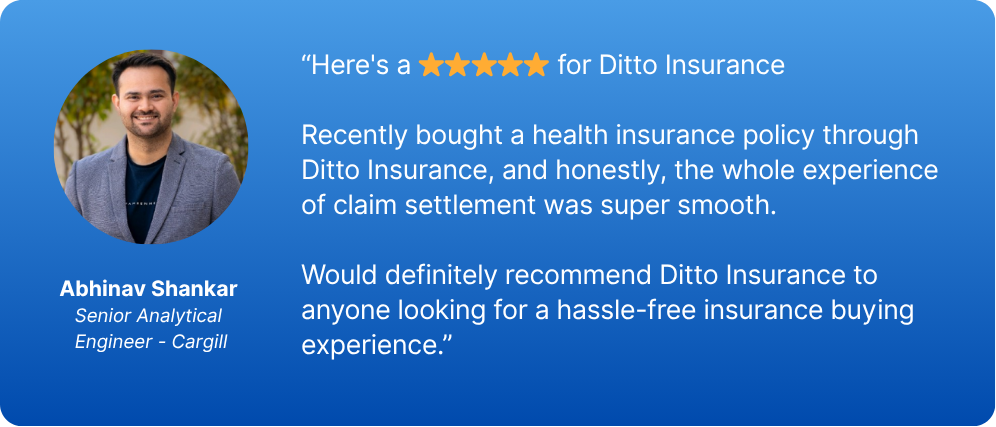
At Ditto, we’ve assisted over 8,00,000 customers with choosing the right insurance policy. Here’s why customers like Abhinav love us:
- No-Spam & No Salesmen
- Rated 4.9/5 on Google Reviews by 5,000+ happy customers
- Backed by Zerodha
- Dedicated Claim Support Team
- 100% Free Consultation
You can book a FREE consultation with us. Slots are filling up quickly, so be sure to book a call now or chat with us on WhatsApp!
Should You Buy Arogya Sanjeevani Health Insurance: Ditto’s Take
When it comes to the Arogya Sanjeevani Policy, the question is not whether to buy it, but when it becomes an option and who should go for it. It's also important to understand its limits and buy it for protection and not just for the price. Since this policy has very little scope for product feature or add-on differentiation (and is mandated by IRDAI), insurers don’t actively market it either.
This plan suits customers with serious PEDs, high-risk profiles, repeated rejections, or tight budgets who still want some level of health cover. It is not ideal for young, healthy families who can qualify for comprehensive plans that have fewer restrictions, better features, and greater long-term value.
Arogya Sanjeevani should be positioned as a safety net or a compromise product (last resort). It’s better than having no insurance at all, but most families shouldn’t rely on it if better options are available.
As a first choice, we at Ditto recommend exploring comprehensive health insurance plans. If those aren’t possible due to medical history or lifestyle factors, Arogya Sanjeevani can be considered. Since this article mentions our partner insurer HDFC ERGO and its plan, it’s good to know how we assess insurers and rank health insurance plans. You can read Ditto’s Cut to understand our evaluation process in detail.
Frequently Asked Questions
Last updated on: