


Overview
According to the IRDAI annual report, health insurance premiums in India crossed ₹1.27 lakh crore in FY 2025, indicating that more people are buying coverage than ever before. But buying health insurance and having health insurance are two different things. One means you paid a premium. The other means your plan will actually cover what you need.
This is one of the most underrated benefits of health insurance. In India, the fear of a medical emergency wiping out savings, forcing a family to borrow money, or delaying necessary treatment because of cost is very real. A good health plan reduces the financial pressure by separating your hospitalization bill from your bank balance.
In other words, health insurance is not just about reimbursing hospital bills. It is about ensuring a medical crisis does not become a financial one. In this guide, we walk you through the 10 key benefits of health insurance you should actually care about, how to evaluate them, and how to choose a plan that delivers when it matters most. If you’re planning to buy health insurance and want to avoid common gaps, you can also get a personalised recommendation based on your needs.
In-Patient Hospitalization Cover
This is the foundation of every health insurance policy. When you're admitted to a hospital for treatment, your plan steps in to pay the bills. This includes room rent, ICU charges, surgeon and anesthetist fees, nursing charges, medicines used during the stay, and diagnostic tests done as part of treatment.
Sounds straightforward, right? This is where most insurers introduce their first set of restrictions.
- For example, some policies come with a co-payment. A 10% co-payment means you pay 10% of each hospital bill. For example, if the bill is ₹1 lakh, you pay ₹10,000, and the insurer covers the rest.
- Or take room rent, for example. Many plans cap it at 1% of the sum insured per day. that's ₹10,000 per day on a ₹10 lakh policy. Choosing a private room at ₹15,000 means the insurer doesn't just charge you the ₹5,000 difference. Instead, they apply what's called a proportionate deduction to your entire claim. Your surgeon's fees, ICU charges, and everything else get reduced proportionally, since all charges are linked to the room category.
- Then there are disease-wise sub-limits, caps on what the insurer will pay for specific conditions, such as cataract surgery or hernia repair. Your sum insured might be ₹10 lakh, but the payout for that condition might be capped at ₹40,000.
What to Look For: Plans with no co-payment, no room rent caps, and no disease-wise sub-limits. These features have a huge impact on actual claim payouts.
Pre- and Post-Hospitalization Expenses
A hospitalization doesn't start the day you're admitted and end the day you're discharged. Think about what typically happens before and after it.
Before admission, you're likely to undergo Magnetic Resonance Imaging (MRI), blood tests, and specialist consultations, all to confirm the diagnosis and prepare for the procedure. After discharge, there are follow-up visits, physiotherapy, prescribed medicines, and repeat tests to monitor recovery.
What to Look For: Longer coverage windows on both sides, ideally 60 days pre- and 90 to 180 days post-hospitalization expenses should be covered.
Cashless Hospitalization
Imagine someone needs an emergency surgery on a Saturday night. The hospital wants a cash advance of around ₹2-3 lakh immediately before they proceed.
This is the scenario cashless hospitalization is designed to solve. Instead of paying the hospital upfront and claiming reimbursement later, the insurer settles dues directly with the hospital. So you can focus on the medical situation rather than arranging funds at the last minute.
But the reality of this benefit depends entirely on one thing: the insurer's hospital network. A plan with 10,000+ network hospitals across tier-1 and tier-2 cities gives you real flexibility.
What to Look for: Verify that the hospitals you actually prefer are on the cashless network of the insurer before you buy any plan.
Daycare Procedures
A few decades ago, most medical procedures required at least one overnight hospital stay. Insurance policies were written with the assumption that you needed to be hospitalized for 24 hours for a claim to be valid.
But since then, medical technology has advanced. Cataract surgery, chemotherapy, dialysis, and certain joint procedures are now completed in hours. No 24-hour stay needed.
Currently, most modern plans cover an IRDAI-defined list of daycare procedures, subject to certain conditions, such as the use of local or general anesthesia.
What to Look For: A plan that covers daycare procedures up to the sum insured, with minimal conditions.
Talk to an expert
today and
find
the right
insurance for you.


Domiciliary Treatment
Sometimes, treatment happens at home, not by preference, but by necessity. A patient too fragile to be moved safely. A post-surgical recovery requires ongoing care. A situation where no hospital beds are available.
Domiciliary treatment cover extends your insurance to medical care administered at home, under specific conditions. It's not for routine home remedies or mild illnesses and applies only when a qualified doctor recommends home-based treatment.
This benefit isn't universal. Some policies include it, whereas others exclude it entirely. For families with elderly members or anyone managing a chronic condition, this coverage can be genuinely valuable.
What to Look For: Check whether the policy includes domiciliary treatment, what conditions are covered, and what documentation the insurer requires to process such claims. While it’s a good feature, it’s okay if your plan doesn’t include it.
No Claim Bonus (NCB)
Every year you don't file a claim, your insurer rewards you for it. This is the No Claim Bonus, and depending on how it's structured, it can meaningfully increase the value of your coverage over time.
Here's the math: Start with a ₹10 lakh policy that adds 50% NCB per claim-free year, up to 100%. After two years without a claim, your effective coverage is ₹20 lakh. You're still paying premiums for a ₹10 lakh cover, but you have significantly more protection.
The catch: If you do file a claim, the accumulated NCB typically resets. Nowadays, most modern plans offer a loyalty bonus, so your sum insured increases irrespective of claims.
What to Look For: At least 100% bonus, the more the better, and ideally, the one that grows irrespective of your claim history, to tackle medical inflation.
Restoration Benefit
Imagine you have a ₹10 lakh family floater plan. Your spouse gets hospitalized in March, and the treatment costs ₹9 lakh. Two months later, your child needs surgery.
Without a restoration benefit, you would have only ₹1 lakh left for the rest of the policy year.
With restoration, your ₹10 lakh cover gets refilled automatically. So, if your child needs surgery later, the full cost can still be covered, subject to policy terms.
Restoration is probably the most critical feature in a family floater plan, because multiple people share the same coverage pool. The more family members on the plan, the more valuable this benefit is.
But not all restoration benefits work the same way. Some plans restore coverage only for a different illness than the one that triggered the original claim. Others allow the same illness restoration. The best plans offer unlimited restoration, on partial exhaustion of sum insured, and the coverage can be refilled multiple times within the same policy year.
What to Look For: Unlimited restoration, ideally usable for both the same and different illnesses without any cooling-off period.
Tax Benefits of Health Insurance
Health insurance is one of the few financial products that reduces your tax liability directly. Under Section 80D of the Income Tax Act, you can claim deductions on premiums paid, but only under the Old Tax Regime.
- Up to ₹25,000 per year for premiums paid for yourself, your spouse, and your children
- An additional ₹25,000 for premiums paid toward your parents' health insurance
- If your parents are senior citizens, that limit goes up to ₹50,000
- If you yourself are a senior citizen, your own deduction limit also rises to ₹50,000
Put together, a person paying premiums for their family, and parents can claim up to ₹1 lakh in deductions annually.
What to Keep in Mind: Section 80D deductions are not available under the new tax regime.
Ambulance Cover
Ambulance costs are easy to underestimate until you're actually calling one. Depending on the city, distance, and type of transport, a road ambulance can cost anywhere from ₹2,000 to ₹15,000. An air ambulance, needed in serious emergencies or remote locations, can cost several lakhs.
Most comprehensive health insurance plans cover road ambulance charges as standard. Some extend this to air ambulances with a defined cap.
In a genuine emergency, such as an accident, a cardiac event, or a sudden collapse, the last thing anyone should be thinking about is whether they can afford the ambulance ride.
What to Look For: Confirm both road and air ambulance coverage, and check whether there's any cap on this coverage.
Preventive Health Check-Ups
Many health insurance plans include a free annual health check-up, typically covering basic blood tests, cholesterol screening, and blood sugar levels. Some plans extend this to more comprehensive panels.
On its own, a preventive check-up isn't why you should buy a health plan. But it's a useful benefit. Early detection of conditions like diabetes, hypertension, or elevated cholesterol allows for lifestyle or medical intervention before the condition transforms into expensive hospitalization.
The way it's offered varies. Some insurers reimburse check-up costs. Others have tie-ups with diagnostic labs and offer it as a direct benefit.
What to Look For: Whether the check-up benefit is available from day one or kicks in after a certain number of claim-free years, and which diagnostic centers you can actually use. If it is an optional benefit, make sure that the cost-to-benefit ratio favors you.
Did You Know?

How to Choose the Best Health Insurance With the Right Cover?
Get Expert Advice
Get advice from unbiased, advisory platforms like Ditto. This can help you shortlist plans based on your profile, and also get continued support for any changes or claims that you might make later on in your policy.
No Co-Payment, No Room Rent Caps, No Sub-Limits
These restrictions can reduce your claim payout even when your sum insured looks adequate. Choose plans without these limits wherever possible.
Consumables Cover
Items like gloves, syringes, PPE kits, masks, and surgical accessories can add up to a high out-of-pocket cost during hospitalization. Prefer plans that cover consumables either as an inbuilt feature or through a useful add-on.
Restoration Benefit + Bonus
Restoration refills your cover after it is used up, while a bonus increases your cover over time. Together, they help your policy stay useful across multiple claims and rising medical costs.
Waiting Periods
A shorter waiting period means you can claim sooner for pre-existing diseases and specific conditions. Prefer plans that reduce these periods to 1 or 2 years, or even less.
Cashless Hospital Network
Check whether your preferred hospitals are part of the insurer’s cashless network. Do not rely only on the total number of network hospitals.
Insurer Metrics
Check claim settlement ratio, incurred claims ratio, annual health insurance business, and complaint volume before you buy. These numbers help you understand the insurer’s scale, claim behavior, and customer experience.
Sum Insured
Pick a cover that can handle major hospitalizations, not just small claims. A ₹10-15 lakh cover per individual or ₹15-25 lakh family floater is a reasonable starting point today.
Note: If you'd like to explore the detailed figures reported by insurers and the IRDAI in their annual disclosures and public reports, visit Ditto Data Labs, our proprietary repository of health insurance data, meticulously compiled, verified, and maintained by the Ditto team over the years.
Why Choose Ditto for Health Insurance?
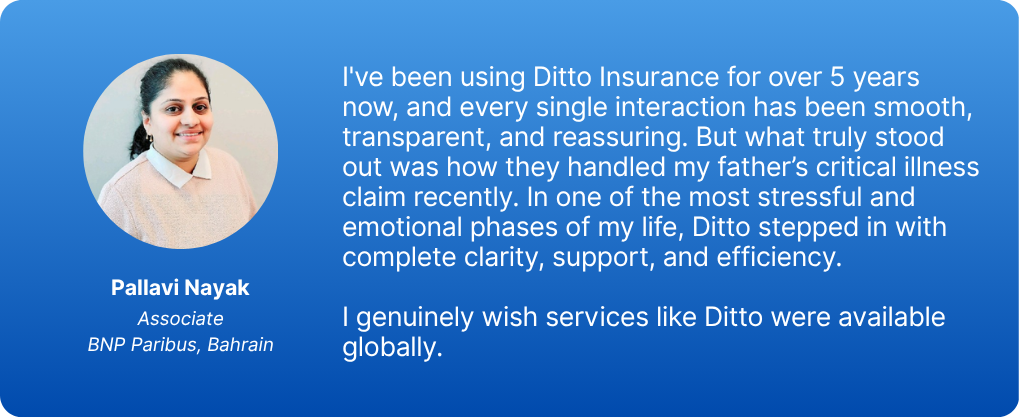
At Ditto, we’ve assisted over 8,00,000 customers with choosing the right insurance policy. Why customers like Pallavi below love us:
- No-Spam & No Salesmen
- Rated 4.9/5 on Google Reviews by 15,000+ happy customers
- Backed by Zerodha
- Dedicated Claim Support Team
- 100% Free Consultation
Confused about the right insurance? Speak to Ditto’s certified advisors for free, unbiased guidance. Book your call or chat on WhatsApp with us now!
Ditto's Take
If we had to pick the features that separate a genuinely good health plan from one that sounds good on paper, it would come down to three things:
- No restriction like room rent caps, co-payment or disease-wise sub-limits
- A strong bonus and restoration benefit
- A cashless network that actually covers the hospitals you use
Tax savings and preventive checkups are useful, but they should not drive your decision.
Remember, if you have employer-provided group insurance, that's not complete protection. Group plans typically cap coverage at ₹2-5 lakh, end when you leave the job, and often don't cover dependents adequately. A personal policy bought while you're young and healthy is cheaper, and the waiting periods finish sooner.
If you're ready to start comparing options, we've put together a detailed breakdown of the best health insurance plans in India, evaluated on the features that actually matter at claim time, not just the premium. It's a good starting point for shortlisting plans worth considering that include the health insurance benefits we discussed in this guide.
Frequently Asked Questions
Last updated on: